A Toronto founder builds a SaaS company from nothing to a $5 million valuation over seven years. She got married five years ago. Now divorce is on the table.
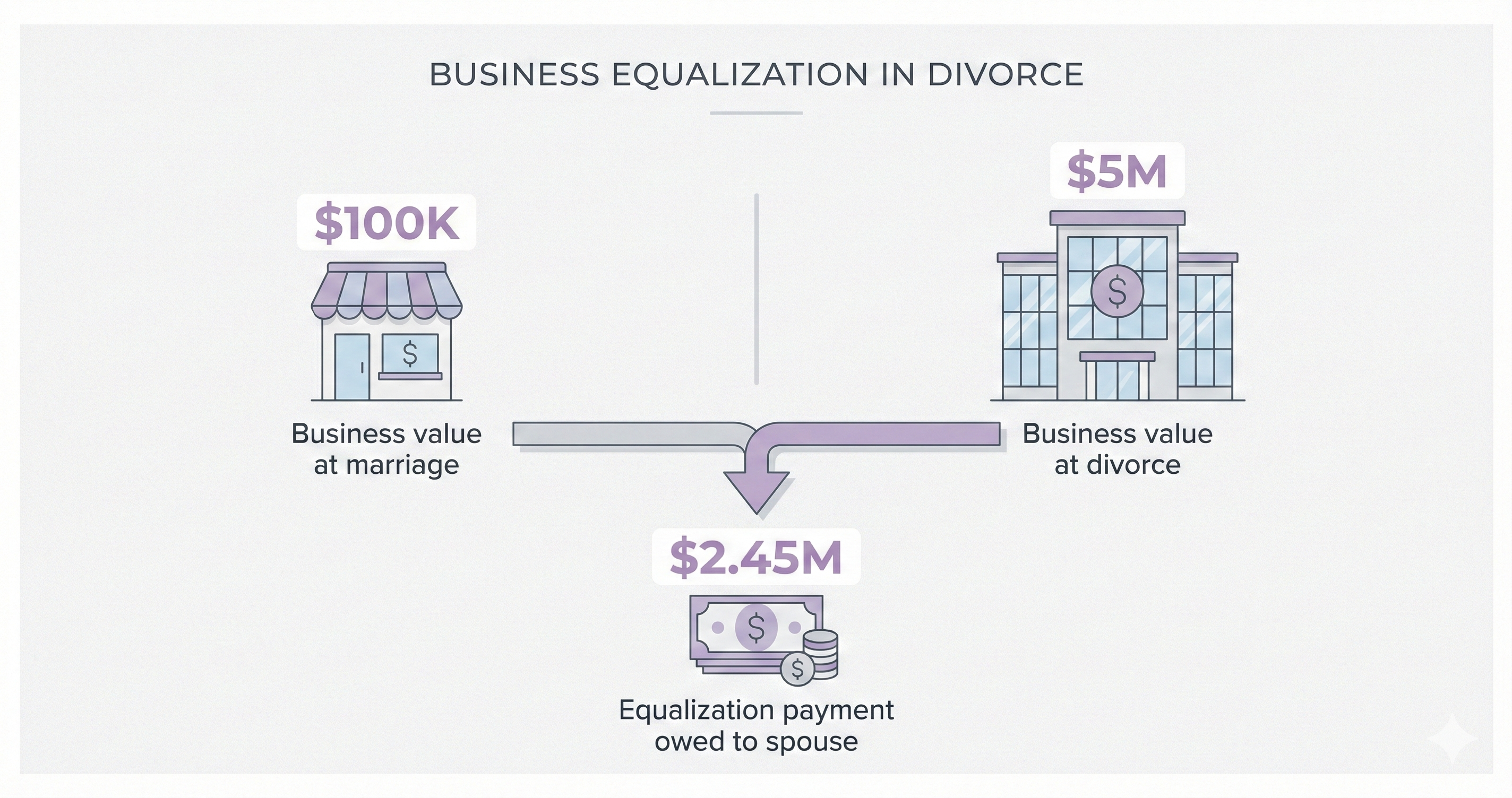
Her spouse never wrote a line of code or sat in a single board meeting. Yet under Ontario law, they could be entitled to half of the company's growth during the marriage. If the business was worth $100k on the wedding day and $5 million now, she might owe an equalization payment of roughly $2.45 million.
Most founders don't have $2.45 million in cash. The wealth is tied up in servers, IP, and future projections. To pay out, she might have to sell the company, take on crushing debt, or give her ex a seat on the cap table.
This is not a rare nightmare. It is the default setting of Canadian family law. But it does not have to be your story.
Why Your Business is Vulnerable in Canada
Many entrepreneurs assume that because they own the shares or registered the business in their name, it is "theirs." Unfortunately, Canadian family law views marriage as an economic partnership. When that partnership ends, the financial gains made during the relationship are split.
The rules vary slightly by province, but the risk to business owners remains high across the board.
Ontario: The Equalization of Net Family Property
In Ontario, the Family Law Act uses a system called equalization. You calculate your net worth on the day you marry and your net worth on the day you separate. The increase in your net worth during the marriage is shared 50/50.
If your business grows from a valuation of $0 to $10 million during your marriage, that $10 million increase is "family property." You owe your spouse half the value of that growth.
British Columbia and Alberta: Excluded Property
BC and Alberta use an "excluded property" model. Generally, assets you bring into the marriage are yours to keep. However, the growth in value of those assets is often shareable.
British Columbia: The value of the business at the start of the relationship is excluded. But the increase in value is family property.
Alberta: Similar to BC, the exemptions usually apply to the starting value, but the appreciation is subject to division.
The Bottom Line: In almost every scenario, if your business becomes successful while you are married, your spouse gets a cut of that success unless you have a contract that says otherwise.
How Different Business Structures Are Affected
The way your business is set up changes how the division happens, but it rarely prevents it.
Sole Proprietorship
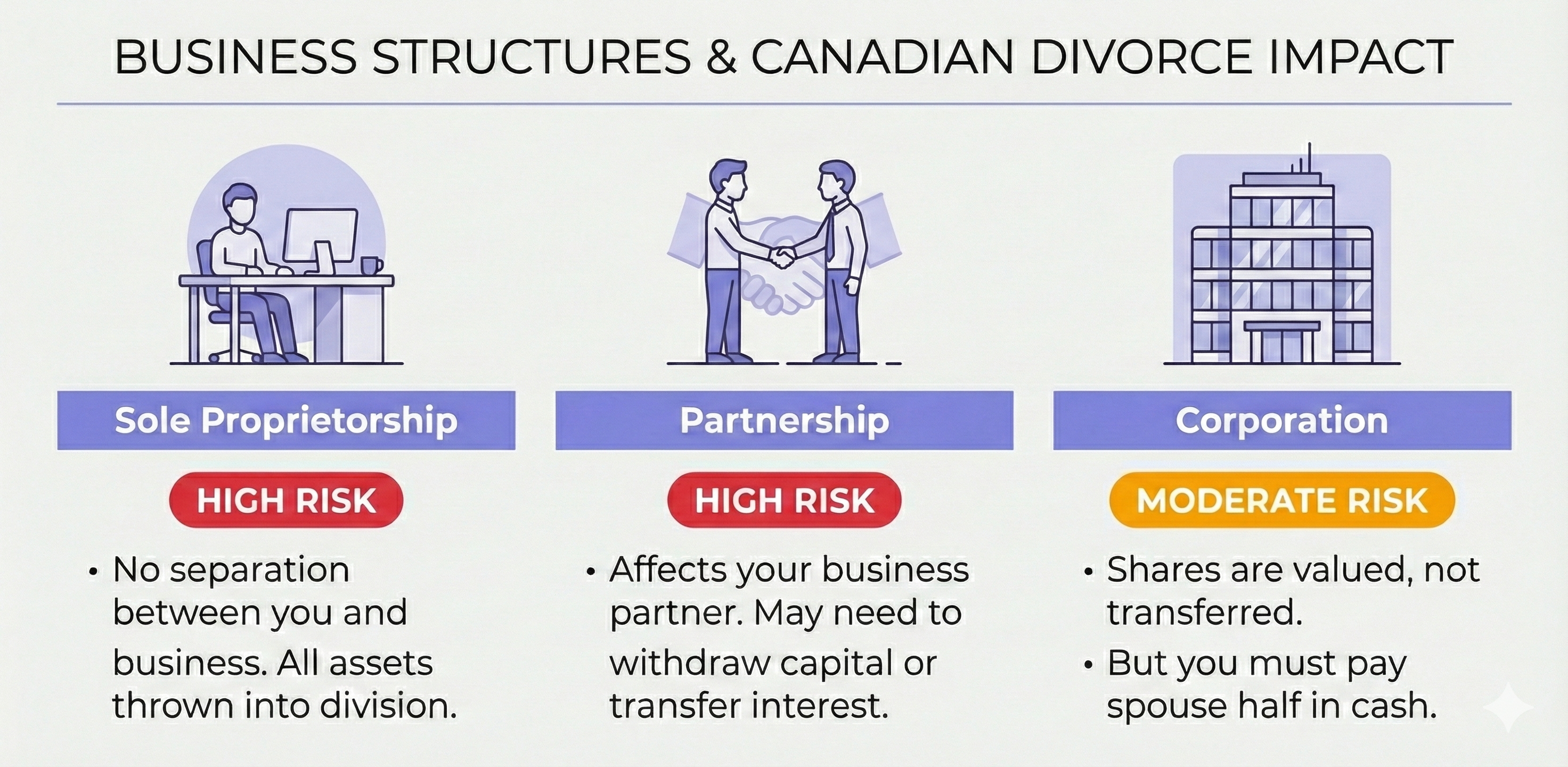
If you are a freelancer or sole prop, there is no legal distinction between you and the business. Your business bank account, your equipment, and your receivables are just personal assets. In a divorce, these are thrown into the pot with your house and car to be divided.
Partnership
If you have a business partner, things get messy. A divorce does not just affect you. It affects them. If you need to withdraw capital to pay out a spouse, you might cripple the business's cash flow. In some cases, a court could technically order the transfer of partnership interest. This forces your business partner to work with your ex.
Corporation
You might own shares in a corporation rather than the assets themselves. While a court rarely orders the transfer of the shares themselves (especially if there are other shareholders), they will value those shares. Then they will order you to pay your spouse half that value in cash.
Note: Many Shareholder Agreements include a clause forcing a shareholder to sell their shares if they get divorced and can't pay the settlement. This is specifically to prevent an ex-spouse from ending up on the cap table.
What a Prenup Can Protect
A prenuptial agreement (technically called a "marriage contract" in Canada) is the only surefire way to opt out of these default laws.
Here is what you can do with a prenup template:
Exclude the Business Entirely: You can state that your business, including all future growth, income, and new entities derived from it, is your separate property.
Protect Future Ventures: Serial entrepreneurs can include clauses that protect not just the current business, but any future businesses started during the marriage.
Protect Against Debt: Startups often come with loans. A prenup can ensure that if the business fails, the business debt remains yours alone. This protects your spouse's personal credit and assets.
What It Can't Do
A prenup cannot decide child custody or child support. But regarding the business? It gives you almost total control to decide who owns what.
The "But They Didn't Help Build It" Misconception
We hear this all the time. "My partner has their own career. They don't work in my business. Why would they get half?"
The law does not care about effort. It cares about value.
In the eyes of the law, your spouse supported the marriage while you built the business. Maybe they paid the mortgage while you took a $0 salary. Maybe they watched the kids while you flew to pitch meetings. That domestic support allowed you to focus on the business. Therefore, they are entitled to a share of the financial outcome.
If you want to change this arrangement, you must put it in writing before you marry.
The Valuation Nightmare
If you do not have a prenup and you get divorced, you have to value your business. This is expensive and contentious.
The "Date of Marriage" Value: To prove how much the business grew, you need to prove what it was worth the day you got married. If you married 10 years ago, digging up old financials to prove a valuation is a nightmare.
Subjective Valuations: Is your consultancy worth 1x revenue? 5x EBITDA? Is the IP worth millions or nothing without you?
Battle of the Experts: You will hire a valuator who says the business is worth less (to pay less). Your spouse will hire a valuator who says it is worth more (to get more). You both pay $15,000+ in fees just to argue about the number.
With a prenup: You can skip the valuation entirely if the asset is excluded. It does not matter what it is worth because it is not being divided.
How to Talk to Your Partner (Without It Getting Awkward)
Bringing up a prenup can feel unromantic. For entrepreneurs, it is practically a business requirement.
1. Blame the Investors (or the Structure) "My business partners and I are setting up a rule that we all need prenups to protect the company. It is standard for the shareholder agreement so that we don't put the company at risk."
2. Frame it as "Business Debt Protection" "This business is risky. If it goes under, I don't want creditors coming after your savings or our house. The prenup protects you from my business risks."
3. Focus on Fairness, Not Greed "I want us to build a life together. But I also have a responsibility to my employees and co-founders to keep the business stable. Let's decide what is fair now, while we love each other, rather than leaving it to a judge later."
Step-by-Step: What to Do Before the Wedding
If you are an entrepreneur getting married in Canada, here is your playbook:
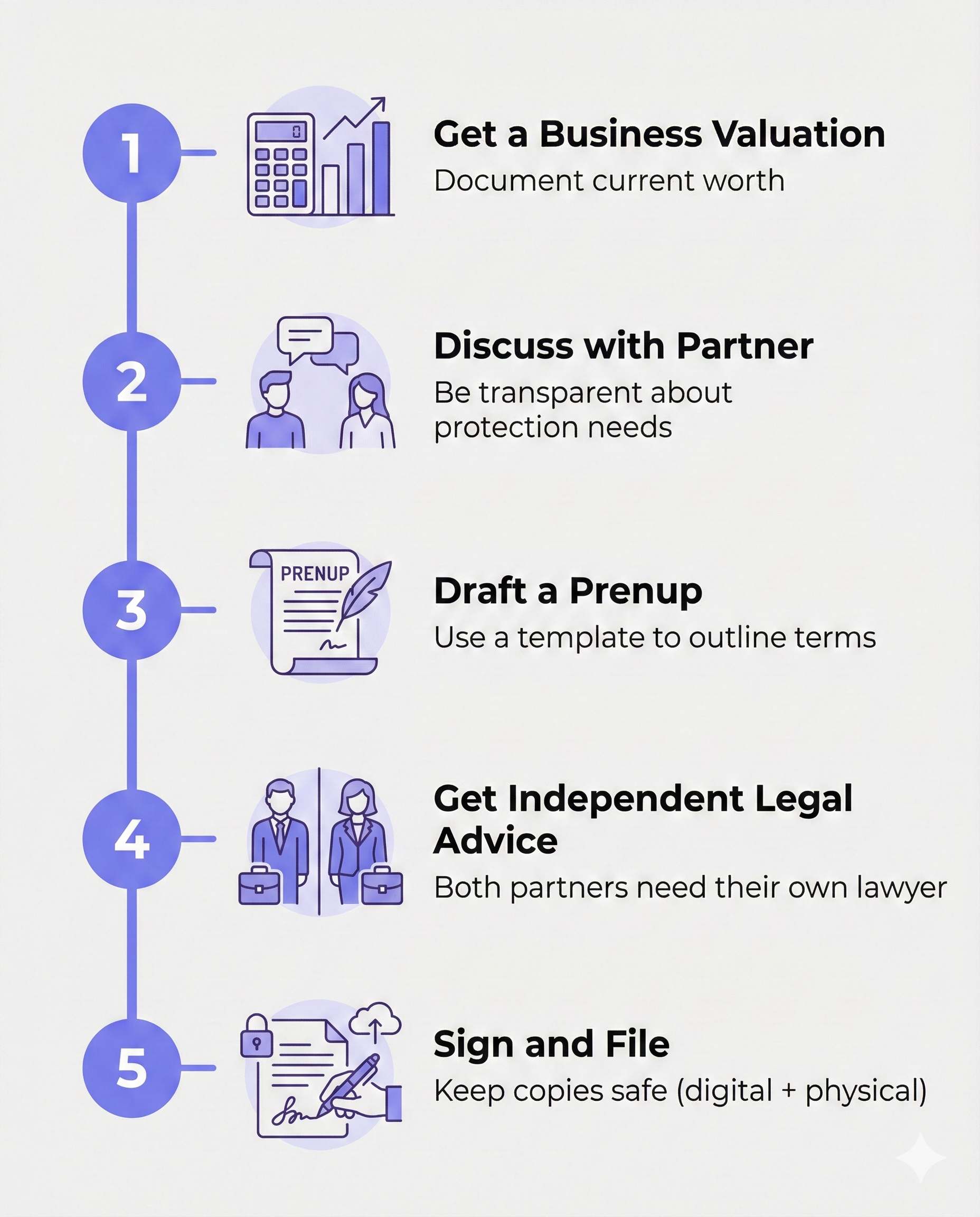
Get a Valuation (Optional but recommended): If you are not doing a prenup, strictly document the value of your business right now. Keep bank statements, tax returns, and a formal valuation report.
Discuss with Your Partner: Be transparent. Explain that the business is a separate entity that needs protection.
Draft a Prenup: You do not need to spend $5,000 on a lawyer just to start drafting. You can use a prenup template to outline your terms, exclude the business, and define how you will handle shared assets like a home.
Get Independent Legal Advice (ILA): This is non-negotiable. For the prenup to be enforceable in Canada, both you and your partner need your own lawyers to review the contract and sign a certificate of independent legal advice.
Sign and File: Keep copies in a safe place (digital and physical).
Frequently Asked Questions
Does a prenup override a Shareholder Agreement? No, they work in parallel. A Shareholder Agreement controls the relationship between you and your business partners. A prenup controls the relationship between you and your spouse. You need both.
What if I start the business after we get married? Without a prenup, a business started during the marriage is almost always considered family property (shared 50/50). You can sign a "postnup" (marriage contract signed after the wedding) to exclude a new business, but your spouse has to agree to sign it.
How much does a prenup cost compared to a divorce? A divorce involving business assets often costs $20,000 to $50,000+ in legal and valuation fees. That is on top of half the value of your company. A prenup template costs a fraction of that. Even with legal review, you are likely looking at $2,000-$3,000 total. It is the cheapest insurance policy you will ever buy.
Can my partner just sign a waiver? Not really. A simple "I promise not to take your business" written on a napkin does not hold up in Canadian court. You need a formal domestic contract with full financial disclosure and independent legal advice.
Does a prenup mean my spouse gets nothing? Absolutely not. Most couples use prenups to protect specific assets (like the business) while agreeing to share everything else (like the matrimonial home, savings, and retirement accounts).
Ready to protect what you've built?
Don't leave your startup's future in the hands of a family law judge. Create your prenup template in minutes and start the conversation with your partner.
Related Reading
- Prenuptial Agreements in Ontario: The Complete 2026 Guide
- Are Prenups Enforceable in Canada?
- How Much Does a Prenup Cost in Canada?
- How to Talk About a Prenup Without Starting a Fight
This article is for informational purposes only and does not constitute legal advice. Prenuply AI Inc. is not a law firm. Family law varies by province and territory. We strongly recommend obtaining independent legal advice (ILA) to ensure your agreement is legally binding and fair.