If you're getting married in Ontario and considering a prenuptial agreement, you're not alone. A recent survey found that 61% of Canadians believe getting a prenup is a good idea, and that number is even higher among younger couples.
But here's what most people don't realize: in Ontario, prenuptial agreements aren't actually called "prenups" in legal terms. They're called marriage contracts, and they're governed by the Family Law Act. This distinction matters because Ontario has specific requirements that differ from other provinces, and from what you might have seen in American movies.
This guide covers everything you need to know about creating a legally enforceable prenuptial agreement in Ontario, including what you can (and can't) include, how much it costs, and how to ensure your agreement will actually hold up if challenged. (This is general information, not legal advice. For advice on your specific situation, consult a qualified Ontario family lawyer.)
What Is a Marriage Contract in Ontario?
Under Section 52 of Ontario's Family Law Act, a marriage contract is a written agreement between two people who are married or intend to marry. It allows couples to set their own rules for how property, debts, and support will be handled if the marriage ends, rather than defaulting to what the law would otherwise require.
The terminology can be confusing:
- Prenuptial agreement (prenup): A marriage contract signed before the wedding
- Postnuptial agreement (postnup): A marriage contract signed after the wedding
- Marriage contract: The legal term in Ontario that covers both
For practical purposes, they're the same document with the same legal effect. The timing of when you sign doesn't change what you can include or how enforceable it is.
Marriage Contract vs. Cohabitation Agreement
If you're living together but not married, you'd use a cohabitation agreement instead. These are governed by Section 53 of the Family Law Act and serve a similar purpose. If you later marry, your cohabitation agreement automatically becomes a marriage contract unless you specify otherwise.
For more on this distinction, see our guide on Prenup vs Cohabitation Agreement in Canada.
Why Ontario Couples Get Prenups
To understand why prenups matter in Ontario, you need to understand how Ontario law treats married couples by default.
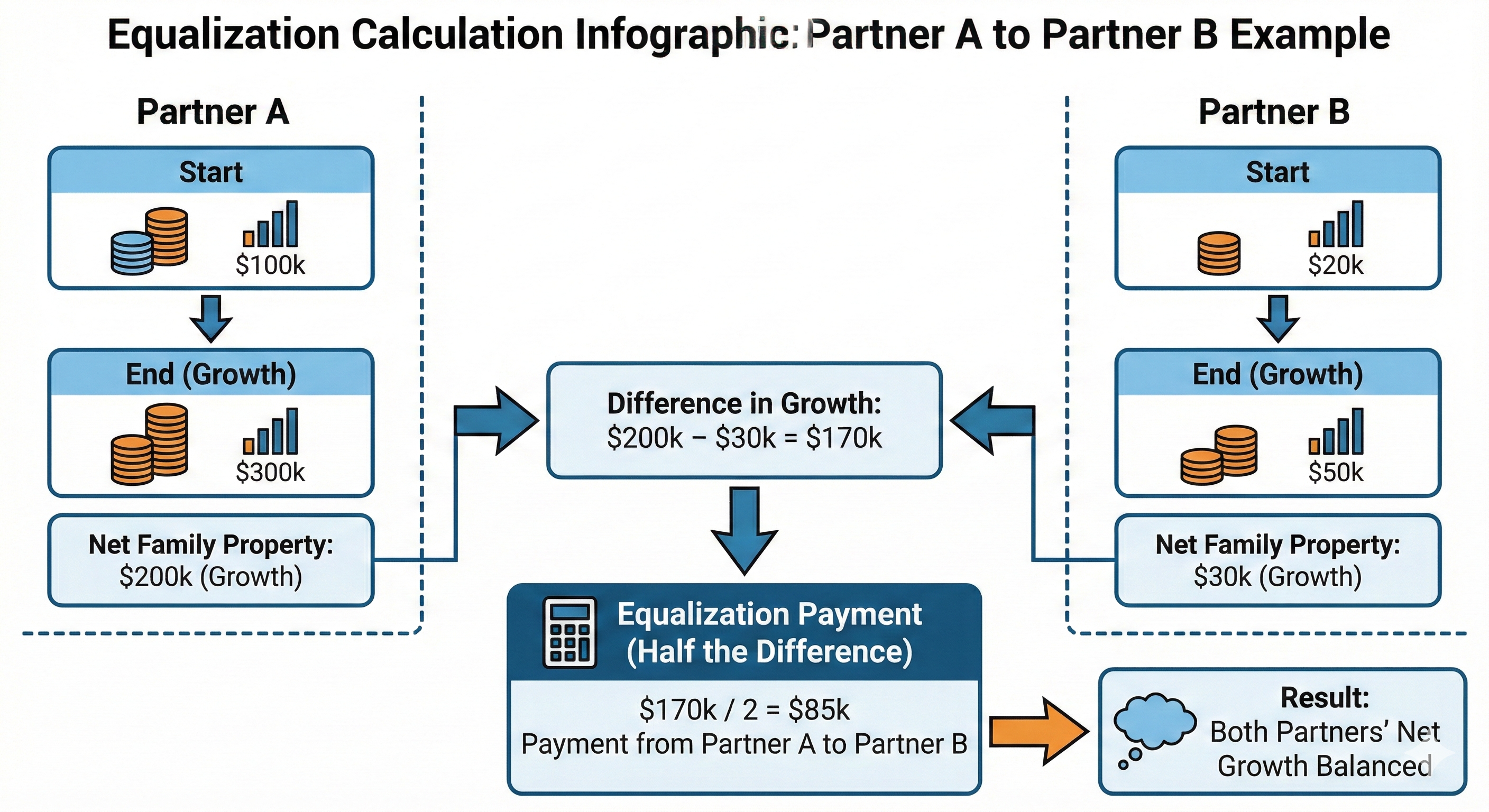
When you marry in Ontario, the law treats your marriage as an economic partnership. If you divorce, you're generally required to equalize the growth in your net worth during the marriage. This is called equalization, and it applies regardless of whose name is on the assets.
Here's a simplified example: You enter the marriage with $100,000 in savings. Your spouse enters with $20,000. During the marriage, your savings grow to $300,000 while your spouse's grow to $50,000. Under equalization, the growth is calculated ($200,000 for you, $30,000 for your spouse), and the difference is split. You'd owe your spouse an equalization payment of $85,000.
A prenup can change this default outcome. Common reasons Ontario couples use prenups include:
Protecting pre-marital assets: Keeping what you brought into the marriage separate from what's divided.
Business ownership: Shielding a business from division, especially if there are other partners or shareholders involved.
Inheritance protection: Ensuring family inheritances stay within your family.
Second marriages: Protecting assets intended for children from a previous relationship.
Debt protection: Clarifying that one spouse's debt remains their own responsibility.
Spousal support clarity: Defining whether support will be paid and under what circumstances.
What You Can Include in an Ontario Prenup
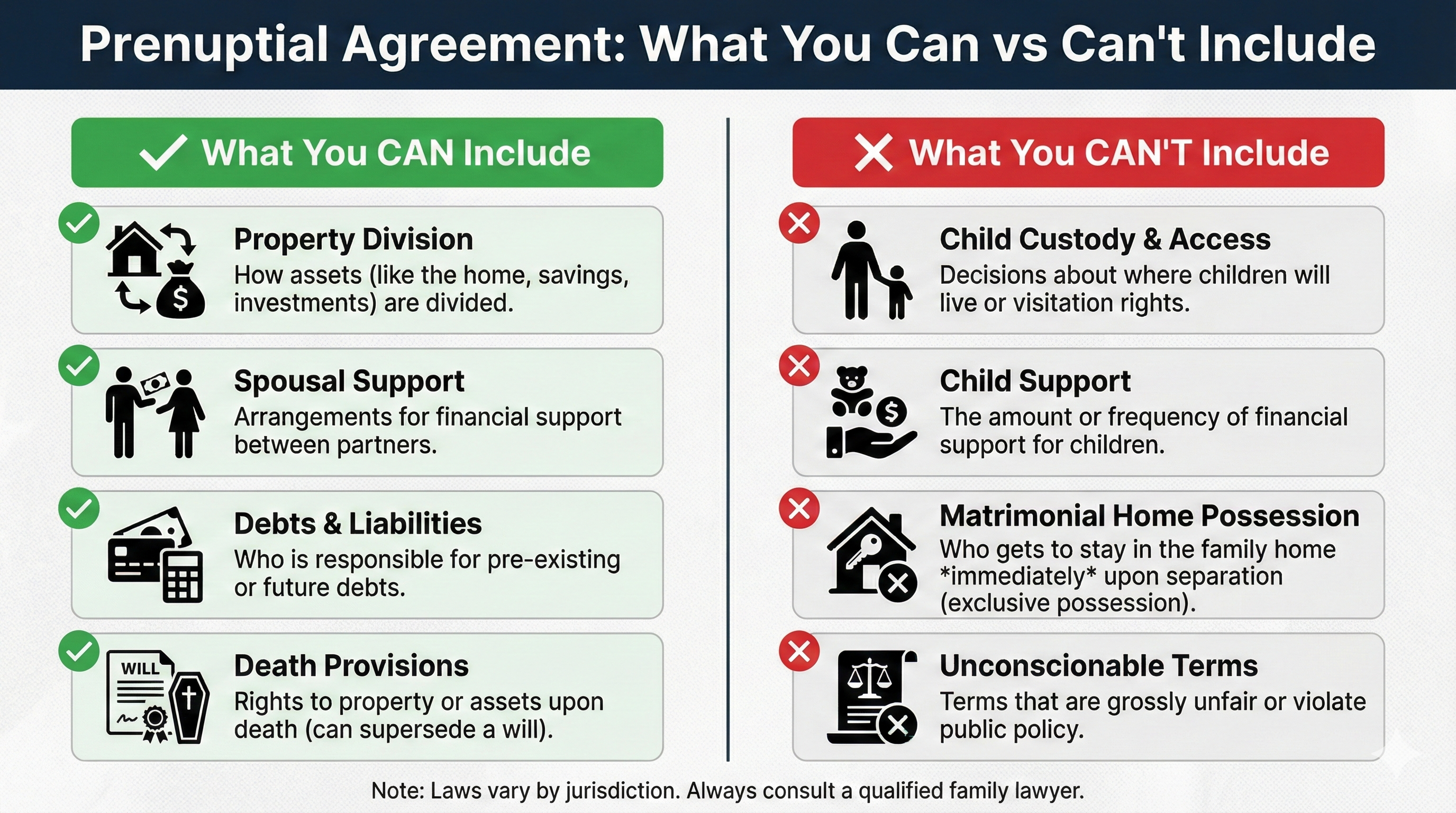
Ontario's Family Law Act gives couples significant flexibility in what they can agree to. A marriage contract can address:
Property Division
You can specify which assets remain separate property and won't be subject to equalization. This includes real estate, investments, retirement accounts (RRSPs, pensions), cryptocurrency, business interests, and valuable collections. You can also agree on how jointly-acquired property will be divided.
Spousal Support
You can include terms about spousal support (alimony), including whether either party will be entitled to it, for how long, and under what conditions. You can even include a full waiver of spousal support, though courts can override this if the waiver would result in unconscionable circumstances at the time of separation.
Debt Allocation
If one spouse is entering the marriage with significant debt (student loans, credit card debt, business debt), the prenup can clarify that this debt remains their sole responsibility. The same applies to debts acquired during the marriage.
Death Provisions
You can include terms about what happens if one spouse dies, including waiving spousal rights to inherit under the Succession Law Reform Act. This is particularly relevant for blended families where you want assets to pass to children from a previous relationship.
Other Matters
The Family Law Act allows you to agree on "any other matter in the settlement of their affairs." This can include things like how household expenses will be shared, management of joint accounts, or financial responsibilities during the marriage.
What You Cannot Include in an Ontario Prenup
Ontario law places clear limits on what a marriage contract can cover:
Child Custody and Access
A prenup cannot predetermine custody arrangements or parenting time. Courts decide these matters based on the best interests of the child at the time of separation, not based on what parents agreed to years earlier. Any clause attempting to restrict custody rights is unenforceable.
Child Support
Similarly, you cannot contract out of child support obligations. Children have an independent right to support from both parents, and this right cannot be waived by the parents.
The Matrimonial Home (With Limitations)
This is where Ontario law gets nuanced. Under Section 52(2) of the Family Law Act, a marriage contract cannot limit a spouse's rights to possession of the matrimonial home under Part II of the Act. This means both spouses have an equal right to live in the home during separation, regardless of whose name is on the title.
However, you can agree on the division of the home's value. You just can't determine who gets to live there.
Unconscionable Terms
Even if you include something that's technically allowed, courts can set aside provisions that are "unconscionable." This is a high bar, but it means agreements that are extremely one-sided or that would leave one spouse destitute may not be enforced.
Requirements for a Valid Ontario Prenup
For a marriage contract to be legally enforceable in Ontario, it must meet specific requirements under Section 55 of the Family Law Act:
1. Written and Signed
The agreement must be in writing and signed by both parties. Verbal agreements are not enforceable, no matter how clear the understanding between partners.
2. Witnessed
Both signatures must be witnessed. The witnesses should be independent adults (not the other spouse).
3. Full Financial Disclosure
Both parties must provide complete and honest disclosure of their assets, debts, income, and financial circumstances. Hiding assets or understating values can be grounds for setting aside the entire agreement.
4. No Duress or Coercion
Both parties must enter the agreement voluntarily. Pressure, threats, or manipulation can invalidate the contract. Timing matters here: presenting an agreement the night before the wedding raises red flags.
5. Capacity to Understand
Both parties must have the mental capacity to understand what they're signing and its implications.
Independent Legal Advice (Strongly Recommended)
While not strictly required by the Family Law Act, independent legal advice (ILA) for each party is strongly recommended and effectively expected by Ontario courts. The absence of ILA is one of the most common reasons courts set aside marriage contracts.
Each spouse should have their own lawyer review the agreement and explain:
- What rights they're giving up
- What the agreement means in practical terms
- Whether the terms are fair and reasonable
A certificate of independent legal advice, signed by each party's lawyer, significantly strengthens the enforceability of the agreement.
For more on what makes a prenup enforceable, see Are Prenups Enforceable in Canada?
How Much Does a Prenup Cost in Ontario?
The cost of a prenuptial agreement in Ontario varies widely based on complexity and approach:
Traditional lawyer-drafted prenup: $2,500 to $10,000+ per couple. Each spouse typically pays for their own lawyer, and costs increase with complexity, negotiation time, and hourly rates ($300-$600/hour is typical for family lawyers in Ontario).
Online prenup services: $500 to $1,500. These provide a template customized to your situation, which you then take to a lawyer for independent legal advice.
DIY templates: Under $100. These are risky because generic templates often miss Ontario-specific requirements or fail to address your actual situation adequately.
The cost calculation should factor in what you're protecting. If you have a business worth $500,000 or expect a significant inheritance, spending $3,000 on a properly drafted agreement is relatively minor insurance.
For a detailed cost breakdown, see How Much Does a Prenup Cost in Canada?
How to Get a Prenup in Ontario: Step by Step
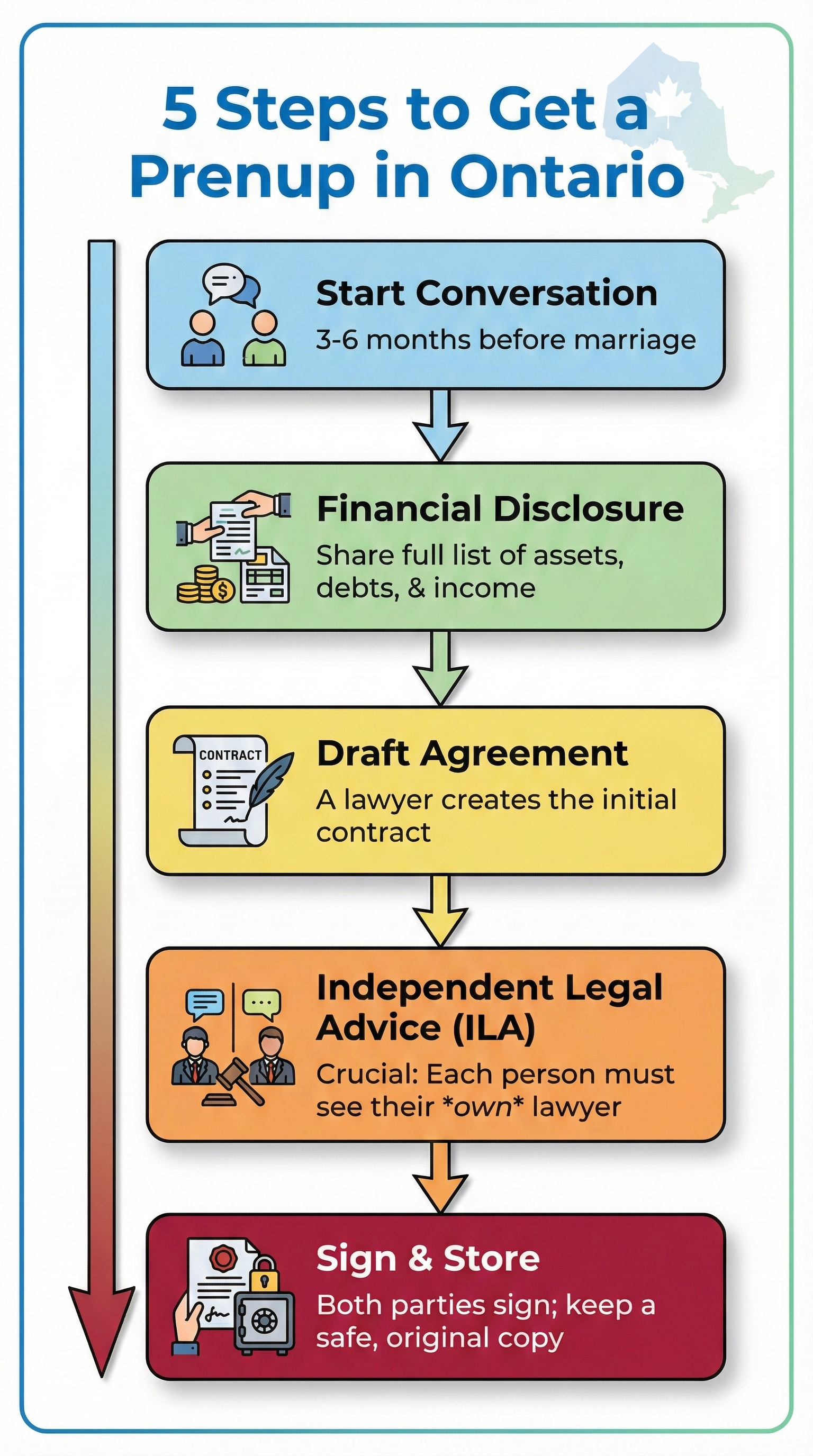
Step 1: Start the Conversation Early
Don't wait until the week before your wedding. Ideally, begin discussing a prenup at least 3-6 months before the wedding date. This gives you time to:
- Have honest conversations about finances and expectations
- Gather financial documentation
- Draft and review the agreement
- Get independent legal advice
- Make revisions if needed
Rushing the process is one of the most common ways prenups get challenged later.
Need help with that conversation? Read How to Talk About a Prenup Without Starting a Fight.
Step 2: Full Financial Disclosure
Both partners should prepare a complete picture of their finances:
- Bank account statements
- Investment account statements
- Property valuations
- Business valuations (if applicable)
- Debt statements
- Income documentation (pay stubs, tax returns)
- Expected inheritances or gifts
Attach this disclosure to the agreement as schedules.
Step 3: Draft the Agreement
You can work with a lawyer from the start, or use an online service to create a first draft that you then review with lawyers. The key is ensuring the agreement:
- Uses proper Ontario legal terminology
- Addresses your specific situation
- Complies with Family Law Act requirements
- Is clear and unambiguous
For guidance on what to look for, see Prenup Template Canada: What to Look For.
Step 4: Independent Legal Advice
Each partner should review the agreement with their own lawyer. This typically involves:
- The lawyer explaining the agreement's terms
- Discussion of what rights are being waived
- Assessment of whether the terms are fair
- Signing a certificate of ILA
Step 5: Sign and Store
Once both parties are satisfied:
- Sign the agreement in the presence of witnesses
- Ensure witnesses sign as well
- Each party keeps an original signed copy
- Store in a safe place (safety deposit box, with your lawyer)
For a complete preparation guide, see The Canadian Prenup Checklist.
Can a Prenup Be Challenged in Ontario?
Yes, and it happens more often than people expect. Common grounds for challenging a marriage contract include:
Lack of financial disclosure: If one spouse hid assets or significantly understated their value, the other spouse can argue they didn't know what they were agreeing to.
No independent legal advice: While not technically required, the absence of ILA makes it much easier to argue the agreement wasn't understood or was unfair.
Duress or coercion: Evidence that one spouse pressured the other into signing, especially close to the wedding date.
Unconscionability: If circumstances have changed dramatically and enforcing the agreement would be unconscionable (for example, a spousal support waiver that would leave one spouse destitute after a 20-year marriage where they sacrificed their career).
Technical defects: Missing signatures, witnesses, or failure to meet formal requirements.
To protect your agreement from challenge:
- Allow plenty of time before the wedding
- Ensure complete financial disclosure
- Both parties get independent legal advice
- Keep the terms reasonable and fair
- Document everything
Prenup vs. No Prenup: What Happens Without One?
If you divorce in Ontario without a prenup, the Family Law Act's default rules apply:
Property division: Net family property is calculated and equalized. The spouse with more growth pays the other spouse half the difference.
The matrimonial home: Regardless of who owned it before marriage or whose name is on the title, both spouses have equal rights to possession and equal shares in its value.
Spousal support: Determined based on factors like length of marriage, roles during marriage, income disparity, and ability to become self-sufficient.
Debts: Generally, each spouse is responsible for debts in their own name, but joint debts are shared.
For many couples, these default rules work fine. But if you have significant pre-marital assets, own a business, expect an inheritance, or are entering a second marriage, the defaults may not align with your intentions.
Special Considerations for Ontario Prenups
Business Owners
If you own a business, a prenup is particularly important. Without one, the growth in your business's value during marriage could be subject to equalization. This can force a sale, bring an unwanted party into ownership discussions, or create cash flow problems if you need to pay a large equalization payment.
Your prenup should clearly exclude the business from equalization and specify how it will be valued if needed.
Real Estate Investors
Investment properties are treated differently than the matrimonial home. You can exclude them from equalization in a prenup, but the matrimonial home has special protections that limit what you can contract around.
Expected Inheritances
Under Ontario law, inheritances are already excluded from equalization, but only if kept separate from family assets. If you mix inherited funds with joint accounts or use them for family purposes, they may lose their protected status. A prenup can provide additional clarity and protection.
Second Marriages and Blended Families
Prenups are especially common in second marriages where one or both spouses have children from previous relationships. The agreement can ensure assets pass to intended beneficiaries rather than being diluted through equalization.
Frequently Asked Questions
Is a prenup legally binding in Ontario? Yes, if it meets the requirements of the Family Law Act: written, signed, witnessed, with full financial disclosure and no duress. Independent legal advice significantly strengthens enforceability.
Can I write my own prenup in Ontario? Technically yes, but it's risky. DIY agreements often fail to meet legal requirements or address Ontario-specific issues properly. At minimum, both parties should have a lawyer review any agreement before signing.
How long before the wedding should I get a prenup? Ideally 3-6 months. This allows time for disclosure, drafting, review, negotiation, and independent legal advice without the pressure of an imminent wedding.
Can a prenup be changed after marriage? Yes. Spouses can amend or revoke a marriage contract at any time by creating a new written agreement that both parties sign.
Does a prenup expire? No, a properly executed marriage contract remains in effect until the marriage ends or the parties agree to revoke it.
What if my spouse won't sign a prenup? You cannot force someone to sign. If a prenup is important to you, this is a conversation to have early in your relationship. Some couples find that discussing a prenup actually strengthens their relationship by forcing honest conversations about money and expectations.
For more common questions, see Is Wanting a Prenup a Red Flag?
Next Steps
A prenuptial agreement isn't about planning for divorce. It's about having honest conversations about finances and making informed decisions together. For many Ontario couples, it provides peace of mind and prevents potential conflicts down the road.
If you're considering a prenup, start by:
- Having an open conversation with your partner about your financial situations and goals
- Gathering your financial documents
- Understanding what you want the agreement to accomplish
- Getting proper legal guidance to ensure your agreement will be enforceable
Ready to create your prenup? Create your prenup template in minutes and get a lawyer-friendly draft customized for Ontario law.
Related Reading
- Are Prenups Enforceable in Canada?
- Prenup vs Cohabitation Agreement in Canada
- The Canadian Prenup Checklist
- How Much Does a Prenup Cost in Canada?
- Prenup Laws by Province
This article is for informational purposes only and does not constitute legal advice. Prenuply AI Inc. is not a law firm. For advice specific to your situation, consult with a qualified Ontario family lawyer.