If you expect to receive an inheritance, or you already have one, it is normal to want to keep that asset in your family. The tricky part is that inheritances do not always stay “separate” automatically once you move in together, get married, or start using inherited funds for shared goals.
A protect inheritance prenuptial agreement Canada strategy is really about planning: setting clear expectations, documenting what is meant to stay excluded, and putting guardrails in place so an inheritance is less likely to become a flashpoint later.
This guide explains how prenuptial agreements (and cohabitation agreements) can help protect inherited assets in Canada, what clauses matter most, and what you should do in real life (not just on paper) to keep inheritances traceable and respected.

What “protect inheritance” means in a Canadian prenup (and why it matters)
In Canada, family property rules can treat assets differently depending on:
- Your province
- Whether you are married or common-law
- How the inheritance is handled during the relationship
- Whether the inherited asset becomes a shared asset (for example, used to buy a family home)
A protect inheritance prenuptial agreement Canada approach typically aims to:
- Confirm that inheritances received by either spouse remain excluded from property sharing or equalization (as permitted in the province).
- Clarify what happens to growth, income, and reinvestments from inherited assets.
- Create rules about commingling (mixing inherited assets with joint assets).
- Prevent accidental conversion of inheritance into family property, especially through the matrimonial home / family residence.
If you are earlier in the process, it can help to start with What is a Prenuptial Agreement in Canada? A Complete Guide and then come back to the inheritance-specific provisions.
How inheritances are treated in Canada (high-level overview)
Inheritance treatment is not identical across Canada. Even within a province, details can depend on the exact facts.
Married vs common-law: why the difference matters
- Married couples: Most provinces have a property division regime for married spouses (for example, equalization in Ontario). Contracts can often modify or opt out of parts of that regime if done properly.
- Common-law couples: Property division rules often differ. In many places, common-law partners keep property in their own name, but disputes can arise through claims like unjust enrichment or constructive trust. A cohabitation agreement can still be very valuable.
If you are not sure which agreement you need, see Prenup vs Cohabitation Agreement in Canada: Which One Do You Need, and When?.
Inheritances can be “separate”, until they are not
Even where inheritances are generally treated as excluded or separate, problems usually arise when:
- The inheritance is deposited into a joint account and mixed with employment income.
- Inherited money is used as a down payment on a shared home.
- Inherited money funds renovations on the family residence.
- The asset is retitled into joint names.
- Records are not kept, so it becomes hard to trace what came from inheritance.
A prenup can set expectations, but the way you handle the asset during the marriage is often what decides whether it stays protected.
What a prenup can and cannot do for inheritance protection in Canada
A prenup (often called a marriage contract in Ontario) can be a strong tool, but it is not magic.
What a prenup can do
Depending on province and proper drafting, a prenup can:
- State that inheritances are excluded from property division or equalization
- Address whether income and growth on inherited assets are excluded
- Set rules for commingling and define what counts as commingled
- Create a process for documentation and tracing
- Set out treatment of gifts from family, family loans, and early inheritances
- Clarify outcomes if inherited funds are used for joint purposes
What a prenup typically cannot do
In Canada, a prenup generally cannot:
- Override child support obligations
- Guarantee that a court will enforce every term if the agreement is unfairly negotiated or disclosure is missing
- Fix bad facts later, for example, if you intentionally put inherited assets into joint names and then argue they were “never meant to be shared”
For enforceability pitfalls to avoid, read Are Prenups Enforceable in Canada? What Makes a Prenup Invalid (and How to Avoid Costly Mistakes).
The inheritance protection clauses that matter most
If your goal is protect inheritance prenuptial agreement Canada, these are the provisions to discuss with your lawyer.
1) Clear definition of “inheritance” (and related family transfers)
A strong agreement defines:
- Inheritance (cash, investments, property, private company shares, collectibles)
- Gifts from family during the relationship (not just on death)
- Inter vivos transfers (assets transferred before death)
- Family loans (and whether they are true debts or disguised gifts)
Why it matters: ambiguity is a common reason couples fight later. Clarity now reduces risk.
2) Exclusion of inherited assets from sharing or equalization
This clause is the backbone: it states that inheritances received by either spouse remain that spouse’s property and are excluded from the division calculation, to the extent permitted under local law.
You can also specify treatment of:
- Inherited assets owned before marriage
- Inheritances received during marriage
- Inheritances received after separation (still relevant to document)
3) Growth, reinvestment, and “income on inheritance”
This is where many agreements fall short.
Questions to decide:
- If an inherited investment account grows, is the growth excluded?
- If inherited assets produce dividends or rent, is that income excluded or shared?
- If inherited money is used to buy a new asset, is the replacement property excluded?
Practical approach many couples choose:
- Exclude the inheritance and its traceable proceeds
- Decide whether income is separate or shared, depending on how you budget as a couple
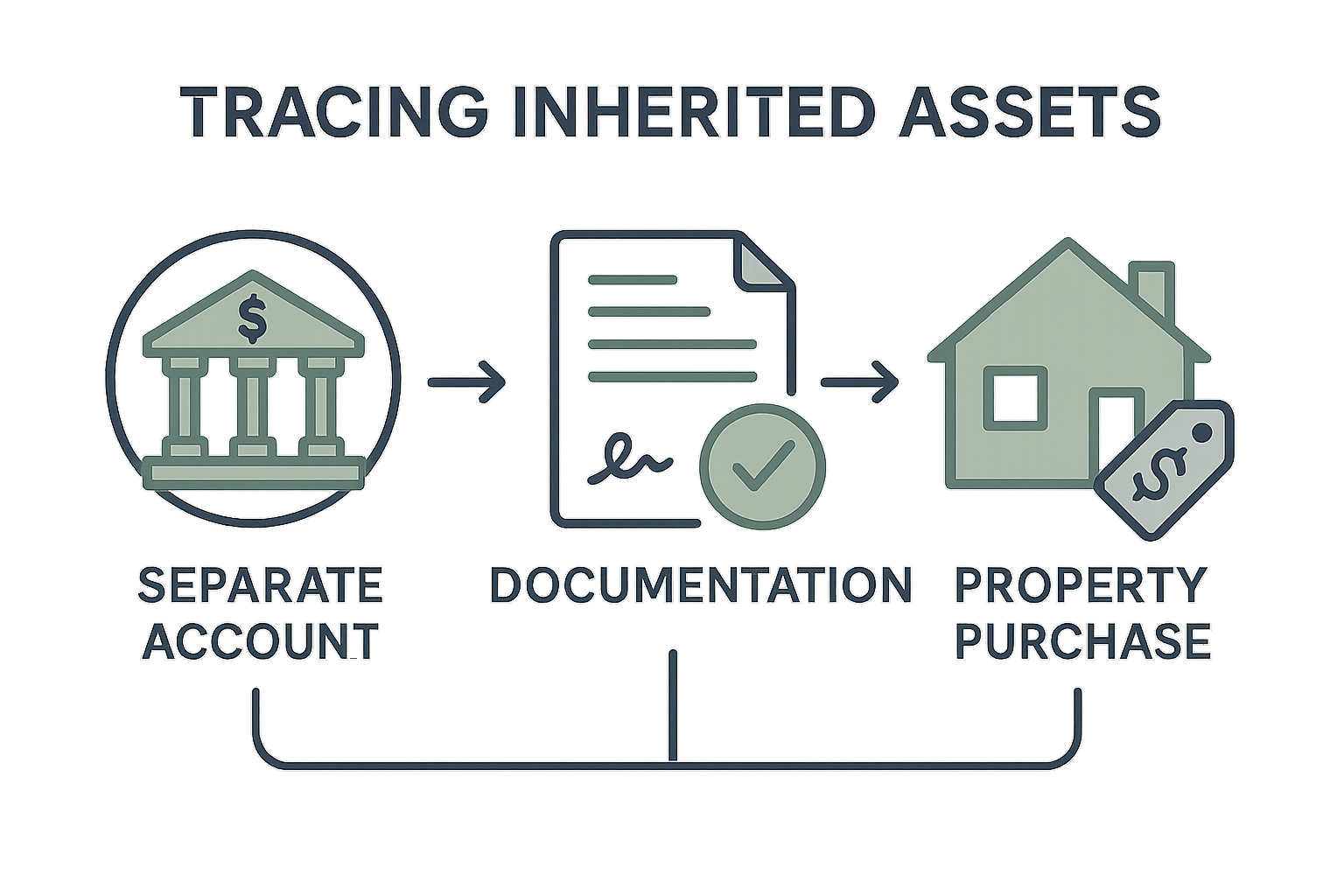
4) Tracing and record-keeping requirements (the “paper trail” clause)
Courts and negotiations often come down to proof. Your prenup can require:
- Inheritance to be kept in a separate account in the recipient’s name
- Annual or periodic statements to be retained
- A requirement to document transfers into other assets (for example, “inheritance funds used for a down payment must be evidenced by bank records and closing documents”)
This does not have to be controlling. Think of it as an agreed habit: keep the receipts.
5) Anti-commingling rules (and what happens if commingling occurs)
Common commingling events include:
- Depositing inherited cash into a joint chequing account
- Using inherited funds to pay down a joint mortgage
- Funding joint renovations
Your agreement can set a rule such as:
- If commingling happens, the spouses agree the recipient spouse will be entitled to a reimbursement (if traceable), or
- Commingled amounts are deemed shared (simple, but less protective)
Couples often prefer a middle ground: preserve protection if the funds are traceable, but avoid constant micromanagement.
6) Matrimonial home / family residence protections (critical in Ontario)
Many inheritance plans fall apart when inherited funds touch the family home.
If you are in Ontario, the matrimonial home has special treatment under the Family Law Act. Even assets that are otherwise excluded can lose protection once tied to the matrimonial home. This is a common area where couples need province-specific advice.
Related reading: Ontario Prenup and the Matrimonial Home: Can You Protect a House Bought Before Marriage? and Prenuptial Agreements in Ontario: The Complete 2026 Guide.
7) Treatment of inheritances used for family goals (down payments, renovations, debt repayment)
Many people want to protect inheritance while still using it to build a life together.
A prenup can specify options like:
- Loan approach: inherited funds advanced to the relationship are treated as a repayable loan (with or without interest)
- Reimbursement approach: if inherited funds are used for a joint asset, the recipient spouse gets first repayment on sale or separation
- Percentage approach: the recipient spouse gets a defined percentage of equity corresponding to the inherited contribution
This is often more realistic than a strict “never touch it” rule.
8) Family business interests and inherited shares
Inheritances are not always cash. Many inherit shares in a family corporation, partnership interests, or a future interest in a trust.
Your agreement can address:
- Confirmation that inherited shares and any future issuances remain excluded
- Valuation methods and timing if a buyout is needed
- Confidentiality and limits on disclosure of sensitive business information
If this overlaps with business ownership, see Prenups for Entrepreneurs: How to Protect Your Business From Divorce in Canada.
9) Trusts and expected inheritances (what you can, and cannot, pre-plan)
You cannot contract around an inheritance you do not actually have yet in a way that binds third parties (like a parent’s estate plan). But you can still plan for likely scenarios by:
- Stating that any future inheritance received by either spouse will be treated as excluded property
- Addressing how distributions from a family trust will be treated (for example, distributions kept separate, and whether income is shared)
If a significant inheritance is expected, it can be worth coordinating with the family’s estate planning lawyer as well.
Practical steps to preserve inheritance outside the prenup (what actually works)
Even the best agreement can be undermined by messy finances. These steps help keep inherited assets protected and traceable.
Keep inherited funds separate by default
- Use an account in the inheriting spouse’s name
- Avoid routine transfers into joint accounts
- Keep investment accounts separate unless you have a clear tracing plan
Document the source of funds
Keep:
- A copy of the will or estate distribution statement (if available)
- Bank records showing receipt of funds
- Investment statements and transaction history
- Closing documents if inheritance was used to buy property
Be cautious using inherited money for the home you live in
This is where protection often disappears. If you want to use inherited funds for a down payment or renovation:
- Talk to a family lawyer first
- Decide whether you want a loan, reimbursement, or percentage approach
- Put the plan in writing in the agreement
Update the agreement when life changes
Consider a review if you:
- Receive a large inheritance
- Buy or sell a home
- Have children
- Start receiving trust distributions
- Move provinces
Province-specific notes: Ontario, BC, Alberta, Quebec
Inheritance and family property rules are provincial. If you want to protect inheritance effectively, you need advice in the province where you live (or where you will separate, if that ever happens).
For a broad overview, see Prenup Laws by Province: Ontario, BC, Alberta & Quebec Guide.
Ontario: watch the matrimonial home issue closely
Ontario’s Family Law Act has special rules for the matrimonial home that can override what people assume about “excluded property.” A carefully drafted marriage contract plus careful handling of funds is especially important when inheritance is used for a home.
British Columbia: excluded property and tracing are central
BC family law includes the concept of excluded property and often focuses on tracing and treatment of increases in value. The details matter, especially around growth and the use of excluded property for family purposes.
See Prenuptial Agreements in BC: The Complete 2026 Guide.
Alberta: contract clarity and fairness still matter
Alberta allows partners to contract about property and support, but enforceability can depend on factors like disclosure, voluntariness, and whether the arrangement is significantly unfair given the circumstances.
Quebec: different system, different defaults
Quebec’s civil law system is distinct. The default family patrimony and matrimonial regime rules can affect what is shareable. If you are in Quebec, get Quebec-specific legal advice before assuming a “standard Canadian prenup” approach will work.
How to bring up inheritance and prenups without conflict
Inheritance can feel personal. It often comes tied to family history, grief, expectations, and pressure from parents.
What tends to work:
- Lead with values: “I want us to be clear and fair, and to reduce uncertainty.”
- Be transparent: explain what you expect to inherit and what you do not know yet.
- Avoid framing it as distrust: position it as family wealth planning and clarity.
- Invite collaboration: ask what would make your partner feel protected too.
For a step-by-step conversation framework, read How to Talk About a Prenup Without Starting a Fight.
Step-by-step checklist: how to protect inheritance with a prenuptial agreement in Canada
Use this as a planning roadmap before you meet your lawyer.
- List inherited or expected inherited assets
- Cash, investments, property, shares, trusts, collectibles
- Decide how you want to use the inheritance
- Keep separate, partially shared, or used for a major purchase
- Choose a protection method for shared uses
- Loan, reimbursement, or percentage equity
- Gather documentation
- Statements, receipts, legal documents, property records
- Discuss province-specific risks
- Especially the family residence rules
- Draft the agreement and build in tracing rules
- Get Independent Legal Advice (ILA) for both partners
- Sign properly and store the agreement safely
You can also use The Canadian Prenup Checklist: Timeline, Documents, and Questions to Ask to plan your timing and paperwork.
Common mistakes that can accidentally put inheritance at risk
These are the patterns that most often lead to disputes:
- No full financial disclosure at signing
- Signing too close to the wedding, creating pressure arguments
- Putting inherited funds into a joint account without tracking
- Using inherited money for the family residence without a written plan
- Not addressing growth and income from inherited assets
- Not getting Independent Legal Advice (ILA)
If you are using a template, be cautious and make sure it is designed for Canadian provincial differences. See Prenup Template Canada: What to Look For (and What to Avoid) Before You Download Anything.
FAQ: Protect inheritance prenuptial agreement Canada
Can a prenup fully protect an inheritance in Canada?
A prenup can significantly improve the odds that an inheritance is treated the way you intend, but it cannot guarantee an outcome. Protection depends on provincial law, proper drafting, full disclosure, fairness, and whether the inheritance remains traceable and not converted into a shared asset.
Does inheritance become marital property if I deposit it into a joint account?
It can. Mixing inherited money with joint funds can make it difficult to trace and may be treated as shared depending on the province and facts. If you want inheritance to stay separate, keeping it in a separate account with clear records is often the simplest approach.
What if I use inherited money for a down payment on our home?
This is one of the highest-risk situations for inheritance protection. In some provinces, the family residence has special rules. A prenup can address reimbursement or loan treatment, but you should get province-specific legal advice before using inherited funds for a home purchase.
Do we both need Independent Legal Advice (ILA) for inheritance clauses?
Yes, Independent Legal Advice (ILA) for each partner is one of the most important steps for enforceability in Canada. ILA helps show that both partners understood the agreement and entered it voluntarily with proper disclosure.
What if I have not received the inheritance yet?
You can include provisions stating that future inheritances received by either spouse are intended to remain excluded and separate. However, you cannot control third-party estate planning decisions through your prenup. If a major inheritance is expected, consider coordinating with an estate planning lawyer too.
Next step: create a clear starting draft, then review it with lawyers
If protecting family wealth is a priority, a written agreement can reduce uncertainty and prevent misunderstandings later.
The best time to do it is usually when things are calm and collaborative, well before the wedding.
Prenuply helps Canadian couples generate a customized prenuptial agreement template based on their situation, including inheritance-related questions and options. You can start your draft here: /signup.
Legal disclaimer
This article provides general information about how to protect inheritance with a prenuptial agreement in Canada. It is not legal advice. Prenuply AI Inc. is not a law firm and does not provide legal services. For advice about your specific situation, consult a qualified family lawyer in your province. Independent Legal Advice (ILA) is essential for enforceable prenups in Canada.