
If you are searching for an online prenup in Canada, you are probably not trying to avoid being careful. You are trying to avoid paying a lawyer to spend hours collecting basic facts, rewriting obvious clauses, and turning a practical decision into a month-long project before you even know what you want.
That instinct is reasonable. A prenup starts with information: who you are, where you live, what each partner owns, what each partner owes, what you want to keep separate, and what you want to handle together. An online tool can help organize all of that into a clearer first draft.
But there is a line you should not blur. An online prenup tool can help you prepare. It cannot be your lawyer, it cannot give independent legal advice, and it cannot promise that a court will enforce your agreement years later.
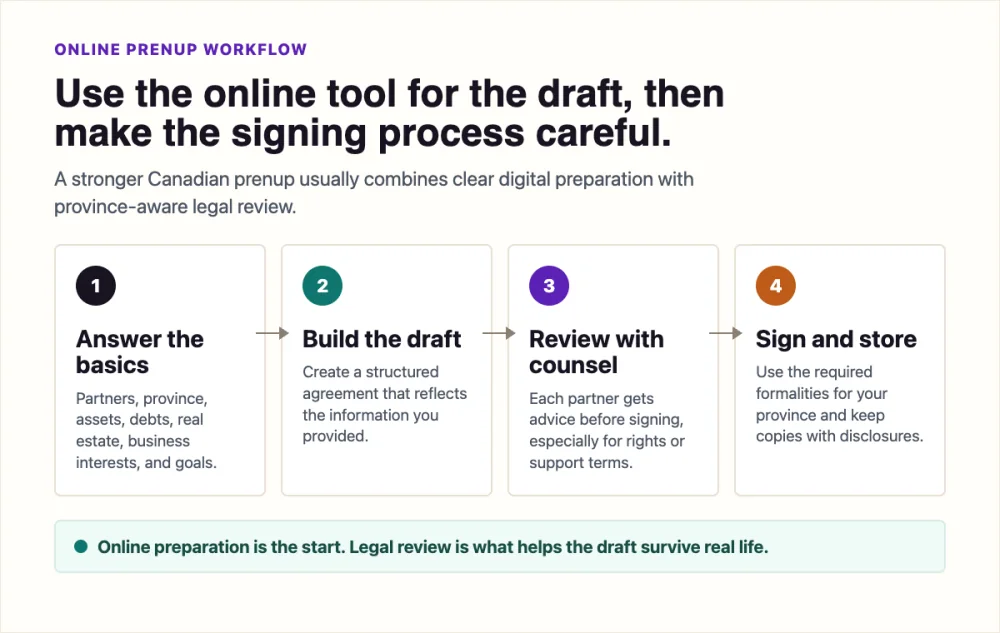
The sweet spot for many Canadian couples is simple: use an online prenup platform to create a structured, province-aware draft, then have each partner review it with independent legal counsel before signing.
Quick answer: can you get a prenup online in Canada?
Yes, you can start a prenup online in Canada. In many cases, an online platform can help you create a useful draft of a marriage contract or prenuptial agreement.
The part to be careful about is signing and relying on it.
A stronger Canadian prenup usually needs:
- A written agreement
- Clear identification of both partners
- Proper signatures and witnessing, where required
- Full financial disclosure
- Terms that are not wildly unfair or impossible to understand
- Enough time before the wedding to avoid pressure
- Independent legal advice for each partner, especially where significant rights are being changed
- Province-specific handling, because family law is not identical across Canada
In Ontario, for example, the Family Law Act deals with marriage contracts and says domestic contracts must be in writing, signed by the parties, and witnessed. It also gives courts reasons to set aside a domestic contract, including lack of financial disclosure or a failure to understand the nature or consequences of the agreement.
That does not mean every word must begin inside a lawyer's office. It means the final agreement should be handled with care.
What an online prenup tool can do well
A good online prenup tool is not just a blank form. The value is in the questions it asks and the structure it gives you.
For Canadian couples, an online prenup platform can help with four very practical things.
1. It gets the conversation out of your heads
Most couples do not struggle because they lack opinions. They struggle because the conversation is vague.
One partner says, "I just want to protect the house I bought before we met." The other hears, "You are planning for divorce." Someone mentions inheritance, business shares, student debt, family help with a down payment, or a future maternity leave, and suddenly the conversation feels larger than expected.
An online process turns that fog into prompts:
- What assets did each partner own before marriage?
- Does either partner own a business?
- Is anyone expecting an inheritance or family gift?
- Will either partner bring significant debt into the marriage?
- Is there real estate, including a home bought before marriage?
- Do you want to address spousal support?
- Which province's law is relevant to your relationship?
Those questions do not replace legal advice. They make the legal review more productive.
2. It creates a draft you can actually discuss
A blank page is hard. A draft is easier.
When you and your partner can read a proposed agreement, you can react to specific terms instead of arguing about a concept. You can spot what feels fair, what feels too harsh, and what needs a lawyer's explanation.
This is where online preparation can save time. Instead of paying a lawyer to collect every basic detail from scratch, you arrive with a draft, a financial outline, and a better sense of your priorities.
3. It keeps province differences in view
Canada does not have one single prenup law. Provinces use different terminology and have different rules around property, family homes, financial disclosure, signing formalities, and spousal support.
For example:
- Ontario commonly uses the term marriage contract.
- British Columbia deals with agreements about property and debt under its Family Law Act.
- Alberta has specific rules around family property agreements and formal acknowledgements under the Family Property Act.
- Quebec is different from the common-law provinces. Marriage contracts are signed before a notary. The Directeur de l'état civil explains that a marriage contract is a legal act signed before a notary.
If you want a deeper province comparison, read our guide to prenup laws by province in Canada.
4. It helps you avoid generic template problems
A downloaded template can be tempting, especially if it is free. The problem is that many templates are too generic, too American, or too thin for the facts that actually matter.
A Canadian online prenup draft should handle details like:
- Province of residence
- Pre-marital property
- Real estate and the family home
- Business interests
- Inheritance and gifts
- Debt allocation
- Spousal support preferences
- Financial disclosure schedules
- Signing and review steps
We covered this in more detail in our guide to prenup templates in Canada. The short version: a template is only useful if it fits the relationship in front of it.
What an online prenup tool cannot do
This is the part worth being blunt about.
An online prenup platform should not pretend to be a law firm. Prenuply is a technology company, not a legal services provider. It helps you create a draft based on your answers. It does not give legal advice, represent either partner, or decide what is fair for your specific legal situation.
Here is what still needs human judgment.
It cannot give independent legal advice
Independent legal advice, often called ILA, means each partner has a chance to speak with their own lawyer about the agreement before signing.
That matters because a prenup can affect valuable rights. A lawyer can explain what the agreement changes, what each partner may be giving up, whether the disclosure is enough, and whether a clause creates risk.
Independent legal advice is also useful evidence if the agreement is later challenged. It helps show that each partner had a real opportunity to understand the agreement before signing.
It cannot fix missing financial disclosure
A prenup is only as strong as the information behind it.
If one partner hides assets, leaves out major debts, gives vague values, or rushes disclosure, the agreement may be vulnerable later. Courts tend to care a lot about whether both partners understood the financial picture before signing.
Useful disclosure often includes:
- Bank and investment accounts
- Real estate values and mortgages
- Business ownership interests
- Debts and guarantees
- Pensions and retirement accounts
- Expected inheritances or family gifts, where relevant
- Supporting documents or schedules attached to the agreement
If financial disclosure is the part you are most worried about, start with our Canadian prenup checklist.
It cannot guarantee enforceability
No one can honestly guarantee that a prenup will be enforceable forever. The question is whether the agreement was prepared, reviewed, and signed in a way that makes it more likely to stand up.
Common risk factors include:
- Signing too close to the wedding
- One partner feeling pressured
- Incomplete or misleading disclosure
- No independent legal advice
- Terms one partner did not understand
- Clauses that try to control things the law will not allow
- A result that becomes seriously unfair in the circumstances
For a fuller explanation, read Are Prenups Enforceable in Canada?.
Do you need a lawyer for a prenup in Canada?
For most couples, the practical answer is yes: you should each speak with a lawyer before signing.
That does not necessarily mean the lawyer has to draft the first version from a blank page. There is a difference between using a lawyer wisely and using a lawyer for every administrative step.
A common path looks like this:
- Use an online prenup platform to create a draft.
- Gather financial disclosure documents.
- Talk through the draft with your partner.
- Each partner hires separate counsel for review.
- Revise the agreement if needed.
- Sign with enough time, proper witnesses, and the formalities required in your province.
That process is often more efficient than beginning with a vague lawyer meeting where neither partner has organized their goals.

Online prenup vs template vs lawyer-drafted prenup
There is no single best option for every couple. The right path depends on complexity, budget, timeline, and risk tolerance.
| Option | Best for | Main advantage | Main risk |
|---|---|---|---|
| Free template | Very simple early planning | Fast and cheap | May be generic, outdated, or not province-specific |
| Online prenup platform | Couples who want a structured first draft | Better questions, cleaner draft, easier lawyer review | Still needs legal review before signing |
| Lawyer-drafted prenup | Complex assets, high conflict, unusual terms | Direct legal drafting and advice | Higher cost and slower start |
| Online draft plus lawyer review | Many modern Canadian couples | Balances cost, structure, and legal caution | Requires follow-through with independent counsel |
This is why the phrase "prenup without a lawyer" can be misleading. You may not need a lawyer to collect every answer or produce the first draft, but you should not skip legal review if you plan to rely on the agreement.
If cost is the reason you are exploring online options, our breakdown of prenup costs in Canada compares lawyer-drafted agreements, online platforms, and independent legal advice.
What should an online Canadian prenup include?
A good online prenup draft should not feel like a fill-in-the-blank form from another country. It should be built around Canadian family law concepts and the couple's actual facts.
At a minimum, expect sections covering:
- The parties and planned marriage
- Province or governing law considerations
- Financial disclosure
- Property owned before marriage
- Treatment of future property
- Treatment of the family home, where legally appropriate
- Business interests
- Inheritances and gifts
- Debts and liabilities
- Spousal support, if addressed
- Tax-aware language, without pretending to give tax advice
- Dispute resolution
- Independent legal advice and signing acknowledgements
- Schedules listing each partner's assets and debts
The exact wording matters, but so does the factual record around the agreement. A neat document with weak disclosure is not a strong document.
Province notes for online prenups in Canada
The article you are reading is national, but your agreement should not ignore provincial law.
Ontario
Ontario marriage contracts can deal with rights and obligations during marriage, on separation, on annulment or dissolution of marriage, or on death. They commonly address property and support obligations.
Ontario domestic contracts must be in writing, signed, and witnessed. Ontario law also allows a court to set aside a domestic contract in certain situations, including failure to disclose significant assets, debts, or liabilities, or failure to understand the nature or consequences of the contract.
If you live in Ontario, read our Ontario prenup guide, especially if one partner owns a home before marriage.
British Columbia
In British Columbia, spouses can make written agreements about division of property and debt. The BC Family Law Act also sets out when agreements may be set aside, including issues around disclosure, vulnerability, lack of understanding, and significant unfairness.
If you are in BC, read our BC prenup guide.
Alberta
Alberta couples should be especially careful about formal requirements and independent advice. The Family Property Act contains rules for agreements between spouses or adult interdependent partners, and Alberta agreements may involve acknowledgement requirements that should be handled with legal help.
In plain English: do not treat an Alberta prenup like a quick signature page.
Quebec
Quebec is its own category. A Quebec marriage contract is not just an online document to print and sign at home. It is a notarial act.
If you are in Quebec, use online preparation as a planning tool only, then work with a Quebec notary for the marriage contract itself.
How to make an online prenup stronger before lawyer review
If you want the online process to lead to a better final agreement, do a few things before you send the draft to counsel.
Start earlier than feels necessary
Do not wait until invitations are mailed, flights are booked, and everyone is emotionally locked into the wedding weekend.
A prenup conversation is easier when there is room to think. Signing under time pressure can also create enforceability risk.
A practical timeline is:
- Start the conversation at least three to six months before the wedding if you can.
- Complete the first draft and disclosure before lawyer review.
- Leave time for questions, revisions, and separate legal appointments.
- Avoid signing in the final days before the wedding unless your lawyer says the timeline is appropriate.
Be specific about assets and debts
Do not write "investment account" if you can identify the institution, account type, approximate value, and owner. Do not write "business" if you can describe the corporation, shares, loans, and approximate value.
Specificity helps your lawyer. It also makes the agreement easier to understand later.
Talk about fairness, not just protection
A prenup that feels one-sided is harder to discuss and may be riskier. Think about both partners' realities.
For example:
- If one partner owns a home, how will mortgage payments during marriage be handled?
- If one partner pauses work for children, how does that affect support discussions?
- If family money helps buy property, is it a gift, loan, or excluded contribution?
- If a business grows during the marriage, what happens to the increase in value?
A strong prenup is not just a wall around one person's assets. It is a clear agreement about how the couple wants to handle money.
Keep a paper trail
Save the draft versions, disclosure schedules, financial statements, lawyer-review notes, and signed copies. If someone questions the agreement later, the surrounding records may matter.
Where Prenuply fits
Prenuply is built for the part of the process that many couples want to make simpler: creating a clear, Canadian, province-specific first draft.
You answer plain-language questions about your relationship, assets, debts, province, and goals. Prenuply generates a personalized prenuptial agreement template that you can review with your partner and take to independent legal counsel.
It is not a replacement for a lawyer. It is a better starting point for the lawyer conversation.
If you are ready to organize your information and create a draft, you can start your Canadian prenup online.
FAQ about online prenups in Canada
Is an online prenup legal in Canada?
An online draft can be part of a legal prenup process, but the draft alone is not the whole story. The final agreement still needs to meet the requirements of the relevant province, including signing formalities, disclosure, fairness, and legal review considerations.
Can I write my own prenup in Canada?
You can prepare your own draft, but relying on a self-written prenup without legal advice is risky. Most couples are better served by creating an organized first draft and then having each partner get independent legal advice before signing.
Can both partners use the same lawyer?
For independent legal advice, no. Each partner should have their own lawyer. One lawyer cannot independently advise both sides about what each person may be giving up.
How long does an online prenup take?
The online drafting part can be fast. The full process takes longer because you still need disclosure, partner discussion, lawyer review, revisions, and signing. A sensible timeline is usually measured in weeks, not minutes.
Is Prenuply a law firm?
No. Prenuply AI Inc. is a technology company, not a law firm. Prenuply helps users create customized prenup templates for lawyer review. It does not provide legal advice or legal services.
Bottom line
An online prenup in Canada can be a smart first step if you treat it as preparation, not a shortcut around legal care.
Use the online tool to organize your facts, create a clear draft, and make the conversation less intimidating. Then protect both partners by getting independent legal advice, completing full disclosure, and signing properly for your province.
That combination is practical, affordable, and much closer to how real couples actually want to work.
This article provides general information about online prenups in Canada. It is not legal advice. Prenuply AI Inc. is not a law firm and does not provide legal services. For advice about your specific situation, consult a qualified family lawyer or, in Quebec, a notary.