If you're getting married in BC and thinking about a prenup, you need to understand one thing first: BC's property division rules are different from other provinces, and they apply to common-law couples too.
Live together for two years in a "marriage-like relationship" and you already have property rights under the Family Law Act. Get married without a prenup, and the default rules kick in automatically. Those defaults might work for you. Or they might not. Either way, you should know what you're signing up for.
This guide breaks down how prenups work in BC, what the law requires, and how to create an agreement that will actually hold up. (This is general information, not legal advice. For advice on your specific situation, consult a qualified BC family lawyer.)
What BC Calls a Prenup
The Family Law Act (in force since March 2013) doesn't use the word "prenup." It just talks about written agreements between spouses about property division.
You'll hear these called marriage agreements, cohabitation agreements, domestic contracts, or prenuptial agreements. They all do the same thing: let you opt out of BC's default property rules and create your own arrangement.
How Property Division Works Without a Prenup
BC divides property into two categories: family property and excluded property.
Family property is everything you or your spouse own at the date of separation. The family home, investments, bank accounts, RRSPs, pensions, vehicles, business interests. It gets split 50/50 by default, regardless of whose name is on the title.
Excluded property stays with the original owner. This includes:
- Property you owned before the relationship started
- Gifts and inheritances received during the relationship (if intended for one spouse only)
- Personal injury settlements and insurance proceeds
- Property you bought with excluded property (if you can trace it)
So far, so good. But here's where people get tripped up.
The Growth Problem
The original value of excluded property stays yours. But any increase in value during the relationship becomes family property.
Say you own a condo worth $400,000 when you move in together. Ten years later, it's worth $700,000 when you separate. You keep the original $400,000. But the $300,000 growth? That's family property. Your spouse gets half: $150,000.
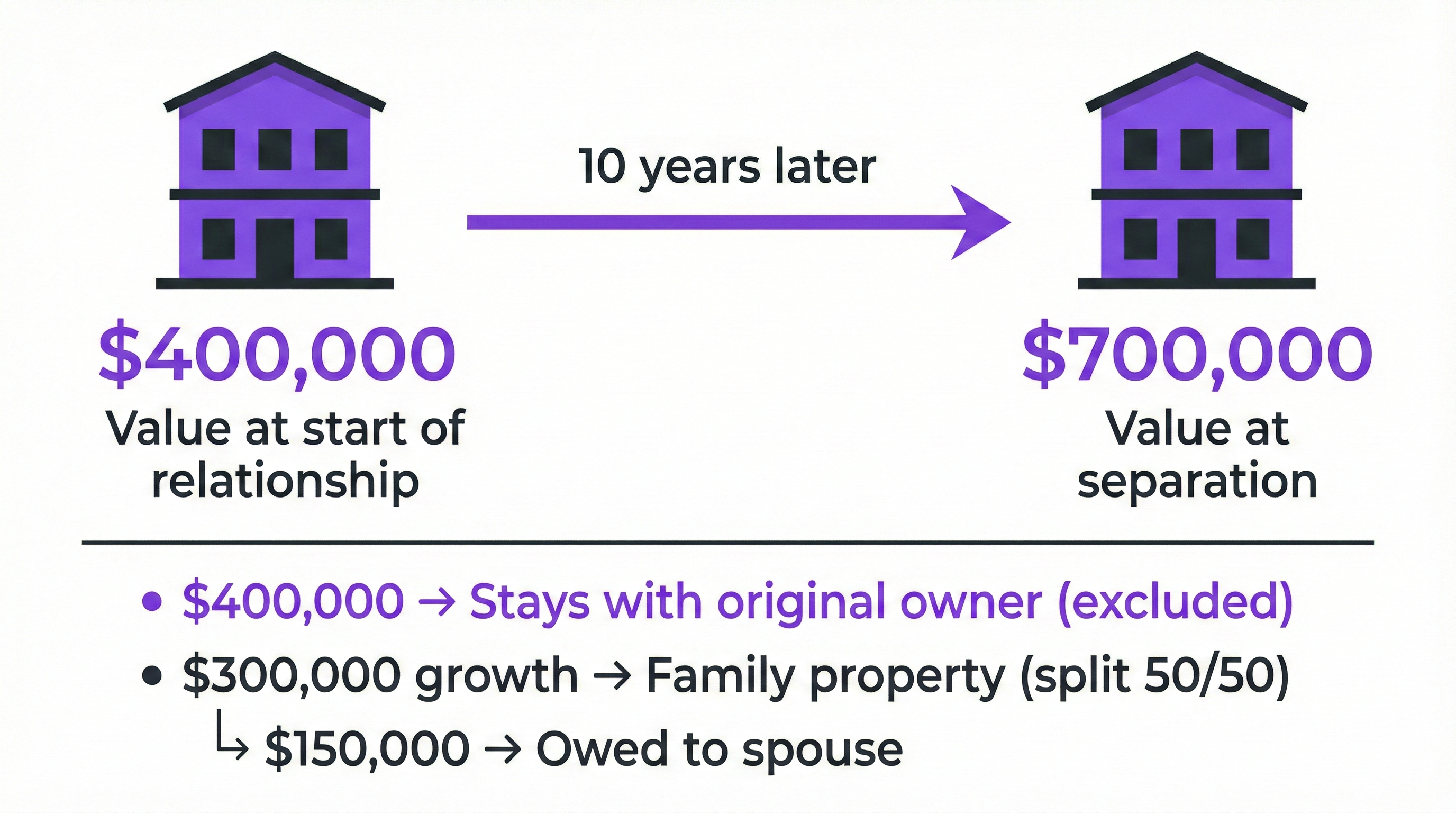
This applies to everything. Real estate, investments, retirement accounts, businesses. A prenup can change how this growth gets handled.
Common-Law Couples Have the Same Rights
BC treats common-law and married couples identically for property division. Two years of living together in a marriage-like relationship, and you're "spouses" under the Family Law Act.
No wedding required. No prenup means the default rules apply. This is different from Ontario's approach, where common-law couples don't have automatic property rights.
What You Can Put in a BC Prenup
Section 92 of the Family Law Act gives couples broad freedom. Your prenup can:
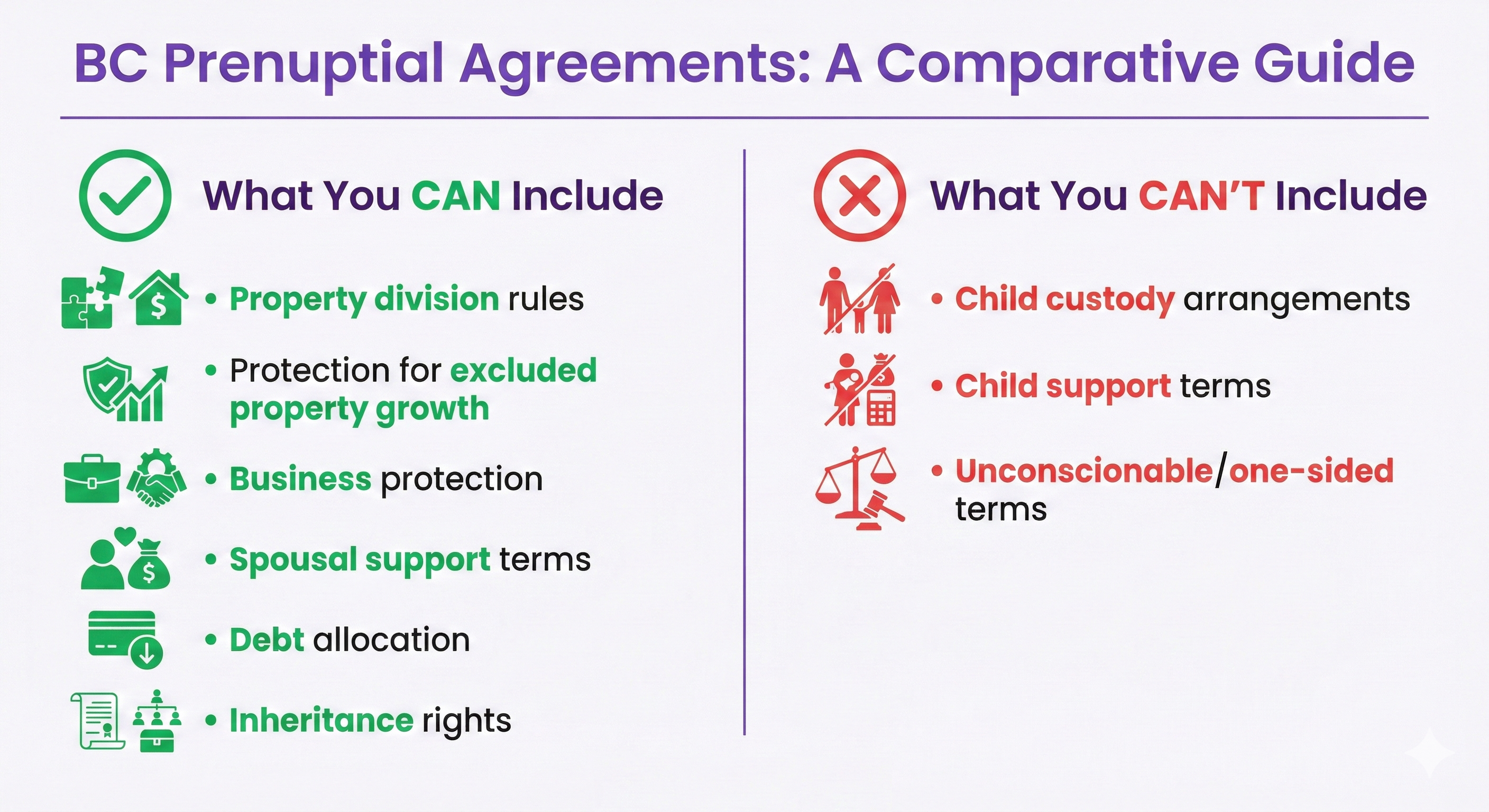
Change property division rules. Agree to split things unequally, or agree that certain property won't be divided at all.
Protect growth on excluded property. Keep the increase in value on your pre-relationship assets instead of sharing it.
Clarify what's excluded. The law already excludes certain property, but a prenup makes boundaries explicit. Important for businesses, investment portfolios, expected inheritances.
Address spousal support. Include terms about whether support gets paid, how much, and for how long. Courts can still review these terms if they'd cause significant unfairness.
Allocate debt. Clarify that pre-relationship debt stays with whoever brought it in.
Plan for death. Waive certain inheritance rights. Relevant for blended families.
What You Can't Put in a BC Prenup
Child custody and parenting time. Section 44 of the Family Law Act says parenting agreements only bind if made after separation (or in anticipation of it). Courts decide custody based on the child's best interests at the time, not what parents agreed to years earlier.
Child support. Same deal. Section 148 says child support agreements only bind after separation. Kids have an independent right to support that parents can't contract away in advance.
Unconscionable terms. Agreements that would leave one spouse destitute while the other keeps everything won't be enforced.
What Makes a BC Prenup Enforceable
Section 93 of the Family Law Act sets the requirements:
Written and signed. Verbal agreements don't count.
Witnessed. Each signature needs a witness. Same person can witness both, though different witnesses are better.
Full financial disclosure. Both parties must disclose all assets, debts, and income. Hide something significant and the whole agreement can be thrown out.
No duress or coercion. Both parties must sign voluntarily. Present an agreement the night before the wedding and you're asking for trouble.
Both parties understood it. If one spouse didn't grasp what they were signing, enforceability weakens.
Independent legal advice. Not technically required, but practically essential. An agreement where both parties had their own lawyer is far harder to challenge. Most BC family lawyers won't finalize a prenup without both parties having ILA.
How Courts Set Aside Prenups in BC
Section 93 creates a two-part test.
Part 1: Was the process fair? The court looks at what happened when the agreement was signed. Did one spouse hide assets? Take advantage of the other's vulnerability? Did both parties understand the terms? If the process was flawed, the agreement can be set aside.
Part 2: Is the outcome significantly unfair? Even if the process was fine, the court can set aside an agreement that's become "significantly unfair" over time. They consider how long it's been, whether the parties intended to create certainty, and how much they relied on the agreement.
"Significantly unfair" is a high bar. BC courts have said it requires something "unjust or unreasonable" or "compelling and meaningful." The law favors upholding agreements that were fairly made.
Protecting Your Agreement
To minimize challenge risk:
- Start months before the wedding, not days
- Document all assets and debts thoroughly
- Both parties get their own lawyer
- Keep terms reasonable (extremely one-sided agreements invite challenge)
- Keep records of the negotiation process
- Consider updating if circumstances change significantly
What a Prenup Costs in BC
Full lawyer-drafted: $2,000 to $5,000+ for the couple. Each spouse needs their own lawyer for independent legal advice, which can double the total. Complex situations (businesses, trusts, significant assets) cost more.
Online services: $400 to $1,500. You get a customized template based on a questionnaire, then take it to lawyers for ILA.
ILA review only: $1,500 to $2,500 per person if you bring a pre-drafted agreement for a lawyer to review.
If you have $500,000 in pre-relationship assets or a business that could be divided, $3,000-5,000 for a solid agreement is reasonable insurance. For more on costs across Canada, see our guide to prenup costs.
How to Get a Prenup in BC
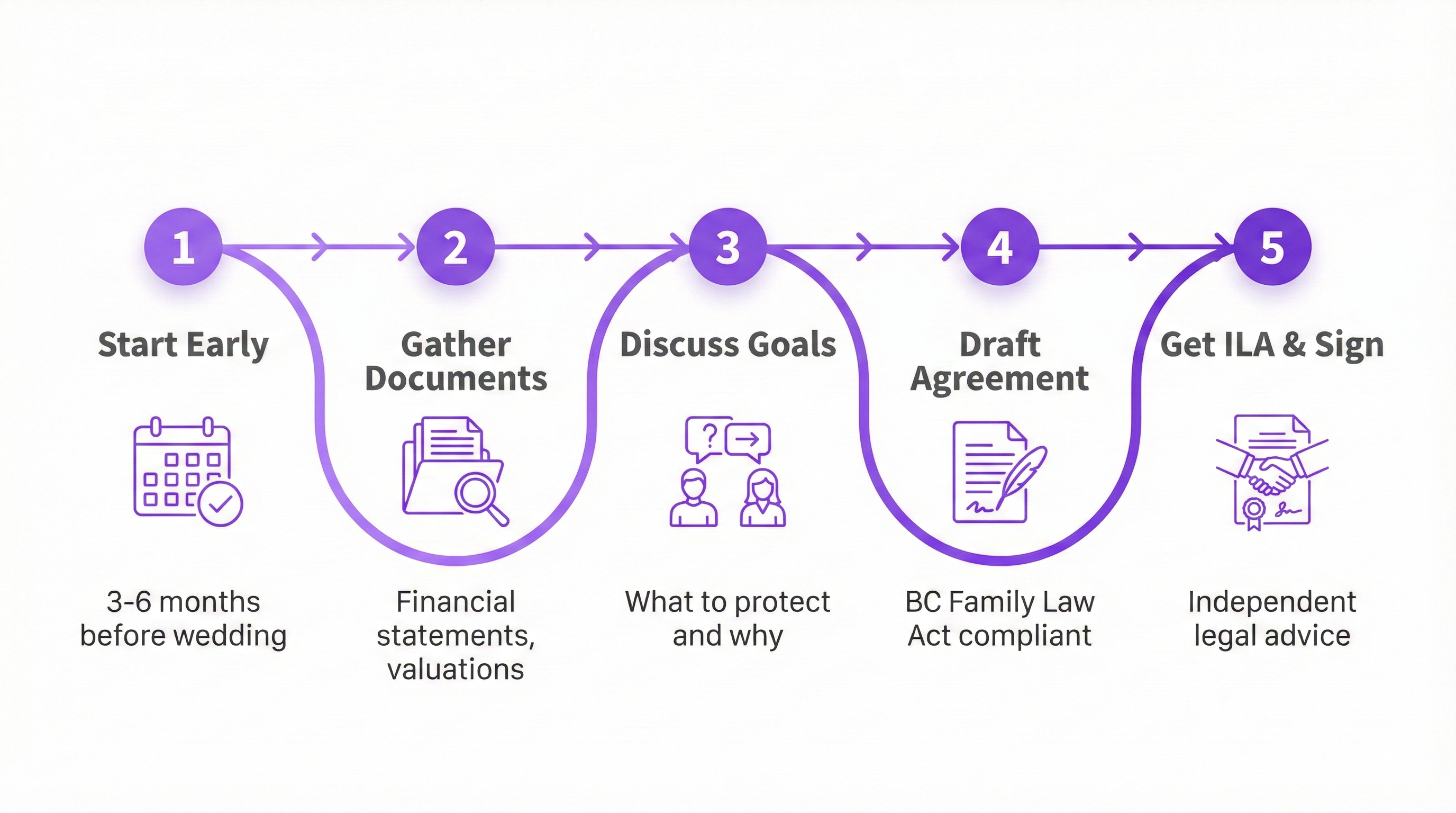
1. Start early. Have the conversation 3-6 months before the wedding. Rushing creates pressure, and pressure creates grounds for challenge.
2. Gather financial documents. Bank statements, investment accounts, property assessments, business valuations, debt statements, tax returns. Both partners need complete pictures of each other's finances.
3. Talk about goals. What do you each want the agreement to accomplish? Protecting pre-relationship assets? Keeping a business separate? Clarifying debt responsibility?
4. Draft the agreement. Work with a lawyer from the start, or use an online service to create an initial draft. Either way, it needs to comply with BC's Family Law Act.
5. Get independent legal advice. Each partner reviews with their own lawyer. The lawyer explains terms, discusses what rights are being waived, assesses fairness, and signs a certificate of ILA.
6. Sign properly. Both parties sign with witnesses present. Each party keeps an original. Store securely.
Situations Where Prenups Matter Most
Business owners. Without a prenup, the increase in your business value during the relationship becomes family property. That can force a sale or require a large cash payment to your spouse. See our guide for entrepreneurs for more detail.
Real estate investors. Properties owned before the relationship are excluded, but their growth isn't. A prenup can protect both.
Blended families. Second marriages often involve assets intended for children from previous relationships. A prenup ensures property passes as intended.
Significant pre-relationship assets. If you're bringing substantial savings, investments, or property into the relationship, the growth on those assets will be shared unless you agree otherwise.
Expected inheritances. Already excluded under the Family Law Act, but protection can be lost if funds get mixed with family assets. A prenup adds clarity.
Common Questions
Do common-law couples need prenups in BC? If you want to change the default property division rules, yes. After two years together, the Family Law Act applies automatically.
Can we change a prenup after marriage? Yes. Create a new written agreement, sign it, have it witnessed.
What if my partner won't sign? You can't force it. If a prenup matters to you, have that conversation early. Some couples find the discussion strengthens their relationship by forcing honest conversations about money.
Does a prenup cover death? It can include provisions about inheritance rights. But you should also have a will that aligns with your prenup terms.
How is BC different from Ontario? Ontario uses equalization, calculating the growth in each spouse's net worth during marriage and splitting the difference. BC divides family property directly. BC also automatically applies property rules to common-law couples after two years; Ontario does not. For a full comparison, see our province-by-province guide.
Getting Started
A prenup isn't about expecting divorce. It's about understanding your financial rights, having honest conversations, and making deliberate choices rather than accepting defaults you may not have known existed.
If you're considering a prenup in BC:
- Learn what property you each have and how BC law would treat it without an agreement
- Talk openly about what you want to protect and why
- Gather your financial documentation
- Get proper guidance to ensure your agreement meets BC's requirements
Ready to create your prenup? Create your prenup template and get a draft customized for British Columbia that you can take to a lawyer for review.
This article provides general information about prenuptial agreements in British Columbia. It is not legal advice. Prenuply AI Inc. is not a law firm and does not provide legal services. For advice about your specific situation, consult a qualified BC family lawyer.