
For many couples, the hardest asset to talk about is the one waiting by the door with a leash.
If you brought a dog into the relationship, adopted a cat together, or expect to share a pet after moving in, a practical question deserves an answer before a breakup:
Who keeps the pet, and how will care work if the relationship ends?
Canadian couples can often address pet ownership, possession, expenses, and care arrangements in a prenup or cohabitation agreement. The exact legal treatment varies by province. British Columbia now has specific companion-animal rules, while many other provinces still approach these disputes mainly through ownership and property law.
This guide explains what a useful pet clause can cover, where provincial differences matter, and how to build a plan that is clear enough to use in real life.
It provides general legal information, not legal advice. Family and property law differs across Canada, and a lawyer in your province should review your agreement before you sign it.
Quick answer: can you put pets in a prenup in Canada?
Yes, a Canadian prenup or marriage contract can generally include terms about a pet as part of the couple's property and financial arrangements. A cohabitation agreement can often do the same for unmarried partners.
A pet clause may address:
- Who owns the pet when the agreement is signed
- Whether ownership is separate or joint
- Where the pet will live if the couple separates
- Whether the other partner will have agreed time with the pet
- Who pays for food, grooming, insurance, routine veterinary care, and emergencies
- Who can make major medical decisions
- What happens if one partner moves, cannot care for the pet, or dies
- How disagreements will be handled
But the phrase pet custody agreement can be misleading. Outside specific legislation, Canadian law usually talks about ownership and possession of an animal, not custody or parenting rights. Justice Canada includes pets among the types of property that couples may need to divide, while noting that property rules are provincial and territorial.
The practical takeaway is simple: couples have more control when they write a clear plan together than when they leave the decision to a future ownership dispute.
Prenup, cohabitation agreement, or separate pet agreement?
The right document depends on your relationship and the scope of the plan.
If you plan to marry
A pet clause can be part of a prenup, which may be called a marriage contract in your province. This is useful when the pet is one of several matters you want to address, along with property, debts, a home, a business, or support.
For the wider process, see How to Create a Prenup in Canada.
If you live together or plan to move in
A cohabitation agreement can record who brought the pet into the relationship and what will happen if you separate. It can also cover day-to-day expenses while you live together.
If you are deciding which document fits, start with Prenup vs Cohabitation Agreement in Canada.
If the pet is the only issue
Some couples use a focused pet ownership or pet-sharing agreement. That may be useful when they do not need a broader domestic contract. However, a standalone agreement still needs precise terms, and it should fit the law of the province where the couple and pet live.
Do not assume a note that says “we will share the dog” answers enough questions. A workable agreement explains what sharing means, who owns the pet, who makes decisions, and what happens when the plan stops working.
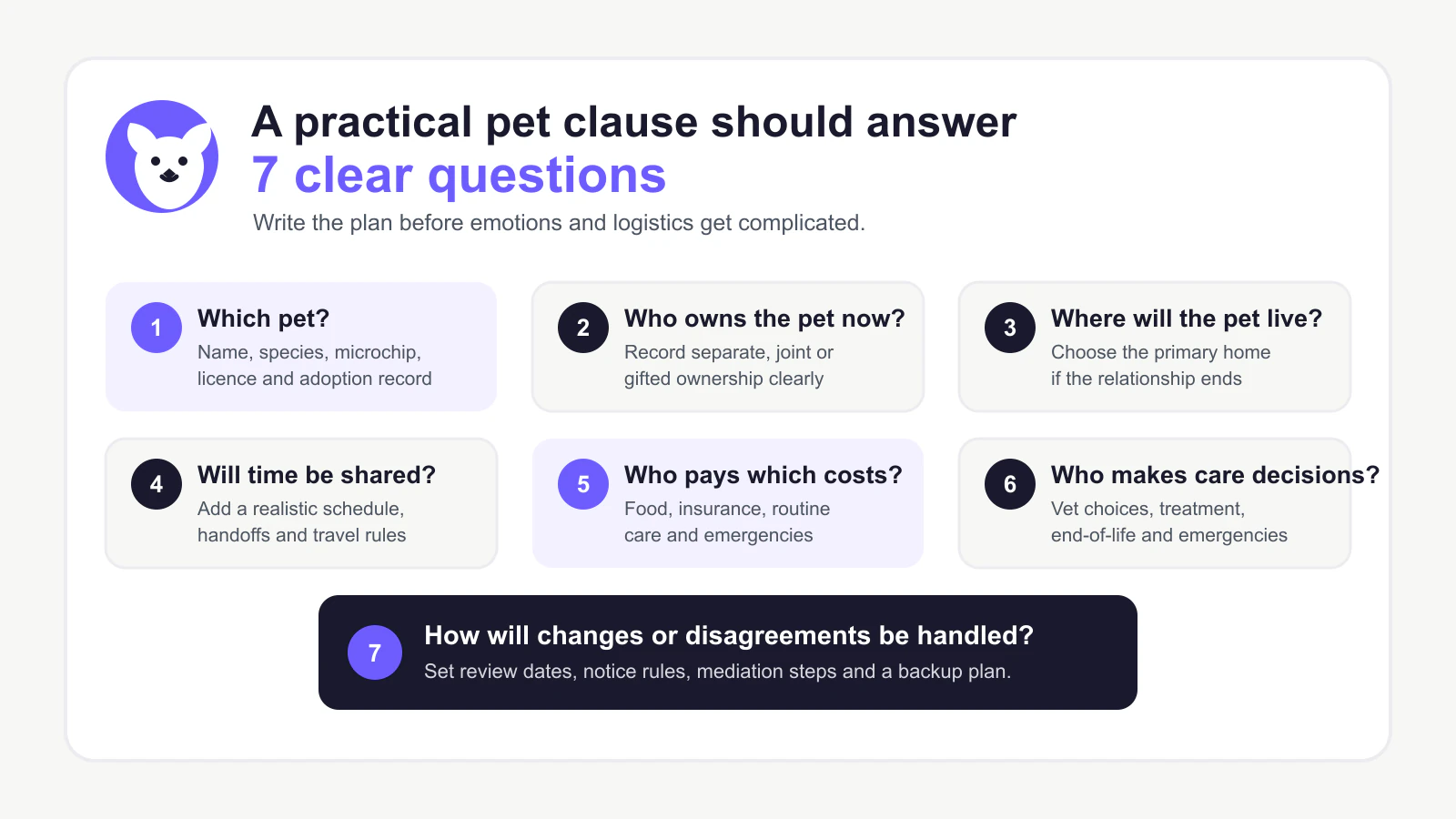
Seven things a practical pet clause should cover
The best pet clause is not the one with the most emotional language. It is the one that gives both partners clear instructions.
1. Identify the pet precisely
Use more than a nickname. Record details such as:
- Registered name and everyday name
- Species, breed, colour, sex, and date of birth or approximate age
- Microchip number
- Municipal licence number
- Adoption agency, breeder, or prior owner
- Current veterinary clinic
- Any existing medical or insurance records
If the agreement covers a future pet, set the decision-making framework now and require a short written update after the pet is acquired. A clause that identifies “any future pets” without saying how ownership will be recorded can create the same ambiguity the agreement was meant to prevent.
2. State who owns the pet now
This is especially important when one partner had the pet before the relationship.
The agreement can record that:
- The pet remains the separate property of the partner who brought it into the relationship
- The pet is jointly owned, if provincial law and the couple's arrangement support that result
- One partner gifted some or all ownership to the other
- Paying routine expenses does not, by itself, change ownership
- A later change in ownership must be made in writing
Supporting records matter. Keep the adoption or purchase agreement, payment receipt, registration, microchip record, veterinary account, insurance policy, and relevant messages about ownership.
3. Choose the pet's primary home after separation
A clause should say where the pet will live if the relationship ends. Consider facts that affect the animal's daily welfare:
- Which person has suitable housing
- Work hours and travel
- The pet's routine and medical needs
- Access to outdoor space, where relevant
- The pet's relationship with children or other animals
- Whether a move would separate bonded animals
- Any history or risk of family violence or animal cruelty
A clear primary-home clause can reduce the risk that both people assume they are entitled to take the pet on the day of separation.
4. Decide whether shared time is realistic
Some couples want the pet to move between homes. Others prefer one stable home with occasional visits. The agreement should match the pet, not an abstract idea of fairness.
If time will be shared, address:
- The regular schedule
- Pickup and drop-off locations
- Holidays and vacations
- Travel outside the province or Canada
- What happens when someone is late or unavailable
- Medication, food, equipment, and records that move with the pet
- Whether a new home, new partner, child, or other animal triggers a review
- Circumstances that suspend sharing, such as unsafe care or unsuitable housing
Remember that an agreement between partners does not automatically bind a landlord, condominium corporation, veterinarian, insurer, registry, or other third party.

5. Allocate ordinary and emergency costs
Pet care can become expensive, particularly when an animal develops a chronic condition. List the expense categories instead of promising vaguely to “split everything.”
Your clause might distinguish among:
- Food and routine supplies
- Grooming, boarding, training, and dog walking
- Annual examinations and vaccinations
- Medication and ongoing treatment
- Pet insurance premiums and deductibles
- Dental care
- Emergency veterinary treatment
- Travel or handoff costs
State whether costs are paid by one owner, divided equally, divided by income, or paid by the person who has the pet at the time. Add a process for approving non-emergency expenses above a chosen amount.
Avoid calling payments “pet support” without defining them. Pets do not have the same statutory support framework as children, and an unclear label does not explain when payment starts, ends, or changes.
6. Assign care and medical decisions
Decide who has authority to make routine and urgent decisions. Address:
- Choice of veterinarian
- Preventive care
- Elective procedures
- Major treatment and spending limits
- Emergency authority when the other person cannot be reached
- Access to medical records
- Quality-of-life and end-of-life decisions
- What happens to remains, ashes, or memorial items
Then make the paperwork match the agreement. Update the veterinary account, insurance contact, microchip registry, municipal licence, and emergency contacts when necessary. A clause may define rights between partners, but it does not automatically update outside records.
7. Add change and dispute rules
Pet arrangements can last many years. Housing, jobs, health, finances, and the animal's needs will change.
Consider including:
- A review every year or after a major event
- Written notice before moving a significant distance
- A short consultation period before changing the schedule
- Mediation before court or tribunal proceedings, where appropriate
- A temporary arrangement while a dispute is being resolved
- A backup caregiver if neither partner can provide care
- A process for permanent transfer or rehoming
Do not rely on a clause that automatically sends every future dispute to a decision-maker without legal review. Arbitration and other dispute-resolution terms are regulated differently across provinces.
What British Columbia couples should know
British Columbia has Canada's clearest family-law rules for companion animals.
Changes that took effect on January 15, 2024 allow separating spouses to make agreements about companion-animal ownership and possession. Under section 92 of BC's Family Law Act, an agreement may provide for joint ownership, shared possession, or exclusive ownership or possession by one spouse.
If spouses cannot agree, a court can order ownership or possession for one spouse. It cannot order joint ownership or require shared possession. The court must consider factors including how the animal was acquired, each spouse's care, family violence, cruelty or threats of cruelty, the pet's relationship with a child, and each spouse's willingness and ability to meet the animal's basic needs.
The Provincial Court of British Columbia's companion-animal guide makes an important distinction: couples can agree to more flexible shared arrangements than a judge can impose.
For BC couples, this is a strong reason to deal with the pet while communication is constructive. A clear agreement can preserve options that may not be available as a court-ordered result.
What Ontario couples should know
Ontario's Family Law Act does not create a separate pet-custody regime. Its domestic-contract provisions do, however, allow couples to make agreements about ownership or division of property and other matters in settling their affairs.
Section 52 of Ontario's Family Law Act addresses marriage contracts, while section 53 addresses cohabitation agreements. A domestic contract must be in writing, signed, and witnessed to be enforceable under section 55.
For an Ontario pet clause, ownership evidence and precise contract language are especially important. Record who acquired the animal, what the parties intend ownership to be, and what will happen on separation. Do not draft the clause as if a pet has the same legal status as a child.
Ontario couples should also keep the pet clause consistent with the rest of the agreement. If one section says all pre-relationship property stays separate but another suggests the pet is jointly owned, clarify which rule controls.
What Quebec couples should know
Quebec uses distinct civil-law language. Article 898.1 of the Civil Code of Québec says animals are not things, but sentient beings with biological needs. It also says that property-related provisions of the Code and other laws nevertheless apply to them.
For unmarried de facto spouses, the Government of Quebec explains that a cohabitation agreement can set rules for dividing property and can include an inventory of personal property and debts.
That creates a useful place to document the couple's intentions about an animal, but Quebec's form and family-property rules are different from common-law provinces. Married couples should obtain advice from a Quebec notary or lawyer about the correct document and wording.
What about the rest of Canada?
There is no single Canada-wide pet-custody rule for couples. Property and domestic-contract laws vary by province and territory, and court approaches can differ.
That does not make a written plan pointless. It makes local review more important.
In any province, ask a family lawyer to confirm:
- Whether the pet should be addressed as separate property, joint property, or a special companion-animal category
- Which domestic contract is appropriate for married or unmarried partners
- What signing and witnessing rules apply
- Whether a shared-possession schedule is likely to be enforceable
- What remedies may be available if one partner breaches the clause
- Whether mediation, arbitration, court, small claims, or a tribunal could hear a dispute
Independent legal advice also helps each partner understand the clause before signing. Read Independent Legal Advice for Prenups in Canada for the review process.
Evidence to organize before signing
A good agreement and good records support each other.
Create a simple pet file containing:
- Adoption, purchase, or gift records
- Proof of payment
- Microchip and licence information
- Veterinary and vaccination records
- Insurance documents
- Receipts for significant expenses
- Training records
- Photos and notes showing the pet's existing routine
- Written messages about ownership or care expectations
- Contact details for a backup caregiver
If one partner already owns the pet, attach or reference that information in the agreement. If the pet was adopted together, record what “together” means legally and financially.
Common pet-clause mistakes
Using child-custody language without defining ownership
Words such as custody, access, and support may feel natural, but they can import the wrong assumptions. Start with ownership and possession, then define any care schedule in plain language.
Focusing only on breakup day
A clause that says who keeps the dog but ignores bills, medical decisions, records, travel, and future changes leaves major disputes unresolved.
Choosing a schedule that does not suit the animal
Frequent handoffs may not work for an anxious, elderly, medically fragile, or highly territorial pet. Build the plan around practical care.
Forgetting outside records
If the microchip, licence, vet account, adoption record, and insurance all name one person, a contradictory agreement may be harder to administer. Make the records consistent where possible.
Treating a pet clause as a substitute for the rest of the agreement
A pet plan does not address the home, debts, property, support, or other financial issues. Use the right agreement for the whole relationship. A cohabitation agreement checklist can help unmarried couples identify the other topics they may need to cover.
When should you update the pet clause?
Review the agreement when:
- You acquire another pet
- A pet is permanently transferred or rehomed
- You marry after signing a cohabitation agreement
- You move to another province
- A child develops a strong relationship with the pet
- One partner becomes the pet's primary caregiver
- The pet develops major medical needs
- Housing or work travel changes substantially
- Shared care is no longer safe or practical
Use a properly signed amendment when the legal agreement needs to change. Do not rely only on an informal text conversation for a permanent ownership transfer.
FAQ
Can a prenup say who gets the dog in Canada?
Yes, a prenup can generally record ownership and say who will have the dog if the relationship ends. The exact effect and drafting requirements depend on provincial law. A local family lawyer should review the clause.
Can unmarried couples make a pet custody agreement?
Yes. Unmarried couples can often include pet terms in a cohabitation agreement or use a focused pet agreement. The legal language may concern ownership and possession rather than custody.
Can we agree to share the dog after separation?
You can write a shared-care arrangement, but enforceability and available court remedies vary. In British Columbia, spouses may agree to shared possession even though a court cannot impose it as the original result. In other provinces, ask a lawyer how a court would treat the clause.
Who owns a pet bought before the relationship?
The person who acquired the pet may have the strongest ownership claim, but facts and provincial law matter. A written agreement can confirm that the pet remains that person's separate property and explain whether the other partner has any agreed care time.
Does paying vet bills make me the owner?
Not necessarily. Payments can be relevant evidence, but ownership may also depend on acquisition records, registration, the parties' agreement, and other facts. Record the intended ownership instead of relying on expense receipts alone.
Can a pet clause cover a future dog or cat?
Yes, it can set a framework for future pets. The agreement should also require the couple to identify each new animal and record ownership, costs, and care terms in a signed schedule or amendment.
Can a pet clause decide what happens if an owner dies?
It can coordinate responsibilities between partners, but it does not replace a will or estate plan. Ownership on death, funds for care, and the authority of an executor require estate-planning advice.
Bottom line
For couples who love their animals, a pet clause is not trivial. It is a practical plan for ownership, care, costs, and difficult decisions.
The most useful clause identifies the pet, records present ownership, chooses a primary home, explains whether time will be shared, allocates expenses, assigns medical decisions, and provides a way to update the plan. Provincial law still controls, so lawyer review matters.
If you are planning to marry, you can start a Canadian prenup draft. If you are moving in together or already cohabiting, you can start a cohabitation agreement draft. Bring the draft, your pet records, and your questions to independent lawyers in your province before signing.
Prenuply AI Inc. is not a law firm and does not provide legal services or legal advice. Prenuply provides technology tools and general legal information to help users prepare agreement drafts for review with qualified legal professionals.