
Quick answer: Yes. In Canada, couples can generally make a cohabitation agreement after they have already moved in together. Ontario law expressly allows two unmarried people who are “cohabiting or intend to cohabit” to enter one. Other provinces also allow spouses or common-law partners to make agreements during their relationship.
The important difference is that an agreement signed after moving in should start with the couple’s real history. It should not pretend the relationship begins on signing day. Property may have been purchased, debts may have changed, one partner may have contributed to the other’s home, and provincial rights may already be developing.
This guide explains what to do if you are already living together, what the agreement can cover, and why the process matters as much as the wording.
Not legal advice: Family law is provincial and fact-specific. A cohabitation agreement template is a useful starting point, but each partner should consider separate advice from a family lawyer in their province before signing.
Can you sign a cohabitation agreement after moving in?
Yes. There is no Canada-wide deadline that closes the door the day you move in.
In Ontario, section 53 of the Family Law Act says two unmarried people who are cohabiting or intend to cohabit may agree on their rights and obligations during the relationship, when it ends, or on death. Section 55 says a domestic contract must be in writing, signed, and witnessed to be enforceable.
British Columbia’s Family Law Act lets spouses make agreements about the division of property and debt. For the statutory protections in section 93, the agreement is written and each signature is witnessed.
Manitoba’s official family-law guidance is equally direct: property agreements may be made before or during the relationship, or when it breaks down.
So, if you moved in six months ago, three years ago, or longer ago, it is not automatically too late. The better question is: what has happened since you began living together, and how should the agreement deal with it fairly and accurately?
Why the move-in date still matters
Signing later is allowed, but the date your shared life began can affect the legal and practical picture.
For example:
- In British Columbia, unmarried partners generally become spouses for property-division purposes after living together in a marriage-like relationship for at least two years.
- In Alberta, adult interdependent partner status can arise after three continuous years in a relationship of interdependence, sooner if the couple has a child, or through an adult interdependent partner agreement. Alberta’s official guidance explains that adult interdependent partners may be covered by the Family Property Act and can opt out with their own agreement.
- Manitoba generally gives qualifying common-law partners property rights under its Family Property Act. The province explains that common-law partners can have equalization rights and can address property in a written agreement.
- Quebec treats de facto spouses differently from common-law partners in several other provinces. In addition, a new parental union regime may apply when de facto spouses become parents of the same child on or after June 30, 2025. The Government of Quebec says the regime creates a parental union patrimony that can include family residences, household furniture, and family vehicles.
These rules do not mean every right is fixed forever once a time threshold passes. They do mean a late agreement deserves careful drafting. The couple should disclose the true move-in date, identify what each person owned then, and record what changed before signing.
Start with two financial snapshots, not one
A couple signing before they move in can take a clean “before” snapshot. A couple already living together often needs two:
- The start-of-cohabitation snapshot: What did each person own and owe when the relationship began?
- The signing-date snapshot: What does each person own and owe now?
The difference between those snapshots can be important. Consider a partner who owned a condo before cohabitation. Since move-in, the other partner may have paid part of the mortgage, funded renovations, or covered more household expenses while the owner built equity. A useful agreement should not hide those facts.
Gather records such as:
- the purchase and mortgage documents for a home;
- account statements from around the move-in date and the current date;
- credit-card, student-loan, line-of-credit, and tax balances;
- records of down payments, gifts, loans from parents, and major renovations;
- ownership documents for a business, vehicle, cottage, or investment account;
- pension, RRSP, TFSA, stock-option, and crypto records;
- evidence of significant contributions to property owned by the other partner; and
- wills, beneficiary designations, insurance policies, and estate-planning documents.
Do not guess when a statement can be obtained. If an older record is unavailable, say so and explain the estimate. Full, understandable disclosure helps both partners make an informed decision and reduces the chance of a future argument that important facts were hidden.

For a more detailed preparation list, use Prenuply’s Canadian cohabitation agreement checklist.
What can an after-move-in cohabitation agreement cover?
The core topics are similar whether the agreement is signed before or after moving in. The factual details are usually richer after cohabitation has begun.
A home one partner already owns
The agreement can address:
- whether title remains with the owner;
- whether payments by the non-owner are rent, household contributions, loans, or equity-building contributions;
- who pays the mortgage, property tax, insurance, utilities, and repairs;
- how renovations will be approved and funded;
- whether appreciation is shared;
- what happens if the property is sold;
- how much notice a partner receives before moving out after a separation; and
- whether the arrangement changes if the couple marries.
If this is your situation, see the focused guide to a cohabitation agreement when one partner owns the house.
A home the couple bought together
Joint title does not answer every question. The agreement can record unequal down payments, ownership percentages, mortgage responsibility, renovation costs, buyout mechanics, appraisal methods, and sale procedures.
It can also explain whether a parent’s contribution was a gift to one partner, a gift to both, or a loan. The paper trail should match the agreement.
Property and debt acquired during the relationship
Couples can set rules for:
- individual and joint bank accounts;
- vehicles, investments, businesses, and valuable personal property;
- credit cards, tax debts, student loans, and business guarantees;
- future purchases and borrowing;
- reimbursement when one partner pays a shared expense; and
- records that should be kept.
A clause should be specific enough to use. “We keep our own property” may be too vague if the couple has mixed funds, refinanced a home, or used a joint account for major purchases.
Household expenses while living together
An agreement can document a method for ongoing costs, such as equal payments, proportional payments based on income, or responsibility for named expenses.
This part should be practical. It should say whether day-to-day contributions affect ownership or support claims. It should also explain how the couple will update the arrangement after a job loss, parental leave, disability, or major income change.
Spousal or partner support
Some couples include support terms or a waiver. Courts can scrutinize support clauses, particularly when circumstances later become very different or enforcement would be unconscionable. Avoid treating a support waiver as a guaranteed shield.
If support is important, read Prenuply’s guide to spousal support in a prenup or cohabitation agreement and obtain province-specific advice.
Death and estate planning
A cohabitation agreement can coordinate with wills, insurance, beneficiary designations, and rights to occupy a home. It should not be treated as a substitute for a will.
Ask what happens if one partner dies while they are still together. Should the survivor have time to remain in the home? Will a debt be repaid? Is life insurance meant to fund a buyout? The agreement and estate documents should tell the same story.
Pets and separation logistics
The agreement can record ownership, care costs, veterinary decisions, and a practical plan if the couple separates. Courts may not enforce every lifestyle promise, but clear financial and ownership terms can reduce conflict.
A province-by-province timing snapshot
| Province | Can an agreement be made after moving in? | Important point |
|---|---|---|
| Ontario | Yes. The Family Law Act expressly covers people who are cohabiting or intend to cohabit. | It must be in writing, signed, and witnessed. If the couple later marries, the agreement is generally deemed to be a marriage contract, but matrimonial-home limits still matter. |
| British Columbia | Yes. Spouses can make agreements about property and debt. | Written, witnessed signatures and meaningful disclosure matter. A court can examine procedural unfairness and significant unfairness under section 93. |
| Alberta | Yes. Spouses and adult interdependent partners can contract out of statutory property rules. | Sections 37 and 38 of the Family Property Act use special formalities, including separate lawyer acknowledgements for an enforceable property agreement. |
| Manitoba | Yes. Provincial guidance says an agreement may be made before or during the relationship. | Qualifying common-law partners may have statutory property rights, so the agreement should identify the relationship timeline and expressly address the rules the couple wants to change. |
| Quebec | Couples can make a cohabitation contract, but the legal framework is different. | De facto spouses should consider ownership, support, wills, and whether the parental union regime applies. Quebec legal or notarial advice is especially important. |
This table is a starting point, not a substitute for local advice. Rules and terminology differ, and a move between provinces can affect the analysis.
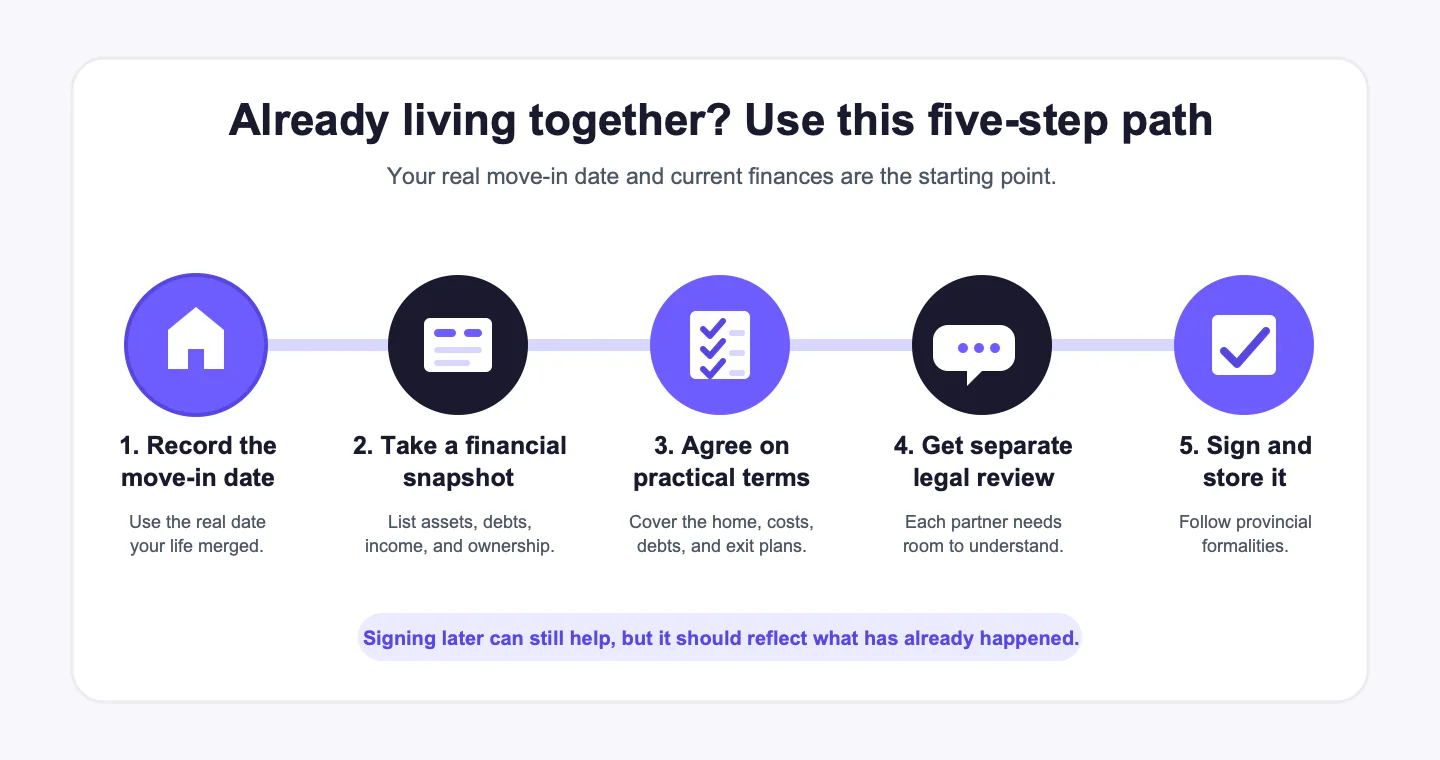
How to make an agreement after you already live together
1. Agree on the goal before debating clauses
Start with a shared sentence: “We want a clear plan for our home, debts, and future decisions.”
That framing is more constructive than presenting a finished document as a demand. If one partner is asked to sign immediately, without information or time to review it, the process can create both relationship tension and legal risk.
2. Write down the relationship timeline
Record:
- the date you began living together;
- every home you have shared;
- when major assets or debts were acquired;
- when you became parents, if applicable;
- any periods of separation;
- any major gifts, loans, refinancings, or renovations; and
- whether marriage is planned.
Do not select a convenient new date simply because the old one creates a harder discussion.
3. Exchange financial disclosure
Each partner should receive a clear schedule of the other’s assets, debts, income, and significant obligations. Attach supporting records where appropriate.
Disclosure is not only for the wealthier partner. A large debt, personal guarantee, tax issue, or expected family obligation can be just as relevant as an investment account.
4. Decide how to treat the period before signing
This is the defining question in an after-move-in agreement.
Possible approaches include:
- preserving any rights that arose before signing and applying new rules only going forward;
- settling or releasing specific past claims after full disclosure and advice;
- crediting documented contributions to a home;
- fixing an ownership percentage as of the signing date; or
- creating a formula based on down payments, principal reduction, or renovation spending.
The right approach depends on the province and the couple’s facts. Do not use retroactive language casually.
5. Draft practical, testable terms
Good terms answer “who, what, when, and how.” For example, a buyout clause should say how value is determined, how long the buyer has to arrange financing, and what happens if the buyout fails.
A vague promise to “divide things fairly” may reproduce the uncertainty the agreement was meant to solve.
6. Leave time for separate legal review
Each partner should have a genuine opportunity to consult a different lawyer. Separate advice helps each person understand what provincial law would otherwise provide, what the agreement changes, and what future events could affect it.
Prenuply can help you prepare an organized draft for review. If you need help finding separate counsel, see lawyer review options.
7. Follow the signing rules and store the records
Formalities vary by province. Witnessing, lawyer certificates, and special acknowledgements can matter.
Keep:
- the fully signed agreement;
- disclosure schedules and supporting records;
- certificates or letters from lawyers;
- proof of the signing date; and
- later amendments in the same organized file.
Both partners should have a complete copy.
Can the agreement erase rights that already arose?
Not automatically.
Partners can often settle or change financial rights by agreement, but the effect depends on provincial law, the wording, disclosure, advice, and fairness. A clause that says “nothing before today counts” may not reliably solve a history of mortgage payments, renovations, business contributions, or unequal caregiving.
That is why an after-move-in agreement should do more than use a standard template. It should identify the past, explain what the couple is doing with it, and show that both partners understood the choice.
What if one partner refuses to sign?
A cohabitation agreement requires consent. One partner cannot impose it after the move.
If the conversation stalls:
- Pause the clause-by-clause negotiation.
- Identify the underlying concern, such as the home, debt, inheritance, or fairness.
- Exchange financial information first.
- Consider mediation or collaborative family-law support.
- Obtain individual legal advice about the current situation.
Do not threaten eviction, marriage cancellation, or financial withdrawal to force a signature. Pressure can damage the relationship and make an agreement easier to challenge.
What happens if you later get married?
The answer depends on the agreement and the province.
Ontario’s Family Law Act says a cohabitation agreement is generally deemed to be a marriage contract if the parties marry. However, Ontario marriage contracts cannot limit statutory rights concerning the matrimonial home in the same way they can address other property. A clause that worked while the home belonged to one unmarried partner may need review before marriage.
In other provinces, the agreement may continue, convert, or require amendment depending on its terms and local law. Add a review trigger well before the wedding, not the week of it.
Other useful review triggers include:
- buying or selling a home;
- having or adopting a child;
- moving to another province or country;
- receiving a major inheritance;
- starting or selling a business;
- a long career break or disability; and
- a major change in income or debt.
Common mistakes when signing after moving in
Avoid these shortcuts:
- using the signing date as a false move-in date;
- listing only current assets and ignoring the start of cohabitation;
- failing to document mortgage, renovation, or down-payment contributions;
- assuming title alone answers every family-law or equitable claim;
- signing the same day the draft is first presented;
- using one lawyer to advise both partners on competing interests;
- copying terms from another province;
- including parenting or child-support promises as if they bind a future court;
- treating a cohabitation agreement as a will; and
- forgetting to review the agreement before marriage.
Frequently asked questions
Is it too late after becoming common-law?
Usually not. Qualifying as common-law or as a spouse under provincial law can change the rights you need to discuss, but it does not normally prevent the partners from making an agreement. Get advice about what has already arisen before deciding what to waive or preserve.
How long after moving in can we sign?
There is no single national cutoff. The longer you wait, the more important the historical records may become. Start now with the real move-in date and a current financial snapshot.
Can we make our own cohabitation agreement?
Couples can prepare their own draft, but enforceability and formalities are province-specific. An online questionnaire can organize decisions and produce a strong starting document. Separate legal review is still valuable, especially where a home, support waiver, business, inheritance, or major imbalance is involved.
Does a cohabitation agreement need to be notarized?
Not everywhere. Witnessing and legal-advice requirements differ. Quebec notarial advice may be important for certain transactions and legal regimes, while Alberta property agreements have special lawyer-acknowledgement requirements. Follow the law of your province rather than a generic internet checklist.
Should we include the exact date we moved in?
Yes. If the date is uncertain, explain the best evidence and agree on a reasonable record rather than inventing a later date. Lease records, utility accounts, insurance changes, tax filings, and correspondence can help.
Can the agreement cover a house we already share?
Yes. It can address ownership, contributions, expenses, appreciation, buyouts, sale, and move-out timing. The current title, payment history, and provincial law all matter.
The practical next step
If you are already living together, the right time to organize the agreement is not “before.” It is now, while you can still gather records and make decisions together.
Start by writing down your move-in date, listing what each partner brought into the relationship, and taking a current financial snapshot. Then use Prenuply’s guided cohabitation agreement process to prepare a province-aware draft for separate lawyer review.
The goal is not to rewrite your relationship. It is to make the financial story you have already built clear enough to plan the next chapter.