
The short answer is yes: a Canadian prenup or cohabitation agreement can address spousal support. The careful answer is that a support clause is not a magic sentence that guarantees no support will ever be paid.
That distinction matters for couples who are trying to plan fairly. Property clauses usually look backward and forward at who owns what. Support clauses also look at future need, income, caregiving, health, career choices, and whether the agreement still makes sense when the relationship ends.
If you are creating a prenup in Canada or a cohabitation agreement, support should be treated as its own planning topic, not as an afterthought.
Quick answer: can you waive spousal support in Canada?
In many Canadian provinces, couples can use a marriage contract, prenuptial agreement, or cohabitation agreement to set terms about spousal support. Those terms might:
- waive support entirely,
- limit support to a fixed amount or fixed period,
- create a formula,
- require a future review,
- preserve support rights if certain events happen, such as children, illness, disability, or a long relationship.
Courts can still review the clause later. A judge may look at whether each partner understood the agreement, whether financial disclosure was complete, whether anyone was pressured, whether the result is unfair, and whether the clause lines up with the purpose of spousal support.
That is why a support waiver should not be copied from a template without context. It should match your incomes, roles, assets, debts, career plans, and province.
Why spousal support is different from dividing property
Spousal support is not a penalty for ending a relationship. It is meant to address economic consequences of the relationship and its breakdown.
For married spouses who divorce, the federal Divorce Act section 15.2 directs courts to consider each spouse's condition, means, needs, and circumstances. It also lists support objectives, including recognizing economic advantages and disadvantages from the marriage, sharing financial consequences of child care, relieving hardship, and promoting self-sufficiency where practical.
Those objectives explain why a support clause gets more scrutiny than a simple asset list. A couple might sign an agreement while both partners earn similar incomes. Five years later, one partner may have left work for child care, moved for the other partner's career, supported a business, or developed a health issue. The support clause may still matter, but the future facts matter too.
The Supreme Court of Canada considered this kind of issue in Miglin v. Miglin, a leading case on spousal support agreements. The main point for couples is practical: courts take agreements seriously, but they can also examine the circumstances around the agreement and whether it still reflects the law's support objectives.
Prenup support clauses vs cohabitation agreement support clauses
A prenup is usually signed before marriage. In Canada, it is often called a marriage contract once the couple is married. A cohabitation agreement is usually signed by unmarried partners who live together or plan to live together.
Both can deal with support, but the legal path depends on the relationship and province.
For married spouses, support may be considered under the Divorce Act if the couple divorces. Provincial family law also matters because provinces set rules for domestic contracts, property, enforcement, and some support claims.
For unmarried partners, support rights depend heavily on provincial definitions. Some provinces use the term common-law partner. Alberta uses adult interdependent partner. Eligibility may depend on relationship length, whether the couple has a child, financial dependence, and other facts.
If you are unsure which document fits your situation, start with Prenuply's guide to prenup vs cohabitation agreement in Canada.
Common ways to structure a support clause
There is no single support clause that works for every couple. The right structure depends on what problem the clause is supposed to solve.
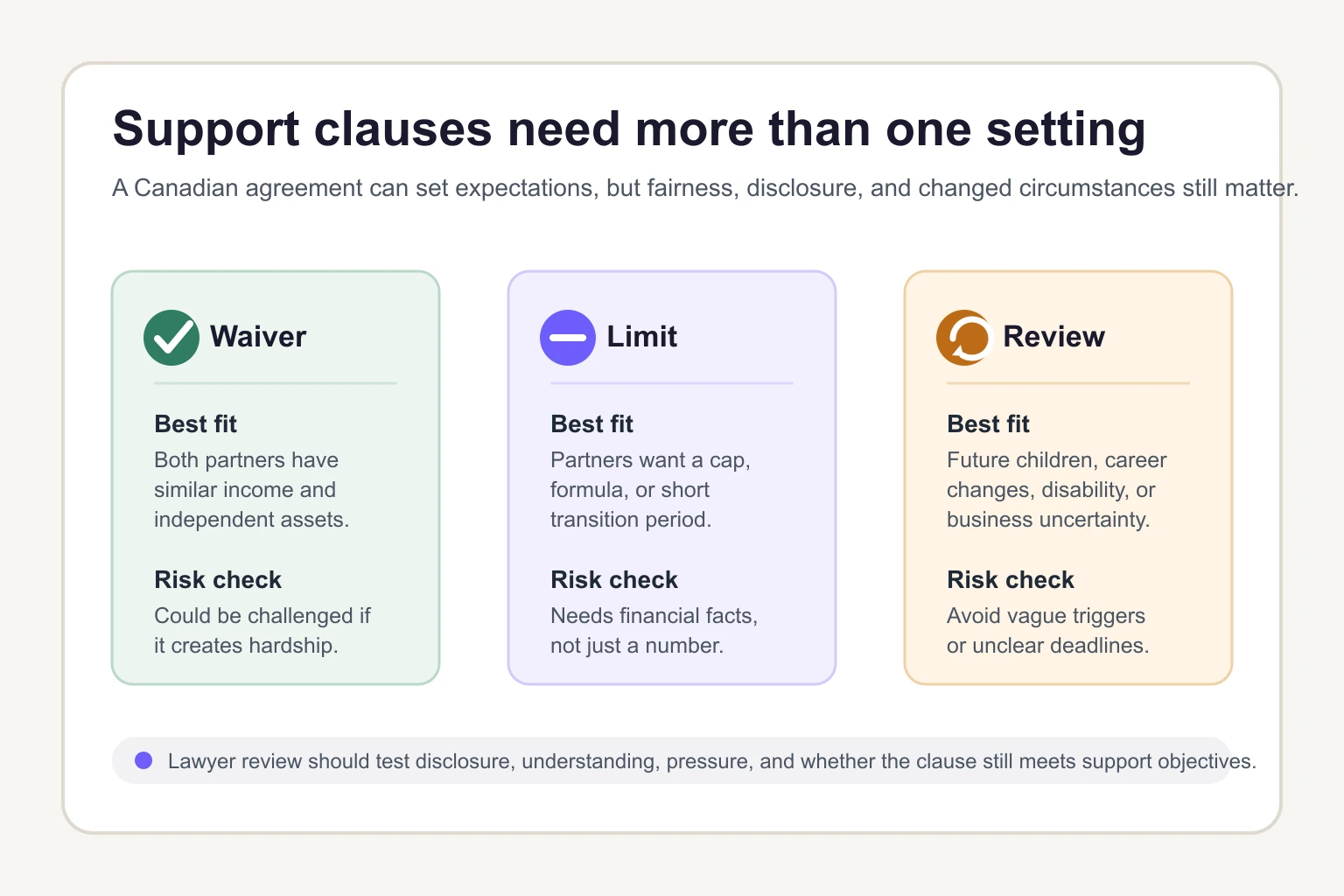
1. Full waiver
A full waiver says neither partner will claim spousal support from the other. This may be more realistic where both partners are financially independent, have similar earning capacity, do not expect major caregiving interruptions, and understand the consequences.
The risk is that life changes. A full waiver may be vulnerable if one partner later faces serious hardship tied to the relationship, especially if disclosure was weak or the waiver was signed under pressure.
2. Limited support
A limited support clause does not waive support entirely. It might set a cap, a fixed duration, a lump sum, or a short transition period.
This can be useful where partners want predictability but still want some safety net. For example, a couple might agree that support is available only for a transition period if one partner relocates, reduces work, or helps the other partner build a business.
3. Review clause
A review clause says the couple will revisit support if certain events happen. Common triggers include having children, one partner leaving the workforce, a long relationship, disability, or a major business sale.
Review clauses can feel less final, but they may be more realistic for younger couples, couples planning children, or couples with uncertain income.
4. Reservation of rights
Some agreements leave support open and focus on property, debt, disclosure, and process. This is not a failure. It can be a deliberate choice where support is too unpredictable to settle fairly in advance.
If support is left open, the agreement should say so clearly. Ambiguity is rarely helpful.
When a support waiver may be challenged
A support clause is more likely to be challenged if one partner can show problems with the agreement process or the result.
Common risk factors include:
- incomplete financial disclosure,
- hidden income, debts, assets, business interests, or trust interests,
- one partner signing without enough time,
- pressure close to the wedding or move-in date,
- no independent legal advice,
- language one partner did not understand,
- a clause that ignores children or caregiving plans,
- a major change in income, health, work, or family responsibilities,
- a result that leaves one partner in serious hardship.
British Columbia's Family Law Act is a useful example. It allows spouses to make written spousal support agreements, including a release of liability for support. It also allows a court to set aside or replace an agreement in circumstances such as failure to disclose relevant financial information, taking improper advantage of vulnerability, lack of understanding, or significant unfairness after later changes.
Ontario couples should also be careful. Ontario's Family Law Act allows marriage contracts and cohabitation agreements to deal with support obligations, but Ontario law also gives courts power to set aside support provisions or support waivers in specific circumstances. The Government of Ontario's spousal support guidance also notes that support depends on facts such as income differences, relationship roles, children, age, health, and ability to become self-supporting.
The lesson is not that support clauses are useless. The lesson is that the clause needs a good paper trail.
What couples should disclose before deciding on support
Support clauses need the same financial honesty as property clauses, plus extra context about earning capacity and roles.
At minimum, each partner should exchange:
- current income,
- expected bonus, commission, or variable compensation,
- employment benefits,
- business ownership and business income,
- assets and debts,
- tax obligations,
- prior support obligations,
- education and career history,
- health limits that may affect work,
- plans for children, caregiving, relocation, or reduced work.
Prenuply already has a detailed financial disclosure checklist for prenups. Use that as a starting point, then add support-specific details about income, career plans, and relationship roles.

Better questions than "can I waive support?"
Many couples start with the wrong question. "Can I waive support?" is only one part of the analysis.
Better questions include:
- What income does each partner have now?
- What income is each partner likely to have in five or ten years?
- Will either partner move, reduce work, change careers, or pause work for family reasons?
- Will one partner support the other's education, professional licence, startup, or business?
- Does either partner have children from a previous relationship?
- Would a full waiver still feel fair if the relationship lasts 15 years?
- Would a limited support period be more realistic than a total waiver?
- Should the agreement require a review after children, relocation, or a major income change?
These questions make the agreement stronger because they show that the couple thought about actual scenarios rather than just deleting future obligations.
Province notes for Canadian couples
Family law is not identical across Canada. A support clause that makes sense in one province may need different wording, signing steps, or lawyer review in another.
Ontario
Ontario couples often use the term marriage contract for a prenup. Cohabiting partners can use a cohabitation agreement, and if they later marry, that agreement can become a marriage contract unless the agreement says otherwise. Support clauses should be reviewed carefully because Ontario courts have statutory tools to review support waivers in certain circumstances.
If you are getting married in Ontario, read Prenuply's Ontario prenuptial agreement guide and the article on what cannot be included in a Canadian prenup.
British Columbia
BC's Family Law Act expressly deals with written spousal support agreements and when they may be set aside. BC also has detailed rules for property and support for spouses, including unmarried spouses who meet the province's definition. A support waiver should be especially careful about disclosure, independent legal advice, and future fairness.
Alberta
Alberta has distinct terminology and formal requirements in some family-property contexts, especially around written agreements and acknowledgments. Adult interdependent partners may also have support issues. If the agreement includes support terms, Alberta couples should get advice on both property rules and support rights instead of assuming a generic Canadian clause is enough.
Quebec
Quebec marriage contracts are usually signed before a notary and operate in a civil-law framework. A Quebec contract can be very useful for choosing a matrimonial regime and organizing property expectations, but support on divorce can still raise federal Divorce Act issues. Quebec couples should work with a Quebec notary or family lawyer before relying on a support waiver.
Other provinces and territories
Most other provinces allow domestic contracts to address support in some form, but the details vary. The safest approach is to draft the support clause around your province, your relationship type, and your facts.
Should you use the Spousal Support Advisory Guidelines?
The Spousal Support Advisory Guidelines are not legislation, but lawyers and judges often use them as a reference point for possible support ranges. They can help couples understand what support might look like if there were no agreement.
For planning, the guidelines can be useful in three ways:
- they give context before choosing a full waiver,
- they help test whether a cap is realistic,
- they make it easier to compare a short support period with a longer one.
Do not treat an online calculator as the final answer. Support calculations can be complicated, especially with self-employment income, business ownership, bonuses, parenting arrangements, tax effects, and prior obligations.
Lawyer review matters more for support clauses
Independent legal advice is helpful for any prenup or cohabitation agreement. It is especially important for support clauses because the consequences may not be obvious when the agreement is signed.
Each partner should have a chance to ask:
- What support rights might I be giving up?
- What could happen if we have children?
- What if I leave work or move for the relationship?
- What if my partner's income grows significantly?
- What if my health changes?
- Would a judge likely view this clause as fair?
Lawyer review also helps prove that each partner understood the agreement. That can matter if the agreement is challenged later.
Drafting checklist for support terms
Before signing a support waiver, cap, or review clause, make sure the agreement can answer these questions:
- Which law and province does the agreement use?
- Are both partners clearly identified?
- Is the relationship type clear?
- Did both partners exchange financial disclosure?
- Does the clause say whether support is waived, limited, reserved, or reviewed?
- Does the clause explain what happens after children, illness, disability, relocation, or a long relationship?
- Does the agreement separate spousal support from child support?
- Does each partner have time for independent legal advice?
- Is the agreement signed well before the wedding or move-in deadline?
- Are there schedules showing income, assets, debts, and key assumptions?
This is also where online preparation can help. A guided tool can collect details, organize disclosure, and produce a cleaner lawyer-review draft than starting from a blank page.
FAQ
Is spousal support the same as child support?
No. Spousal support is support between partners or spouses. Child support belongs to the child and cannot be waived by parents in a prenup or cohabitation agreement. If your draft mixes child support and spousal support together, get it reviewed.
Can a prenup waive alimony in Canada?
Canada usually uses the term spousal support rather than alimony. A prenup can often include a spousal support waiver, but the waiver may still be reviewed by a court later. The stronger the disclosure, advice, timing, and fairness analysis, the better the clause is likely to stand up.
Can a cohabitation agreement waive support for common-law partners?
Often yes, but it depends on the province and whether the partners qualify for support rights in the first place. A cohabitation agreement can be useful because unmarried partners may have different property and support rights than married spouses. See Prenuply's cohabitation agreement checklist for Canada for related planning points.
Is a full waiver better than a cap?
Not always. A full waiver is simple, but it can be brittle if life changes. A cap, review clause, or transition-support clause may give both partners more certainty while still reducing the risk of an unfair result.
Can we add support terms after marriage or after moving in?
Usually couples can sign an agreement later, but timing and pressure still matter. If the relationship has already changed, disclosure and legal advice become even more important.
Bottom line
A prenup or cohabitation agreement can address spousal support in Canada, but support is one of the clauses that deserves the most care. A strong clause is built around disclosure, realistic future scenarios, independent advice, and province-specific rules.
If you are preparing for marriage, Prenuply can help you create a structured prenup draft to review with a lawyer. If you are living together or buying a home before marriage, start with the cohabitation agreement guide and use the draft as a practical starting point for legal review.