
A Quebec cohabitation agreement can give unmarried partners a written plan for property, debts, housing costs and separation. Since June 30, 2025, however, some Quebec couples who are parents are also covered by the newer parental union regime. That means the right agreement depends on which legal lane your relationship is in.
The distinction matters. A standard de facto couple generally does not acquire the same Civil Code property rights as married or civil union spouses simply by living together for a certain number of years. A couple in a parental union has a limited statutory patrimony and other protections. A married or civil union couple is subject to a different set of rules again.
This guide explains those differences in practical terms, what a Quebec cohabitation agreement can cover, and when a notary or lawyer should review the plan.
Quick answer: A Quebec cohabitation agreement, also called a de facto union agreement, can record how unmarried partners will manage property, debts, expenses and separation. If you are in a parental union, the agreement must be coordinated with mandatory legal protections, and certain changes require a notarial act.
What is a cohabitation agreement in Quebec?
A cohabitation agreement is a contract between two people who live together as a couple without being married or in a civil union. In Quebec, you may also see it called a de facto union agreement, an agreement between de facto spouses, or in French, a convention d’union de fait.
According to the Government of Quebec’s cohabitation agreement guidance, couples can use an agreement to address day-to-day responsibilities, property division, the family home, mediation, debts, possible payments after separation and, in some cases, division of earnings registered under the Quebec Pension Plan.
The agreement can be useful before you move in, after you already live together, when you buy a home, when one partner contributes more, or when your family changes. It is not limited to wealthy couples. The value is clarity about expectations that would otherwise remain unwritten.
If you want the national overview first, see how cohabitation agreements work in Canada. Quebec deserves its own guide because its civil-law system and parental union regime differ from the common-law provinces.
First identify your Quebec legal lane
Before choosing clauses, identify which of these three situations fits. A document designed for one lane should not be assumed to solve the issues in another.
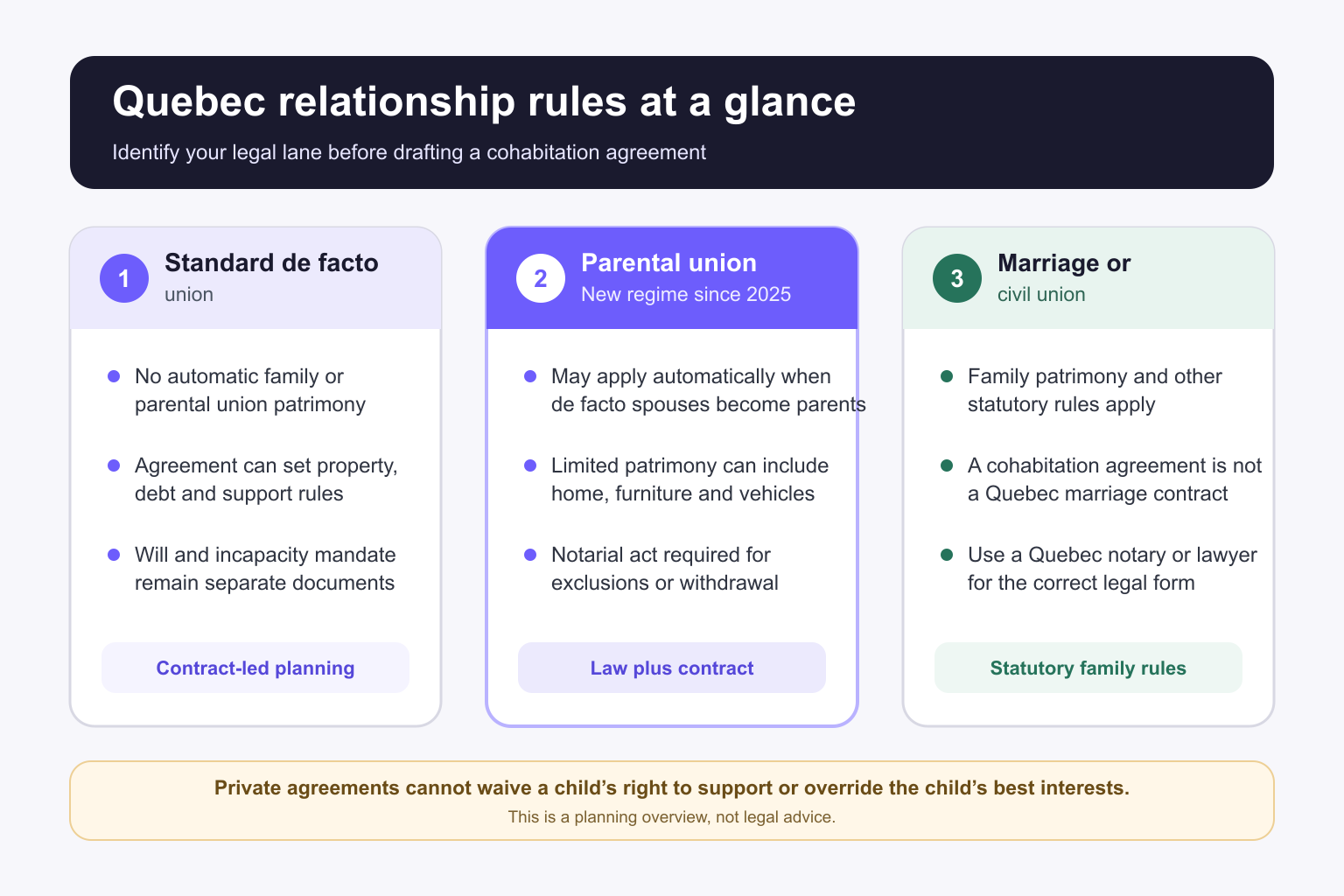
1. Standard de facto union
Two people can live together in a de facto union without marrying or entering a civil union. The Government of Quebec explains that standard de facto spouses do not have the same Civil Code rights and obligations as married, civil union or parental union couples, regardless of how long they have lived together.
That does not mean the relationship has no legal consequences anywhere. Tax, benefit, pension, housing and other laws can each use their own definitions. It means there is no single anniversary on which cohabitation automatically turns a standard de facto relationship into a marriage for every legal purpose.
For property planning, a cohabitation agreement can fill important gaps by defining what each person owns, what is shared and how contributions will be treated.
2. Parental union
Quebec’s parental union regime came into force on June 30, 2025. Under article 521.20 of the Civil Code of Quebec, a parental union can form when de facto spouses become the parents of the same child, or when the parents of the same child become de facto spouses.
In practical terms, de facto spouses who have or adopt a common child on or after June 30, 2025 may enter the regime automatically if the legal conditions are met. Couples whose common children were all born or adopted before that date are not automatically covered, but may be able to opt in by agreement.
Parental union is not the same as marriage. It creates a more limited patrimony and specific protections. It also changes what an ordinary cohabitation agreement can safely do.
3. Marriage or civil union
Married and civil union spouses are subject to family patrimony and other Civil Code rules that do not apply in the same way to standard de facto spouses. A Quebec cohabitation agreement should not be treated as a substitute for a Quebec marriage contract.
If you plan to marry, use the cohabitation period to get organized, then ask a Quebec notary about the correct marriage-contract form. Prenuply has a separate Quebec marriage contract overview for that path.
Why June 30, 2025 matters for Quebec couples
The parental union start date creates several common scenarios:
- A common child is born or adopted on or after June 30, 2025: the parental union may form automatically when the other legal conditions are satisfied.
- All common children were born or adopted before June 30, 2025: the couple is not automatically brought into the regime merely because it continues living together, but may be able to join voluntarily.
- The couple already had a child, then has or adopts another common child after the start date: the regime may begin with the later birth or adoption and is not retroactive to the beginning of the relationship.
- One partner is still married, in a civil union or in a parental union with someone else: formation can be delayed or prevented. This is a situation for specific legal advice.
The Government of Quebec’s parental union guidance says eligible couples who are not covered automatically may form a parental union by a notarial act en minute or by a written contract signed in the presence of two witnesses.
Do not guess your status based only on how long you have lived together. Record key dates, including when cohabitation began, children’s birth or adoption dates, and any earlier marriage, civil union or parental union that may still exist.
What the parental union patrimony includes
When a parental union forms, a parental union patrimony is also created. The Government of Quebec’s patrimony overview explains that the accumulated value is partitioned when the union ends, while each spouse keeps ownership of their property.
Property generally included can cover:
- residences used by the family, such as a house, condominium or cottage;
- furniture and household items used by the family in those residences; and
- motor vehicles used for family transportation.
Property generally outside the default parental union patrimony can include:
- retirement plans and registered retirement savings plans;
- earnings registered under the Quebec Pension Plan or an equivalent plan;
- gifts and inheritances, including increases in their value;
- businesses and farms, except a residential portion used by the family;
- cash and bank accounts; and
- investments, shares and other savings.
The exact calculation is more detailed than a simple list. Ownership, dates, debts, deductions, use of the property and any valid agreement can all matter. The practical point is that parental union creates a limited sharing regime, not a 50/50 split of everything either partner owns.
Does a cohabitation agreement still matter in a parental union?
Yes. The statutory patrimony does not answer every financial question. An agreement can still help couples plan for assets and responsibilities outside the default regime, including:
- bank accounts, investments and business interests;
- household expenses and uneven income contributions;
- personal and joint debts;
- ownership of property acquired outside the patrimony;
- what happens to renovations or mortgage contributions;
- buyout and sale procedures after separation;
- temporary use of the home;
- mediation or another dispute-resolution process; and
- review triggers, such as a move, new property, a business launch or marriage.
But an ordinary agreement cannot simply erase rules the law makes mandatory. For example, Éducaloi’s current guidance notes that a parental union spouse’s right to seek a compensatory allowance cannot be removed by a cohabitation agreement.
Changing the parental union patrimony itself is also formal. The Government of Quebec states that spouses can agree to add assets, but exclusions must be made before a notary. A complete withdrawal from future application of the patrimony also requires a notarial act.
This is why a Prenuply template should be treated as an organized starting point for review, not as a notarial opt-out.
What to include in a Quebec cohabitation agreement
A strong agreement is less about legal-sounding language and more about resolving the couple’s actual decisions. Use the following sections as a planning checklist.
1. The parties and relationship status
Record both partners’ legal names, addresses and relevant dates. State whether you believe you are in a standard de facto union, a parental union, or planning to marry, then have that assumption checked if there is any doubt.
2. A financial inventory
List major assets, debts, income sources, guarantees and ongoing obligations. Attach schedules if the list is long. Include the owner, approximate value, account or property description, and supporting document for each important item.
Financial disclosure is not merely paperwork. It helps both partners understand what the agreement is addressing and reduces later arguments about missing information.
3. The home
Identify who owns the home or signs the lease. If one partner owns it, state whether the other partner’s payments are rent, household contributions, loan repayments, renovation contributions or something intended to build an interest.
If both partners own the home, address ownership shares, the down payment, mortgage payments, major repairs, carrying costs, appraisal, buyout rights and sale timing. The title documents and any hypothec must remain consistent with the contract.
For a broader Canadian treatment of this problem, read what to put in a cohabitation agreement when one partner owns the house.

4. Day-to-day expenses
State how rent or hypothec payments, utilities, groceries, insurance and other household costs will be shared. Couples often choose equal amounts, percentages based on income, or responsibility for different bills.
Also say whether ordinary contributions create any ownership claim. Paying half the electricity bill is not the same decision as funding a major kitchen renovation.
5. Existing and future property
Define separate property, joint property and gifts between partners. Explain how future purchases will be classified and what records will show the intention.
If you want particular assets added to or excluded from a parental union patrimony, stop at the planning stage and use a Quebec notary for the required form.
6. Debts and guarantees
List debts each partner brings into the relationship. Decide how joint credit, tax debts, lines of credit, leases and business guarantees will be handled. Include a process for debts one partner incurs without the other’s knowledge.
An agreement between partners does not automatically bind a bank, landlord or other creditor. Keep the contract consistent with the external documents you sign.
7. Payments after separation
Standard de facto spouses generally do not have an automatic obligation to support each other after separation simply because the relationship was long. The Government of Quebec says a cohabitation agreement can provide for one partner to make payments to the other after separation.
Parental union couples must account for different statutory rights, including the possible compensatory allowance. Avoid copying a generic support waiver into a parental union agreement without Quebec legal advice.
For more context, see Prenuply’s guide to spousal support clauses in prenups and cohabitation agreements.
8. Separation mechanics
Set out practical steps and timelines. Who can remain in the home temporarily? How is notice given? How will personal property be collected? Who chooses an appraiser? How long does a partner have to complete a buyout before the property is listed?
Clear mechanics can be as valuable as the final percentage split because they reduce uncertainty during a stressful transition.
9. Children
Parents can record present intentions about parenting and expenses, but a private agreement cannot eliminate a child’s right to support or override the child’s best interests. Parenting arrangements can also change as children’s needs change.
Treat child-related clauses as a discussion framework that remains subject to Quebec law and court oversight.
10. Wills and incapacity planning
A cohabitation agreement does not replace a will or a protection mandate. Standard de facto spouses do not automatically inherit from each other under the Civil Code without a will. Parental union creates different inheritance consequences, but a will is still essential if the default result does not match your plan.
Coordinate beneficiary designations, life insurance, wills and incapacity documents with the agreement. Do not try to make a gift at death using only a cohabitation clause.
Four Quebec scenarios that need different drafting
Renting together in Montreal with no children
The agreement might focus on rent, the security of each partner’s personal property, furniture purchases, shared bills, debts, moving costs and what happens if one person leaves early. Parental union rules would not apply merely because the couple lives together.
One partner owns a Quebec City condo
The agreement should define what the non-owner’s payments mean, how renovations are approved, whether any repayment or buyout formula applies, and what move-out period is reasonable. If the couple later enters a parental union, the condo’s treatment as a family residence must be reviewed.
A common child is born after June 30, 2025
The couple should identify whether parental union formed, inventory the value and debts associated with patrimony assets at the relevant date, and review any earlier cohabitation agreement. A notary is required for exclusions or withdrawal from the patrimony.
The couple’s children were all born before June 30, 2025
The couple is not automatically covered solely because it remains together. It may choose to enter the parental union regime if eligible, or use a cohabitation agreement to create its own financial rules. Those are different decisions and should be documented deliberately.
Signing a cohabitation agreement in Quebec
Government guidance describes two main routes: draft and sign the written agreement together in the presence of two witnesses, or have it drawn up by a Quebec notary or lawyer. The agreement takes effect when signed.
Even when the chosen form permits witnesses, professional review is sensible when the agreement affects a home, large wealth differences, a business, children, inheritance planning or future payments. Separate advice for each partner can help show that both understood the agreement and made a voluntary decision.
Do not sign under pressure. Exchange the financial information first, leave time for questions, and document changes cleanly. If you later amend the agreement, follow any amendment procedure already written into it and make sure both partners consent.
Can you start a Quebec cohabitation agreement online?
Yes. An online process can help you collect the facts, identify decisions and produce an organized template before professional review. The useful question is not whether the first draft was created online. It is whether the final document fits your relationship status, accurately discloses the finances, uses the required Quebec form and receives the right legal or notarial review.
Prenuply’s flow asks about the home, property, debts, support preferences and partner details, then generates a customized Canadian cohabitation agreement template. For pricing context, compare cohabitation agreement costs in Canada and use the cohabitation agreement checklist before you begin.
Create your Quebec cohabitation agreement template and plan to have the result reviewed by a Quebec legal professional, especially if parental union applies.
Frequently asked questions
How long do you have to live together to be common-law in Quebec?
There is no single period that controls every law. Different tax, benefit and pension programs can use different definitions. Under the Civil Code, simply living together for a set number of years does not give a standard de facto couple the same property rights as married spouses.
Do de facto spouses split property 50/50 in Quebec?
Not automatically in a standard de facto union. Ownership, contracts and any legal claims based on the facts matter. Parental union is different because a limited patrimony can be partitioned, but it still does not mean every asset is split equally.
Does parental union apply automatically?
It can apply automatically when de facto spouses become parents of the same child on or after June 30, 2025 and the statutory conditions are satisfied. Couples with only earlier-born or earlier-adopted common children may be able to opt in voluntarily. Specific facts, including another existing union, can change the result.
Can a cohabitation agreement opt us out of parental union patrimony?
Not by itself. The Government of Quebec’s withdrawal rules require a notarial act. Timing matters because a withdrawal within 90 days of the parental union beginning is treated differently from a later withdrawal.
Can a Quebec cohabitation agreement provide support after separation?
A standard de facto couple can agree that one partner will pay money to the other after separation. Parental union couples have different statutory rules and a possible compensatory allowance, so this section should be reviewed by a Quebec professional.
Does the agreement replace a will?
No. Quebec government guidance expressly says a cohabitation agreement does not replace a will or a mandate in anticipation of incapacity. Coordinate all three.
What happens if we later marry?
Marriage brings a different legal regime. Do not assume the cohabitation agreement automatically becomes a complete Quebec marriage contract. Review it with a notary before the wedding and decide which provisions should be carried into the required form.
Do both partners need lawyers or notaries?
The government’s signing guidance allows a witnessed written agreement or one drawn up by a notary or lawyer. Professional review becomes especially important for parental union, home ownership, unequal finances, a business, estate planning or support. Certain parental union choices can only be completed by notarial act.
Sources checked
- Government of Quebec: About de facto union
- Government of Quebec: Cohabitation agreement
- Government of Quebec: Forming a parental union
- Government of Quebec: Parental union patrimony
- Civil Code of Quebec, article 521.20
- Éducaloi: Cohabitation agreements between common-law couples
- Chambre des notaires du Québec: The parental union regime
This article provides general legal information for Quebec couples. It is not legal advice, and Prenuply is not a law firm. Quebec family-law and notarial requirements can depend on your facts. Have your final agreement reviewed by a qualified Quebec lawyer or notary.