
Quick answer: International couples can use a Canadian prenup or marriage contract to record how they want to treat homes, businesses, accounts, debts, inheritances, and other property connected to more than one country. The hard part is portability. A document prepared for one Canadian province may not produce the same result in another province or country. The safer approach is to identify every legal connection, disclose assets and debts everywhere, choose coordinated Canadian and foreign advice, and complete the signing rules that apply in each relevant place.
A destination wedding does not automatically decide which law will govern your property. Neither does citizenship by itself. Residence, domicile, where property is located, the wording of the agreement, where it was signed, and where a future case is heard may all matter.
This guide is for couples who live in Canada, plan to move to Canada, may move abroad, own foreign assets, have different citizenships, or are getting married outside Canada.
Not legal advice: Cross-border family law can involve several legal systems at once. This article provides general information, not advice about which law governs your relationship. Each partner should obtain advice from a Canadian family lawyer, and local advice in another country may also be needed.
Cross-border prenup planning at a glance
| Question | What to record | Why it matters |
|---|---|---|
| Where are you connected? | Current and planned residence, citizenship, domicile, wedding location | These facts may affect jurisdiction and applicable law |
| What do you own and owe? | Property, accounts, companies, trusts, pensions, loans, guarantees | Foreign items still need complete disclosure |
| Where is each asset located? | Country, legal owner, registration system, currency | A Canadian agreement may not directly change a foreign title |
| Which law should the agreement use? | Governing-law and forum language chosen with counsel | A clause can help, but it is not a universal guarantee |
| Who should advise? | Separate Canadian lawyers, foreign counsel, tax or estate professionals | Different issues may require different local expertise |
| How will you sign? | Witnesses, notarization, acknowledgements, translations, timing | Formal requirements vary by province and country |
| When will you review it? | After a move, new citizenship, major purchase, child, business sale, or law change | A sound plan today can become incomplete later |
Why an international prenup is more complicated
Canada does not have one national property law for every prenup. Provincial and territorial law governs many questions about domestic contracts and property division. The federal Divorce Act also matters when married spouses divorce and spousal support is at issue.
An international couple adds more possible legal systems:
- the province or territory where the couple now lives;
- the province or country where they expect to live after marriage;
- the place where the wedding occurs;
- each partner's citizenship or domicile;
- the country where a home, company, trust, account, or pension is located;
- the law named in an existing marriage contract, shareholder agreement, trust, or will; and
- the court that eventually has jurisdiction if the relationship ends.
These connections do not all carry the same weight. The answer can also differ between property, support, estate, tax, and immigration questions.
That is why a cross-border prenup should not begin with a generic clause saying, "Canadian law applies." Canada has several family-property systems, and another country's court or registry may still apply its own mandatory rules.
Who should consider a cross-border prenup?
The topic is especially relevant if either partner:
- owns a home, rental property, farm, or land outside Canada;
- has a bank or investment account in another country;
- owns shares in a foreign company or a Canadian company with foreign operations;
- is a beneficiary of a foreign trust or family holding structure;
- expects an inheritance from relatives abroad;
- has a pension, retirement account, or stock plan under foreign law;
- owes tax, support, student, mortgage, or business debt elsewhere;
- has signed a prior marital agreement in another country;
- is marrying in one country and planning to live in another;
- is a Canadian living abroad who may return;
- is moving to Canada after marriage; or
- expects frequent international moves for work.
The asset does not need to be extremely valuable before it deserves attention. A modest foreign apartment can raise title, currency, tax, valuation, and enforcement questions that a large Canadian savings account does not.
What can an international prenup address?
Subject to the law that applies, a Canadian agreement may describe:
Foreign homes and real estate
The agreement can record the current owner, acquisition date, mortgage, contributions, rental income, improvements, sale plans, and how value changes should be treated between the spouses.
It should distinguish ownership between the spouses from obligations to outsiders. A clause saying one partner will be responsible for a mortgage does not, by itself, release the other borrower from the lender's contract.
Foreign businesses and shares
The agreement can identify existing shares, future growth, dividends, retained earnings, shareholder loans, management roles, and what happens if the company is sold. It should be coordinated with corporate records, transfer restrictions, and any shareholder agreement.
If the business is family-owned, ask whether the company or trust documents require a marital agreement and whether another jurisdiction recognizes the planned terms.
Accounts, investments, and digital assets
List the institution, country, account owner, approximate Canadian-dollar value, currency, and supporting statement. Include foreign brokerage accounts, private investments, crypto held on a foreign exchange, and money owed to a partner.
Do not use one net-worth number as a substitute for the account list. A future reviewer should be able to see what existed when the agreement was signed.
Inheritances, gifts, and trusts
The agreement can record the couple's intentions for inheritances and family gifts, including income, growth, replacement property, and tracing records. A foreign trust may require separate analysis because legal ownership, beneficial interests, control, and tax treatment can differ.
Prenuply's inheritance prenup guide explains the Canadian planning issues in more detail.
Debts and guarantees
Include mortgages, personal loans, tax balances, support obligations, student loans, business loans, and personal guarantees in every country. Record the borrower, lender, currency, security, balance, and purpose.
An agreement can allocate responsibility between the partners, but it generally cannot remove a creditor's rights without that creditor's consent.
Spousal support
Some couples want to address support because they expect different careers, incomes, or countries of residence. Support terms require careful advice. Under the federal Divorce Act, a court considers the spouses' condition, means, needs, roles, length of cohabitation, and any support agreement, among other factors.
A support clause that appears reasonable under one legal system may face different review elsewhere. Child support and parenting decisions cannot simply be locked in by a prenup.
Build a complete foreign asset schedule
Full, understandable disclosure is one of the most important parts of the process.
For each foreign asset, record:
- The country and precise location. Name the country, province, state, canton, or other region where relevant.
- The legal and beneficial owner. If a company, nominee, trustee, or family member holds title, explain the structure.
- The acquisition history. Record when the asset was acquired and whether it came from earnings, a gift, or an inheritance.
- The value and currency. State the valuation date, original currency, exchange rate used, and whether the amount is estimated.
- The related debt. List mortgages, liens, guarantees, tax claims, and other security.
- The income and expenses. Include rent, dividends, management fees, taxes, insurance, and major maintenance.
- The evidence. Attach or identify statements, deeds, appraisals, corporate records, trust documents, and loan agreements.
- The intended treatment. Say what the couple wants to remain separate, share, reimburse, or review later.
Foreign-language records may need a reliable translation. Currency conversion should use a consistent date and identified source.
For a broader preparation list, use Prenuply's financial disclosure checklist.
Province examples international couples should know
The following examples show why a single national answer is not enough.
Ontario
Ontario's Family Law Act allows people who are married or intend to marry to make a marriage contract dealing with property, support, and other permitted matters. A domestic contract must generally be in writing, signed, and witnessed.
Section 56 allows a court to set aside a domestic contract or provision if a party failed to disclose significant assets, debts, or liabilities, did not understand the nature or consequences, or another contract-law basis applies.
Section 58 specifically addresses contracts made outside Ontario. It says the formalities, essential validity, and effect are governed by the proper law of the contract, subject to Ontario rules that include potential enforceability if the contract follows Ontario internal law. It also preserves Ontario review of support and section 56 issues in specified circumstances.
The practical lesson is not that every foreign prenup will work in Ontario. It is that Ontario has explicit rules for outside contracts, and the drafting and signing history matter.
British Columbia
British Columbia's Family Law Act contains detailed jurisdiction and choice-of-law rules for property.
Sections 92 and 93 allow spouses to make witnessed written agreements about property and debt, while permitting review for significant non-disclosure, vulnerability, lack of understanding, contract problems, or significant unfairness in specified circumstances.
Sections 105 to 109 address jurisdiction, applicable internal law, spouses who choose the law of another jurisdiction, the first common habitual residence under some property regimes, and property located outside British Columbia.
This is a strong example of why "we were married in Vancouver" is not the whole analysis. Habitual residence, the agreement, the legal system connected to the relationship, and the location of property can all matter.
Alberta
Alberta's Family Property Act permits spouses to contract about the status, ownership, and division of property through a written agreement that satisfies sections 37 and 38.
Each party must make a written acknowledgement, apart from the other party, that they understand the agreement, know the future property claims they may be giving up, and are signing freely. The acknowledgement must be made before a lawyer who is not acting for the other partner or taking the other partner's acknowledgement.
An international couple using an Alberta agreement should plan for these lawyer acknowledgements even if a foreign signing process appears less formal.
Quebec
Quebec uses a distinct civil-law system. The Civil Code of Québec requires a marriage contract to be made by notarial act en minute. It also contains private international law rules for conventional and default matrimonial regimes.
Articles 3122 and 3123 address the law applicable to matrimonial regimes, including spouses with different domiciles at marriage and their first common residence in some circumstances. Quebec family patrimony rules form a separate mandatory layer that cannot simply be removed by choosing separation as to property.
International couples marrying, living, or holding important property in Quebec should start with a Quebec notary. Prenuply's Quebec marriage contract checklist explains what to prepare.
Other provinces and territories
Every province and territory has its own legislation, court rules, and contract principles. Do not assume that an Ontario, BC, Alberta, or Quebec summary answers a Saskatchewan, Manitoba, Atlantic Canada, or territorial question.
Use Prenuply's prenup laws by province guide as an orientation, then confirm the current rules with a lawyer in the province that is actually connected to the couple.
Does a choice-of-law clause solve the problem?
A governing-law clause can be useful, but it is not a magic passport.
The agreement might say that Ontario law governs its interpretation, that disputes should be heard in British Columbia, or that the parties intend a foreign matrimonial regime to apply. Those choices can help show the couple's intentions.
They may not control every issue because:
- a court must first have jurisdiction;
- the forum's mandatory family-law rules may still apply;
- a foreign court may use its own conflict-of-laws rules;
- land registries usually follow the law where the land is located;
- creditors, tax authorities, pension administrators, and companies are not automatically bound;
- support and child-related terms can receive special court review; and
- public policy can limit recognition of a term or foreign law.
Ask counsel to separate three questions:
- Which law governs the agreement?
- Which court may hear a dispute?
- Can the resulting order or agreement be enforced where the asset is located?
Those questions sound similar, but they are not interchangeable.
What if the wedding is outside Canada?
Global Affairs Canada's marriage outside Canada guidance says marriages legally performed in a foreign country are usually valid in Canada and generally do not need to be registered here. Couples should still confirm the destination country's document and ceremony requirements.
Marriage validity is only one part of a cross-border prenup plan. The wedding location does not automatically make that country's property law govern all future questions. It also does not guarantee that a prenup signed there will be recognized in every Canadian province.
If the ceremony and agreement will be signed abroad:
- give both lawyers the planned wedding and signing dates;
- ask whether the agreement should be signed before departure;
- confirm witness, notarization, acknowledgement, and translation rules;
- keep proof of signing and each partner's legal advice;
- avoid signing during the destination wedding week if time pressure can be reduced; and
- store certified copies in places each partner can access.
For timing, see How Long Does a Prenup Take in Canada?.

Tax, estate, immigration, and corporate issues sit beside the prenup
A family-law agreement does not replace other planning.
Tax
Canadian residents may have Canadian reporting and tax obligations for foreign property. The Canada Revenue Agency says resident individuals, corporations, and certain trusts that own specified foreign property with a total cost above $100,000 at any time in the year may need to file Form T1135, subject to definitions and exceptions.
That threshold is not a prenup disclosure threshold. A family-law disclosure schedule may need to list foreign property even when no T1135 is required. Ask a cross-border tax adviser before transferring ownership or changing a foreign structure.
Estate planning
Coordinate the agreement with wills, beneficiary designations, trusts, powers of attorney, and local succession rules. Some countries limit testamentary freedom or give spouses mandatory inheritance rights. A Canadian will may not be sufficient to administer land or accounts elsewhere.
Immigration
A prenup does not determine immigration status, citizenship, or sponsorship obligations. Do not use a family-law agreement as a substitute for immigration advice.
Corporate and property records
If the plan concerns shares or land, check the company's governing documents and the local title system. A promise between spouses does not necessarily change registered ownership.
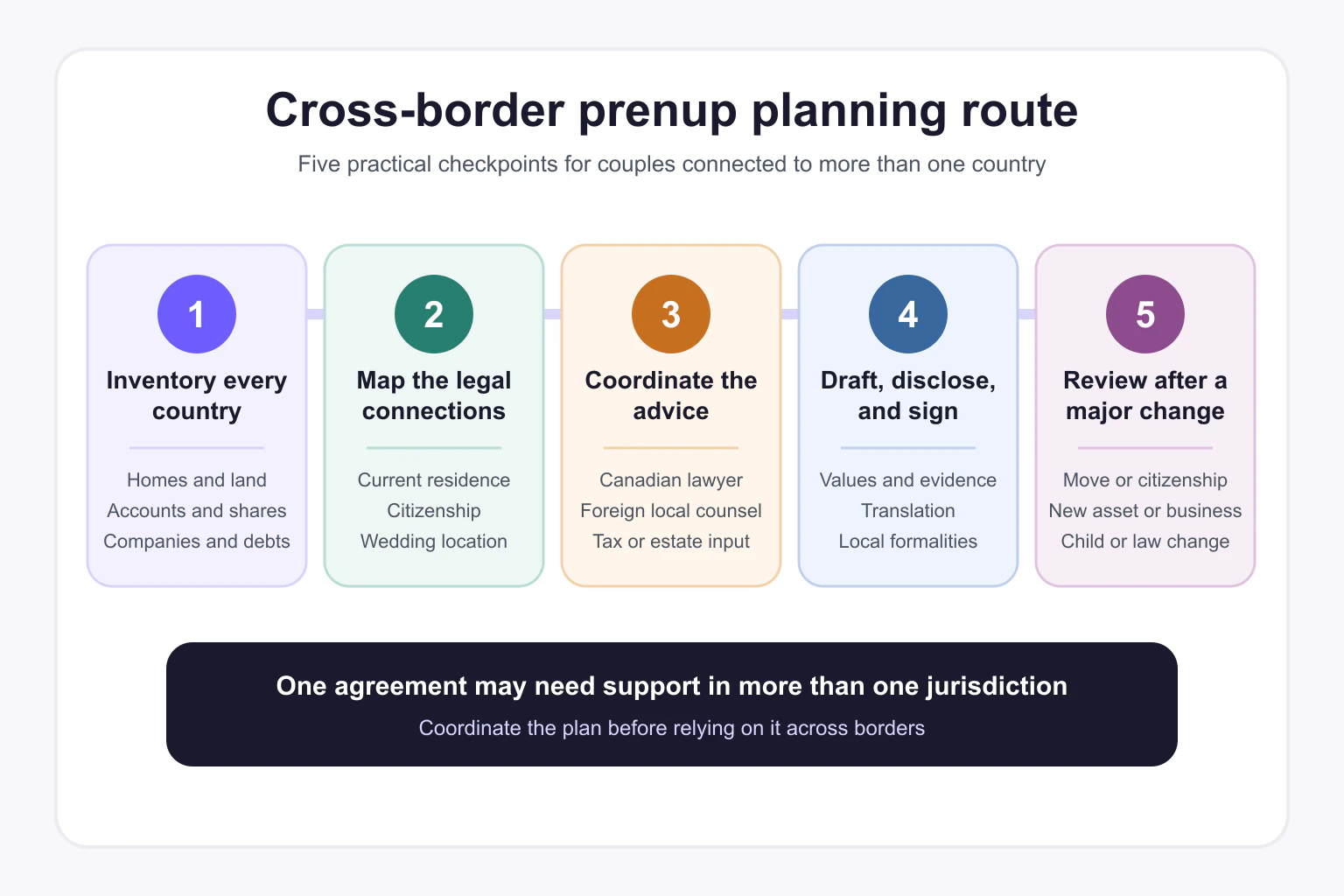
A practical seven-step process
1. Draw the legal map
List current residence, planned residence, citizenships, domicile concerns, wedding location, signing location, and every country containing a significant asset or debt.
2. Gather records before drafting
Complete the foreign asset schedule, obtain current statements, and identify documents that need translation or valuation.
3. Choose the Canadian home base
Ask which province has the strongest current connection and whether an expected move changes the drafting plan. Use the province's terminology and signing requirements.
4. Identify foreign advice early
The Canadian lawyer can help decide whether local foreign counsel is needed. Contact that professional early enough to comment on recognition, land, tax, estate, and signing issues before the agreement is final.
5. Give each partner independent time and advice
Each partner should understand the rights being changed and the practical effect in each important jurisdiction. Separate advice is especially important when language, wealth, immigration status, or access to records creates an imbalance.
Prenuply's independent legal advice guide explains what Canadian review often involves.
6. Complete every required formality
Follow the Canadian province's requirements and any additional local process recommended abroad. Keep the final agreement, schedules, certificates, acknowledgements, translations, and advice records together.
7. Set review triggers
Review the agreement after:
- a permanent move to another province or country;
- a new citizenship or domicile;
- purchase or sale of foreign real estate;
- creation, sale, or restructuring of a business;
- a major inheritance or trust distribution;
- the birth or adoption of a child;
- a long career break;
- a material change in wealth; or
- a relevant legal change.
A review clause does not automatically update the contract. It creates a prompt to obtain advice and make a valid amendment if needed.
Three common cross-border examples
Canadian resident with an apartment abroad
One partner owns a rental apartment in France before marriage. The couple should disclose the title, mortgage, rent, tax, value, and acquisition funds. Their lawyers can discuss ownership between the spouses, growth, mortgage payments made during marriage, sale proceeds, and whether French advice or a local agreement is needed.
Couple marrying abroad, then moving to Canada
The couple signs an agreement in the country where they marry and later settles in Ontario. An Ontario lawyer should review the agreement, the foreign signing process, its governing law, and Ontario sections 56 and 58. The original document and a reliable translation should be preserved.
Canadian couple planning an overseas assignment
The couple signs in Alberta, then expects to live in Singapore for several years while keeping Canadian investments. They should satisfy Alberta's lawyer acknowledgement requirements, obtain advice about the destination country's treatment of the agreement, and set a review trigger before or shortly after the move.
These examples are illustrations only. A change in one fact can change the legal analysis.
Frequently asked questions
Can a Canadian prenup cover property in another country?
It can record the spouses' rights and intentions concerning foreign property. Whether a court or registry abroad will recognize or implement those terms depends on the applicable law, jurisdiction, and local rules.
Do we need two prenups?
Sometimes one coordinated agreement is appropriate. In other situations, lawyers may recommend a Canadian agreement plus a compatible local agreement or instrument. Do not create two documents independently because inconsistent terms can make the plan less clear.
Which country should govern our prenup?
There is no universal answer. The lawyers need to consider residence, domicile, citizenship, wedding and signing locations, asset locations, expected moves, and each jurisdiction's conflict-of-laws rules.
Does the country where we marry control the prenup?
Not automatically. The wedding location is relevant to marriage formalities and may be one connecting factor, but it does not by itself settle every property, support, or enforcement question.
Should foreign assets be listed in Canadian dollars?
Use the original currency and a Canadian-dollar equivalent with a clear valuation date and exchange-rate source. Keep the supporting statement or appraisal.
What if my partner cannot read the agreement's language?
Arrange a reliable translation and legal advice in a language the partner understands. Keep evidence of the translated document and advice. Understanding is more important than merely obtaining a signature.
Can our prenup stop a foreign creditor?
Usually not by itself. A prenup allocates rights and responsibilities between partners. It generally does not remove a bank, tax authority, landlord, company, or other creditor's separate legal rights.
Can we use an online prenup for an international marriage?
An online tool can help organize decisions, create a Canadian working draft, and prepare disclosure. A cross-border couple should have the draft reviewed for the relevant Canadian province and ask whether foreign advice or additional local documents are needed.
Start with one complete cross-border file
The strongest first step is not choosing a governing-law clause. It is creating one accurate file that shows where the couple is connected, what each person owns and owes, what they want the agreement to accomplish, and which professionals need to coordinate.
Prenuply can help you prepare a customized Canadian prenup working draft and financial summary. For an international couple, treat that draft as the beginning of coordinated review, not the end of the legal process.
Last reviewed: July 29, 2026. Family, tax, estate, immigration, and private international law can change.
Sources checked
- Ontario Family Law Act
- British Columbia Family Law Act
- Alberta Family Property Act
- Civil Code of Québec
- Divorce Act, section 15.2
- Global Affairs Canada: Marriage outside Canada
- Canada Revenue Agency: Foreign Income Verification Statement
Prenuply AI Inc. is a technology company, not a law firm. Prenuply provides general legal information and document-preparation tools, not legal services. Obtain advice from qualified professionals in every relevant jurisdiction before relying on a cross-border agreement.