
Quick answer: A Canadian prenup may take only a short time to draft, but a careful agreement usually takes several weeks to finish. For planning purposes, many couples should allow at least 8 to 12 weeks, and start 3 to 6 months before the wedding when they own a home, business interests, investments, pensions, foreign property, or other complex assets.
There is no Canada-wide law that says every prenup must be signed a fixed number of days before the wedding. The real timeline depends on how quickly both partners exchange financial information, agree on terms, obtain separate legal advice, make revisions, and complete the provincial signing requirements.
The distinction matters: receiving a first draft is not the same as having a fully reviewed, negotiated, and signed marriage agreement.
Not legal advice: Family law and signing requirements vary by province. This article provides general planning information. Each partner should consider advice from a separate family lawyer in the province whose law will apply.
How long does a prenup take in Canada?
A straightforward prenup can sometimes move from first conversation to signing within four to eight weeks. Eight to twelve weeks is a more comfortable planning window for many couples. Complex agreements may take three to six months or longer.
These are planning ranges, not legal deadlines or service guarantees.
| Situation | Practical planning range | Why it may take this long |
|---|---|---|
| Finances are simple and the couple already agrees on the main terms | 4 to 8 weeks | Disclosure, one or two draft rounds, separate lawyer review, and signing still need coordination |
| One partner owns a home, investments, or a pension | 8 to 12 weeks | Valuations, tracing, home clauses, tax questions, and negotiations can add time |
| A business, trust, stock options, foreign assets, or a second marriage is involved | 3 to 6 months or more | Professional valuations, corporate records, estate planning, and advice in more than one area of law may be required |
| The wedding is less than four weeks away | Get legal advice immediately | A rushed process can limit meaningful review and create pressure concerns |
The fastest route is not necessarily the one with the fewest days. A process is efficient when each step is organized and neither partner is forced to skip disclosure, reflection, or advice.
Why the full process takes longer than the first draft
Online tools can shorten the questionnaire and first-draft stage. A lawyer may also prepare a first draft quickly when the issues are clear. Neither result means the agreement is ready to sign.
Four separate clocks are usually running:
- The information clock: How long does it take to locate statements, values, tax records, and ownership documents?
- The decision clock: How long do the partners need to agree on the home, debts, support, future assets, inheritances, and other terms?
- The review clock: When can each partner meet with a separate lawyer, receive advice, and request changes?
- The wedding clock: Is there enough time before the ceremony for a voluntary decision without a last-minute ultimatum?
A draft can be produced before the first three clocks have finished. Signing at that point may create a neat document with an incomplete process.
Prenuply helps couples prepare an organized agreement template for lawyer review. It does not replace the disclosure, negotiation, or independent advice that may be appropriate for the couple.
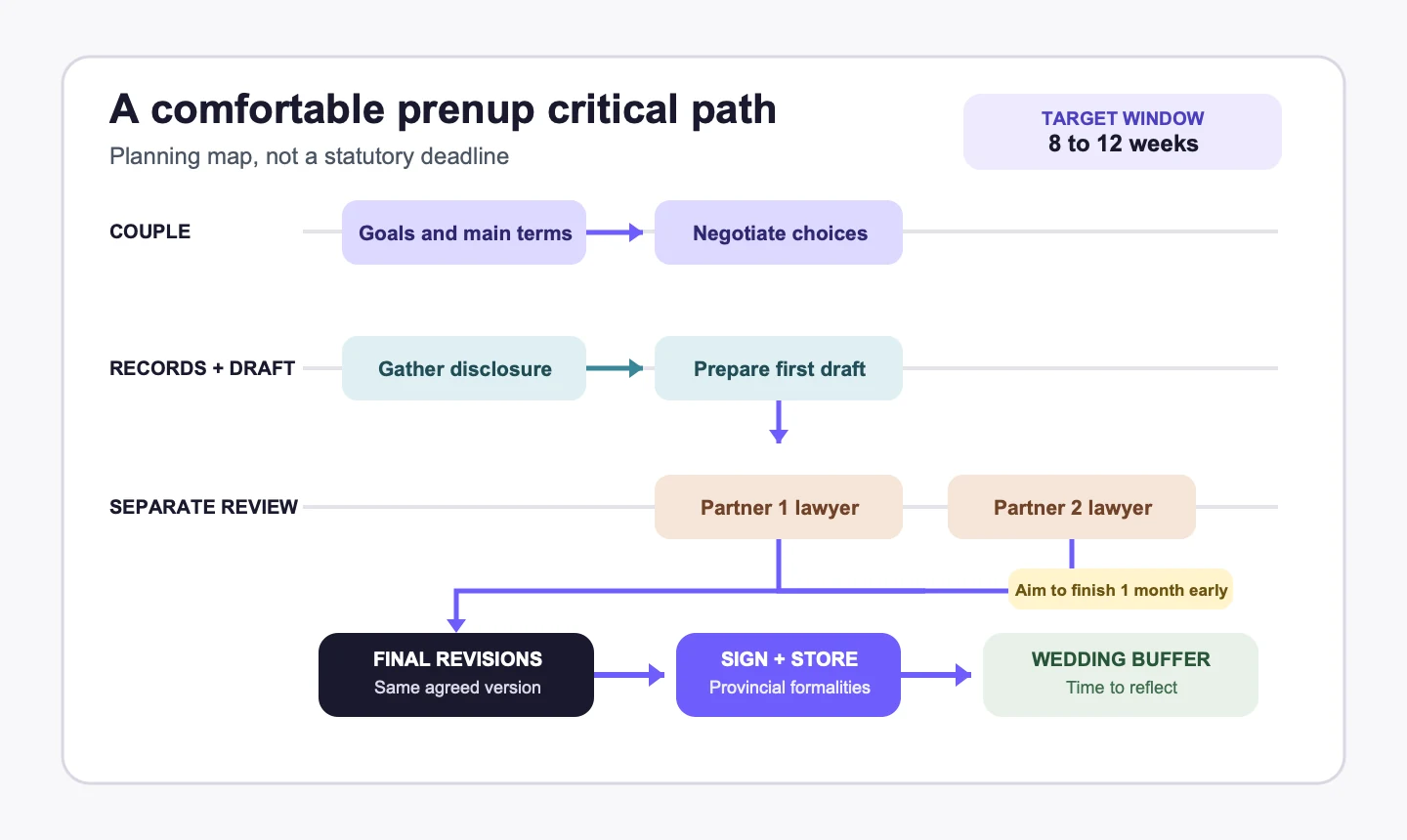
A realistic step-by-step prenup timeline
1. Agree on the purpose and scope: 3 to 7 days
Begin with the problems the agreement should solve, not with legal clauses.
Useful opening questions include:
- What does each partner want to keep separate?
- Will either partner own the family home?
- How should mortgage payments, renovations, or a down payment be treated?
- Are there business interests, family gifts, inheritances, pensions, or stock compensation to protect?
- Will one partner take parental leave or make a long-term career sacrifice?
- Does either partner have significant debt or a personal guarantee?
- What should happen if the couple moves to another province?
The goal is not to settle every detail in one conversation. It is to identify the topics so the draft does not have to be rebuilt later.
If the conversation feels difficult, Prenuply's guide on how to talk about a prenup without starting a fight offers a calmer structure.
2. Gather financial disclosure: 1 to 3 weeks
This is one of the most common sources of delay.
Each partner should prepare an understandable picture of assets, debts, income, and material obligations. Depending on the circumstances, that may include:
- recent bank and investment statements;
- RRSP, TFSA, pension, and locked-in account information;
- mortgage statements, title documents, and property tax records;
- credit cards, student loans, lines of credit, tax debts, and guarantees;
- corporate financial statements and share records;
- stock-option, restricted share unit, and other equity compensation documents;
- trust, inheritance, cottage, and family-loan information;
- crypto wallets and exchange records;
- life insurance and beneficiary designations; and
- current values or a clear explanation of how an estimate was calculated.
Older statements, private-company values, and foreign records can take longer to obtain. Start requesting them before the first draft is finished.
Ontario's Family Law Act allows a court to set aside all or part of a domestic contract in circumstances that include failure to disclose significant assets, debts, or liabilities existing when the contract was made. British Columbia's Family Law Act similarly identifies failure to disclose significant property, debt, or relevant information as a ground a court can consider under section 93.
For a detailed list, use the Canadian prenup financial disclosure checklist.

3. Prepare the first draft: a few days to 2 weeks
The timing depends on the route.
- A guided online service can make the questionnaire and template stage faster.
- A lawyer-drafted agreement may take longer, particularly if the lawyer must analyze a business, trust, foreign property, or unusual support arrangement.
- A do-it-yourself draft may appear fast but create delays later if important clauses, province rules, or financial schedules are missing.
A good first draft should reflect the couple's decisions and use the correct provincial framework. It should not invent values, hide unresolved issues, or treat child support and parenting terms as ordinary property clauses.
If you are comparing routes, see Can You Write Your Own Prenup in Canada?.
4. Negotiate and revise: 1 to 4 weeks, sometimes longer
Most thoughtful prenups need changes.
One partner may want to keep a home separate while the other wants recognition for future mortgage or renovation contributions. A business owner may want growth excluded, while the other partner wants protection for caregiving or lost career opportunities. A complete waiver of spousal support may be replaced with a formula, review trigger, or limited entitlement.
The negotiation is faster when partners discuss principles before line editing. For example:
- distinguish property owned before marriage from growth during marriage;
- decide whether future contributions create reimbursement, ownership, or no interest;
- use clear valuation dates and methods;
- identify review events such as a child, disability, move, business sale, or home purchase; and
- write down unresolved questions for the lawyers instead of arguing from assumptions.
The goal is not to make both sides identical. It is to create terms each partner understands and chooses after accurate disclosure. The article What Is a Fair Prenup in Canada? explains practical ways to test whether proposed terms are balanced.
5. Obtain separate legal review: 1 to 3 weeks
Each partner should have a real opportunity to consult a different lawyer.
Appointments, conflict checks, document review, disclosure questions, advice letters, and proposed revisions all take time. A lawyer may need more information before advising a client to sign. If one partner books a review only after the other has finalized the document, the schedule can slip quickly.
Independent legal advice is not a box to check in a rushed video call. It helps a partner understand:
- the rights provincial law would otherwise provide;
- which rights the agreement changes or waives;
- the practical effect of home, property, debt, and support clauses;
- whether the disclosure is sufficient;
- what future circumstances the agreement does not address; and
- whether the person is signing voluntarily.
Alberta deserves special attention. Sections 37 and 38 of the Family Property Act set out formal requirements for property agreements, including written acknowledgements made separately before lawyers. Each acknowledgement must be made before a lawyer other than the lawyer acting for the other party or receiving the other party's acknowledgement. Those appointments should be planned, not left to the wedding week.
Prenuply's independent legal advice guide explains what to bring and what the review may cover. Couples who need help locating separate counsel can also review Prenuply's lawyer review options.
6. Finalize, sign, and store: 1 to 2 weeks
After both reviews, allow time to:
- reconcile requested changes;
- update disclosure schedules;
- proofread names, dates, defined terms, and cross-references;
- confirm the correct witnesses or lawyer acknowledgements;
- sign the same final version;
- provide a complete copy to each partner; and
- store the agreement and its disclosure records securely.
Do not assume every province uses the same formalities.
In Ontario, section 55 of the Family Law Act says a domestic contract is unenforceable unless it is in writing, signed by the parties, and witnessed. In British Columbia, section 93's statutory agreement framework addresses a written property agreement with each spouse's signature witnessed. Alberta has the lawyer-acknowledgement requirements described above.
In Quebec, the process is different. The Government of Quebec states that a marriage contract must be notarized, signed before a notary, and followed by registration of a notice in the register of personal and movable real rights. The province also confirms that a marriage contract may be signed before or after the marriage.
There is no universal Canadian 30-day rule
You may hear that a prenup must be signed 30 days before the wedding. That is a useful risk-management target in many situations, but it is not a Canada-wide statutory rule.
Ontario, British Columbia, Alberta, and Quebec do not use one shared countdown. Their laws focus on different formalities and circumstances, including disclosure, understanding, voluntariness, witnessing, lawyer acknowledgements, notarization, and fairness.
Timing still matters. A draft presented after deposits are paid, guests are travelling, and cancellation feels impossible may create much more practical pressure than the same proposal discussed six months earlier. A court considering a later challenge can look at the full process, not simply the date beside the signatures.
The better planning rule is:
Start early enough that either partner can ask questions, obtain records, receive separate advice, propose changes, and decline to sign without an immediate wedding crisis.
For many couples, aiming to finish at least one month before the wedding creates a useful buffer. Complex cases should aim earlier.
What makes a prenup take longer?
A home with unequal contributions
The couple may need to decide how to treat the down payment, mortgage principal, appreciation, renovations, sale proceeds, and a possible buyout. Ontario matrimonial-home rules require special care.
A private business or professional corporation
The process may require corporate financial statements, shareholder agreements, tax advice, a valuation method, and rules for retained earnings or future growth.
Stock options, RSUs, or carried interest
Equity compensation can involve grant dates, vesting, liquidity events, tax withholding, and employer restrictions. A simple account balance may not describe the asset.
A second marriage or children from an earlier relationship
The prenup should be coordinated with wills, trusts, beneficiary designations, insurance, and estate-planning goals. A prenup is not a substitute for a will.
Foreign property or a likely move
The partners may need advice in more than one jurisdiction. Choice-of-law language alone does not guarantee that another court will apply every term.
Disagreement about support or future caregiving
Support waivers and career-sacrifice issues often require careful discussion. Terms that seem simple before children or disability may have very different effects later.
Missing or outdated records
A forgotten pension statement, undocumented family loan, or unavailable business valuation can pause the process. A short disclosure list prepared at the start saves time later.
How to speed up a prenup without weakening the process
You can reduce avoidable delay without rushing consent.
- Book separate lawyers early. Do not wait for the final draft to look for appointments.
- Create one disclosure index. List every asset, debt, value date, document, and missing item.
- Agree on principles first. Settle the approach to the home, debt, business, support, and future changes before debating wording.
- Use one source of truth. Keep a dated version log so both lawyers review the same draft.
- Answer questions in batches. Consolidated responses reduce email cycles and inconsistent instructions.
- Separate tax and valuation work. Send specialist questions to an accountant or valuator promptly.
- Protect the signing buffer. Treat the target signing date as earlier than the wedding deadline.
An organized online draft can reduce blank-page time. It should make the next steps easier, not be used to bypass them.
What if the wedding is less than a month away?
Do not hide the date or pressure the other partner to sign.
Take these steps:
- Tell both lawyers the exact wedding date immediately.
- Exchange the available financial disclosure now.
- Identify missing records and disputed terms.
- Ask whether a careful pre-wedding process is still realistic.
- Consider postponing the signing if either partner lacks time to understand or negotiate.
- Obtain advice about a marriage contract signed after the wedding if appropriate in your province.
Ontario law allows people who are already married, as well as people who intend to marry, to enter a marriage contract. Quebec also permits a marriage contract after marriage, with the contract taking effect when it is signed. Other provincial rules and consequences differ.
Waiting until after the wedding is not a guarantee that an agreement will be upheld, and one partner cannot be forced to sign later. It may still be safer than manufacturing a last-minute process. See the dedicated guide to a last-minute prenup in Canada and the explanation of marriage contracts after marriage.
A prenup readiness checklist
Before calling the agreement ready to sign, confirm that:
- both partners know the wedding date and target signing date;
- both partners had meaningful input into the terms;
- assets, debts, income, and significant obligations were disclosed;
- key values have dates and supporting records;
- the agreement addresses the home, debts, support, and relevant future assets;
- business, pension, tax, estate, and foreign-property questions were sent to appropriate professionals;
- each partner had the opportunity to obtain separate legal advice;
- requested changes were resolved or clearly declined;
- the final version matches the disclosure schedules;
- provincial witnessing, lawyer, or notarial requirements are arranged;
- neither partner is signing under an immediate wedding ultimatum; and
- each partner will receive and retain a complete signed copy.
If several boxes remain open, the process is not finished just because a draft exists.
Frequently asked questions
Can a prenup be completed in one week?
A first draft may be produced within a week, especially when the finances and instructions are simple. Completing meaningful disclosure, negotiation, separate legal review, revisions, and signing in that period is much harder. Ask province-specific lawyers whether the timeline is appropriate rather than assuming speed makes the agreement ready.
How far before a wedding should we start a prenup?
Starting three to six months before the wedding gives many couples useful room. Eight to twelve weeks may be workable for a straightforward agreement when both partners are organized and largely aligned. Complex assets or significant disagreement justify more time.
How long before the wedding should a prenup be signed?
There is no universal Canadian number of days. Many couples aim to finish at least one month before the wedding as a practical buffer, not because every province imposes a 30-day rule. The right target depends on disclosure, complexity, advice, negotiation, and local law.
Do both partners need their own lawyer?
Separate legal advice is strongly recommended because the partners' interests may differ. It helps show that each person understood the agreement and had an independent opportunity to assess it. Alberta's statutory property-agreement formalities specifically require separate written acknowledgements before different lawyers in the circumstances covered by sections 37 and 38.
Does a prenup need to be notarized?
Quebec marriage contracts must be notarized. Other provinces use different requirements. Ontario domestic contracts must be written, signed, and witnessed. British Columbia and Alberta have their own statutory rules. Do not copy the signing page from another province.
Can we sign a prenup after the wedding?
Couples in several provinces can enter a marriage contract after marriage, often called a postnuptial agreement or postnup in everyday language. The legal effect and process depend on the province. It is not the same as backdating a prenup.
How long does a prenup last?
A prenup does not usually expire merely because time passes unless its own terms create an expiry or sunset clause. Review it after major events such as a child, home purchase, move, inheritance, business sale, disability, or major income change.
The best timeline protects the decision, not just the date
A good prenup schedule leaves enough room for facts, questions, advice, and voluntary choices. Drafting can be fast. The complete process should be as long as the couple's circumstances require.
If your wedding is months away, start with the financial inventory and main terms now. If it is close, be candid about the date and obtain legal advice before rushing. Prenuply can help you create an organized Canadian prenup template for review, while each partner retains control over the negotiation and signing decision.