
A prenup with no assets in Canada can sound like a contradiction. You are engaged, your savings account is modest, neither of you owns a home, and your car may be the most valuable thing on your balance sheet. Is an agreement still worth discussing?
Sometimes, yes. A Canadian prenup is not only an inventory of wealth you already have. It can also set rules for debt, a future home, business growth, career changes, family gifts, and the financial effect of one partner taking time away from work.
But a prenup is not automatically worthwhile for every couple. If your finances are simple, your expectations are aligned, and you are comfortable with the default family law rules in your province, the cost and effort may outweigh the immediate benefit.
This guide gives you a practical way to decide. It is general legal information, not legal advice. Family law and signing requirements differ across Canada, so take a final draft to qualified professionals in your province.
Quick answer: do you need a prenup if you have no assets?
Having no significant assets today does not make a prenup pointless. It changes the question you should ask.
Instead of asking, “What property do we need to protect right now?”, ask:
- Do either of us have meaningful debt?
- Are our careers, incomes, or future earning paths likely to be very different?
- Do we expect to buy a home with unequal contributions?
- Could either of us start or inherit a business?
- Are parents likely to help with a down payment or other large gift?
- Might one partner pause work, relocate, or reduce hours for the family?
- Would we prefer our own written rules to the default rules in our province?
If several answers are yes, a prenup may have real value even if your current net worth is close to zero. If every answer is no and your finances are likely to remain straightforward, you may decide to wait, learn the default rules, and revisit the decision before a major financial change.
For the broader decision, see Do I Need a Prenup in Canada? 10 Signs It Makes Sense.
Why “no assets” can be the wrong test
Net worth is a snapshot. Marriage is a long financial timeline.
Two people can start with little and build a very different financial life over the next five, ten, or twenty years. The issues that later create conflict are often not visible in the wedding-year balance sheet.
1. Future assets may become more important than current assets
A couple with no real estate or investments today may later acquire:
- a first home or rental property
- RRSPs, TFSAs, workplace pensions, or stock compensation
- a professional practice or incorporated business
- intellectual property, royalties, or a valuable online business
- a family cottage interest
- gifts or inheritance from relatives
A carefully drafted agreement can identify categories of future property, explain whether growth or income will be shared, and create record-keeping rules. It can also include review points so the couple does not rely on a document that no longer fits their life.
That does not mean a prenup can predict every future asset or guarantee how a court will treat every clause. The goal is a clear framework, supported by disclosure and proper legal review. Read more in Can a Prenup Protect Future Assets in Canada?.

2. Debt can matter even when property does not
Student loans, credit cards, tax debt, personal guarantees, and business debt can affect a household long before a couple accumulates wealth.
A prenup may clarify, as between the partners:
- which pre-existing debts remain separate
- whether joint money will be used to repay one partner's debt
- how new joint debt will be approved
- what happens if one partner guarantees a business loan
- how reimbursements will be handled if one partner pays the other's obligation
The agreement does not erase a debt, change a lender's contract, or protect a co-signer from a creditor. It governs expectations between partners, not the bank's rights. Our guide to prenups when one partner has significant debt explains that distinction in more detail.
3. A first home can create unequal contributions quickly
Many couples who have little today are saving toward the same next milestone: a home.
One partner may later contribute more of the down payment. Parents may provide a gift or loan. One person may cover the mortgage while the other pays other household costs. Renovations, title, appreciation, and a future buyout can all become important.
A prenup can establish a process before the money arrives. For example, it may require the couple to document family contributions, record percentages, or sign a home-specific schedule when they buy.
Province-specific rules still matter. Ontario's matrimonial home rules are a notable example, because a marriage contract cannot limit every statutory right connected with possession of a matrimonial home. A family lawyer should review home clauses before you rely on them.
4. Career paths rarely grow at the same speed
“We both have no assets” can hide a major difference in future earning potential.
One partner may be finishing medical residency, building a skilled trade, joining a startup, or expecting equity compensation. The other may plan to relocate, support the household during training, or take parental leave later.
A fair prenup does not have to protect only the future higher earner. It can also address the economic effect of unpaid caregiving, career interruption, or a move that benefits one partner's work. Options may include support terms, review clauses, reimbursement arrangements, or rules that change after a certain number of years.
The best question is not “Who might become richer?” It is “What would feel fair if our contributions take different forms?”
5. Family money may arrive after the wedding
Parents and grandparents increasingly help with down payments, education, business funding, and inheritance. A couple may own little personally while still expecting meaningful family support.
An agreement can help distinguish:
- a true gift from a repayable family loan
- a gift to one partner from a gift to both
- the original contribution from later growth
- separate property from money intentionally placed into joint ownership
- records the couple should keep to trace the funds
This planning should be coordinated with title documents, loan agreements, wills, and tax advice. A prenup should not be treated as a substitute for those documents.
When a prenup may not be worth the cost right now
An honest SEO guide should not tell every reader to buy the product.
A prenup may be a lower priority if:
- both partners have similarly simple finances and little debt
- neither expects a major inheritance, business, family gift, or unequal home contribution
- both understand and accept the default rules in their province
- there is no realistic time for disclosure and separate legal review before the wedding
- the legal and review cost would create financial strain that outweighs the present benefit
- the couple wants only lifestyle rules that a family contract should not try to enforce
Waiting is not the same as ignoring the issue. You can document your starting finances, learn the law that would apply without an agreement, and choose a specific review trigger, such as buying a home or starting a business.
There is one practical caution: creating or changing an agreement after marriage can be possible, but the process and bargaining context are different. If you are already married, read Can You Get a Prenup After Marriage in Canada?.
A decision table for couples starting from zero
| Your situation | What an agreement could clarify | What to do next |
|---|---|---|
| Both have modest income and no debt | Future property rules and review triggers | Compare the benefit with the cost, then learn your province's defaults |
| One has large student or business debt | Separate debt, repayment, guarantees, and reimbursements | Gather current balances and lender documents |
| You plan to buy a home with unequal deposits | Down payment records, title expectations, expenses, and exit process | Discuss the plan before money changes hands |
| One expects a fast-growing career or equity | Treatment of future assets, business growth, and career sacrifice | Use flexible clauses and scheduled reviews |
| Parents may provide money | Gift versus loan, intended recipient, tracing, and growth | Coordinate the agreement with a gift or loan letter |
| One may pause work for caregiving | Support, compensation, review points, and fairness | Model more than one future scenario |
The table is a conversation starter, not a substitute for province-specific advice.
What can a prenup cover when the starting balance is zero?
A useful agreement can still contain specific, testable rules.
Current facts
Even a short disclosure schedule can record:
- chequing and savings balances
- student loans, credit cards, tax debt, and lines of credit
- pensions, employee plans, options, or restricted share units
- vehicles, valuable equipment, or intellectual property
- current income and employment
- family loans or guarantees
“Nothing” should not be shorthand for “we did not check.” If an account has a small balance, list it accurately. If a category is genuinely zero, record that too.
Future property categories
Depending on provincial law and the final drafting, an agreement may address future homes, investments, businesses, professional practices, gifts, inheritance, or growth in property.
Avoid vague promises such as “everything in my name is always mine.” The agreement should define categories, deal with joint contributions, and explain what happens when separate property is mixed with shared money.
Debt rules
The agreement can define separate and joint debt between the partners. It can also create consent rules for major borrowing and a reimbursement process.
Again, those terms do not bind creditors. Do not co-sign or guarantee a loan based only on what the prenup says.
Support and fairness mechanisms
Spousal support is complex and can be reviewed by a court. A draft may include a waiver, limit, formula, review trigger, or no predetermined outcome. Which approach is appropriate depends on the province, the relationship, and whether future caregiving or career sacrifice is foreseeable.
Review clauses
Review clauses are especially useful for couples starting with little. They can prompt a new discussion after:
- buying a home
- starting or selling a business
- receiving a large gift or inheritance
- the birth or adoption of a child
- a major relocation
- one partner leaving the workforce
- a fixed number of years
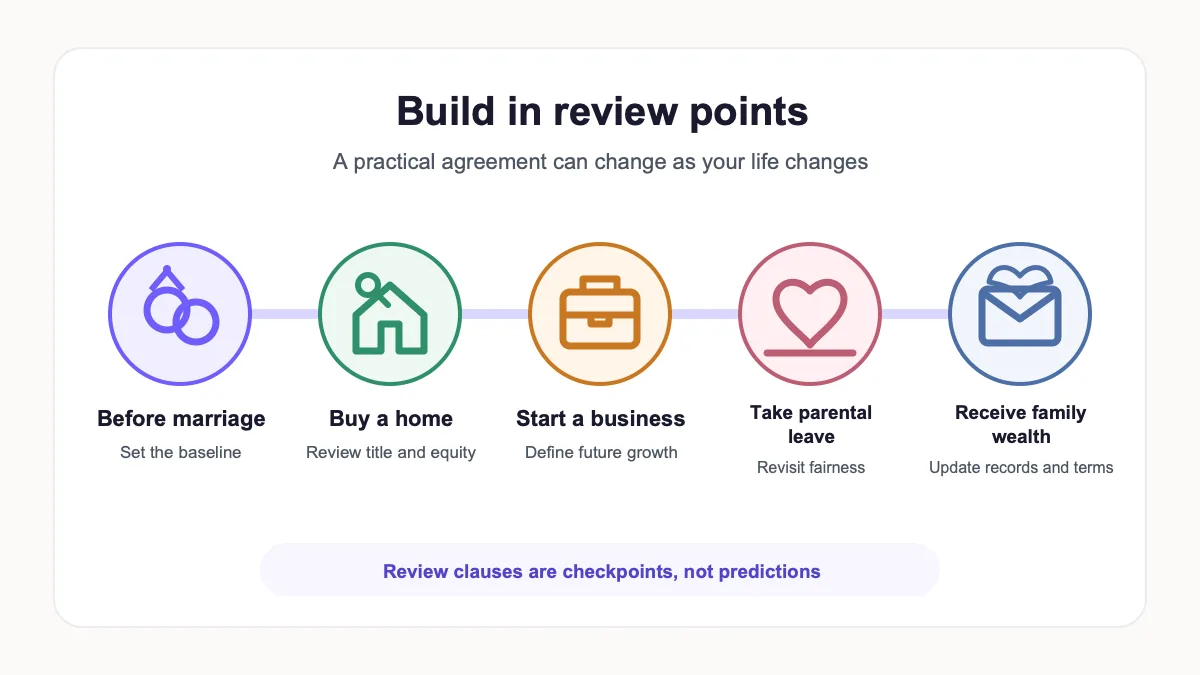
A review clause does not automatically update the agreement. It creates a checkpoint. Any amendment should follow the legal formalities that apply in your province.
What a prenup cannot safely solve
Even a well-prepared agreement has boundaries. It generally should not be used to:
- predetermine future parenting time or decision-making responsibility
- contract out of child support in a way that conflicts with the law
- hide assets, debts, or important financial information
- eliminate a lender's or creditor's rights
- guarantee that every term will be enforced years later
- replace a will, shareholder agreement, title document, or tax plan
- avoid province-specific witnessing, legal advice, or notarial requirements
For a detailed drafting filter, see What Cannot Be Included in a Prenup in Canada?.
Province snapshot: the process still matters when assets are small
The value of your property does not remove the formal requirements or fairness concerns around the agreement.
Ontario
Ontario calls the agreement a marriage contract. The Family Law Act allows people who are married or intend to marry to agree on property and support matters. Domestic contracts must be in writing, signed, and witnessed. A court may set aside all or part of a contract for significant non-disclosure, lack of understanding, or other contract-law reasons.
Ontario also has special matrimonial home rules. Do not assume that a simple separate-property sentence controls every right connected with the family home.
British Columbia
BC's Family Law Act permits spouses to make agreements about family property and debt, including unequal division or exclusion of property. For the statutory property agreement rules, the agreement must be written and each signature witnessed. A court can consider non-disclosure, vulnerability, understanding, and significant unfairness when asked to set an agreement aside.
Alberta
Alberta's Family Property Act expressly contemplates written agreements covering property owned now or acquired later. Sections 37 and 38 set formal requirements for contracting out of the statutory property rules. Each party must make a written acknowledgment, apart from the other, before a different lawyer.
Quebec
Quebec uses a different civil-law framework. The Government of Quebec's marriage contract guidance states that a marriage contract must be notarized and signed before a notary. It may address the matrimonial regime and certain gifts, but family patrimony rules still matter.
A downloadable template by itself is not a completed Quebec marriage contract.
If you live elsewhere in Canada, use the same principle: check the legislation and signing process for your province or territory before relying on a draft.
How to create a useful draft when you own very little
Step 1: write down the reason
Finish this sentence separately, then compare answers:
“We are considering an agreement because we want clarity about…”
Debt, a future home, family money, a business, and caregiving all lead to different clauses. If you cannot identify the problem, do not start by collecting random legal language.
Step 2: learn the default rules
A prenup changes or clarifies what would otherwise happen. You cannot evaluate the tradeoff until you understand the baseline in your province.
Step 3: disclose the real starting point
Prepare a short list of assets, debts, income, pensions, equity compensation, and guarantees. Use exact balances and recent statements. Our Canadian prenup financial disclosure checklist can help.
Step 4: discuss scenarios, not just ownership labels
Ask what should happen if:
- one income doubles
- a parent funds the first home
- one person leaves work for two years
- a side business becomes valuable
- you move to another province
- a separate asset is used for a shared goal
Scenario testing exposes gaps that a list of “mine” and “yours” can miss.
Step 5: include review triggers
Choose events that should cause a fresh discussion. Put reminders in your calendar and keep the signed agreement with the disclosure records.
Step 6: leave enough time
Do not present a surprise draft days before the wedding. Time supports real negotiation, complete disclosure, and informed legal review. If you need help starting the conversation, use How to Talk About a Prenup Without Starting a Fight.
Step 7: get separate professional review
An online tool can help you organize decisions and create a structured draft. It does not replace a lawyer or, in Quebec, the required notarial process. Separate advice can help each partner understand the rights, risks, and consequences. Read Independent Legal Advice for Prenups in Canada before signing.
FAQ
Are prenups only for rich people?
No. Wealth is one reason to consider an agreement, but debt, a future home, business plans, family contributions, and career sacrifice can also create a need for clarity. The value must still justify the cost and effort for your circumstances.
Can a prenup protect income earned after marriage?
An agreement may address how future earnings, savings, investments, or business growth will be treated, subject to provincial law and court review. A broad sentence about “all future income” may not produce the result you expect. Define the rule, consider fairness, and obtain legal advice.
What if one partner has assets and the other has none?
That is a common reason to discuss an agreement, but the process should not protect only one side. Full disclosure, enough time, separate advice, and fair treatment of future contributions are important. The partner with fewer assets may need protection if they relocate, support training, or pause work for the family.
Can a prenup deal with student loans?
It can clarify responsibility between the partners and how repayment will be funded. It cannot remove the borrower's obligation to the lender or protect a co-signer from the loan contract.
Do both partners need lawyers?
Requirements vary. Independent legal advice is strongly recommended across Canada, Alberta has specific separate-lawyer acknowledgments for agreements under its Family Property Act, and Quebec marriage contracts must be notarized. Separate review also helps show that each person understood the agreement and signed voluntarily.
Can we make an agreement after we build assets?
Often yes, but waiting can make negotiations more complicated, especially after a home purchase, business launch, family gift, or marriage. If you wait, choose a clear review date and avoid mixing funds without records.
Is an online prenup useful if lawyers still review it?
Yes. A guided online draft can help you organize disclosure, identify decisions, and give lawyers a clearer starting point. It should be viewed as preparation for legal review, not a replacement for it. See Online Prenup Canada: Is It Legal and Do You Need a Lawyer?.
Bottom line
You do not need to be wealthy for a prenup conversation to be useful. Couples with few current assets may still have debt, uneven career paths, a first home ahead, family assistance, or a business idea that changes the financial picture.
The honest answer is not “everyone needs one.” It is this: compare the risks you can reasonably foresee with the cost and effort of creating a careful agreement. If the agreement would solve a real problem, build it around disclosure, flexible rules, review points, and separate professional advice.
If you are ready to organize your decisions, create a Canadian prenup draft with Prenuply, then take it to independent legal professionals in your province before signing.
Sources checked
This article was researched and checked on July 20, 2026 using the Ontario Family Law Act, the British Columbia Family Law Act, the Alberta Family Property Act, and Government of Quebec guidance on marriage contracts.
Prenuply AI Inc. is not a law firm and does not provide legal services or legal advice. Prenuply provides technology tools and general legal information to help users prepare agreement drafts for review with qualified legal professionals.