
A prenup can protect future assets in Canada, but only if the agreement is drafted with future growth in mind. Many couples focus on what each person owns today, then forget about what those assets might become: a business that grows, a house that gains equity, investments bought during the marriage, shares acquired later, or an inheritance that arrives years after the wedding.
The short answer is that a Canadian prenup can usually set rules for future assets, future increases in value, and property acquired after marriage. The harder answer is that the wording, disclosure, signing process, and province matter. A clause that says "each person keeps their own property" may not be enough for a growing company, mixed bank account, matrimonial home, or inherited money that later gets used for a shared purchase.
This guide explains what future assets mean, which assets couples should think about before signing, and how to make the agreement more useful before lawyer review.
What are future assets in a prenup?
Future assets are property interests that do not exist yet, or do not have their final value yet, when the prenup is signed.
Common examples include:
- a business that one partner owns before marriage but expects to grow
- shares, options, bonuses, or carried interest earned later
- real estate equity that increases during the marriage
- investment accounts built from future income
- a professional practice, partnership interest, farm, or rental portfolio
- an inheritance or family gift expected later
- proceeds from selling a protected asset and buying a replacement asset
- crypto or digital assets bought after marriage
- pensions, RRSPs, TFSAs, and other savings that grow over time
The planning issue is not only who owns the asset today. It is also what happens to growth, income, substitutions, reinvestments, debt tied to the asset, and records that prove where the value came from.
If you are still building your disclosure list, read Prenuply's financial disclosure checklist for Canadian prenups. Future asset protection starts with a clear snapshot of current assets, debts, income, and expectations.
Can a prenup cover property acquired after marriage?
Often, yes. Canadian provinces generally allow couples to make domestic contracts, marriage contracts, or family property agreements that deal with property rights and support obligations, subject to limits.
For example, Ontario's Family Law Act says spouses or future spouses can enter a marriage contract dealing with ownership or division of property, support obligations, and other settlement matters. The same Act says a domestic contract must be in writing, signed, and witnessed, and it gives courts grounds to set aside a contract where there was significant non-disclosure, lack of understanding, or other contract-law problems.
Alberta's Family Property Act is especially explicit about future property. Section 37 says a written agreement can apply to property owned by both parties and by each of them at or after the time the agreement is made, if the formal section 38 requirements are met.
British Columbia's property rules also show why future wording matters. The province explains that family property can include the amount of any increase in the value of excluded property since the relationship started. The BC Family Law Act includes the increase in value of excluded property in family property, while section 85 lists categories of excluded property such as pre-relationship property, inheritances, gifts, and property derived from those categories.
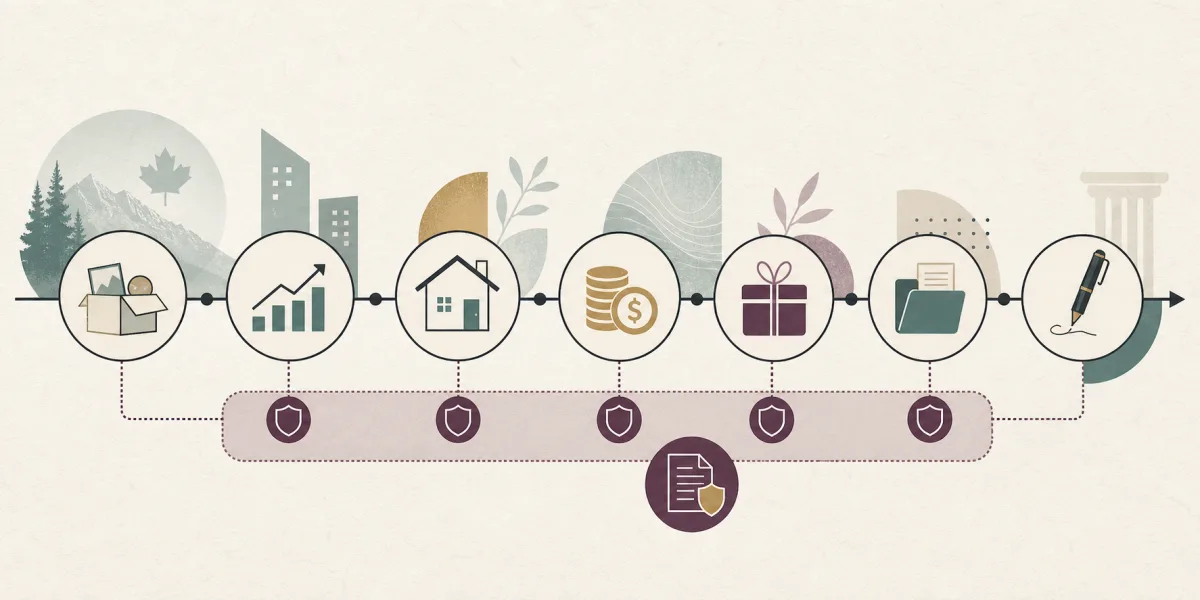
The practical takeaway is simple: do not assume that protecting the starting value automatically protects the future growth. The agreement should say what happens to both.
Future asset clauses couples often need
The right clauses depend on the couple, but these are common future-facing issues to discuss with lawyers.
1. Growth in a pre-marriage asset
One partner might own a business, condo, portfolio, or professional practice before marriage. The agreement can explain whether the starting value stays separate, whether growth stays separate, whether growth is shared, or whether only growth caused by joint contributions is shared.
This distinction matters because an asset may become much more valuable during the marriage. A business could add clients, a rental property could appreciate, or an investment account could compound. If the agreement only lists the asset without saying how increases are treated, the couple may still have a dispute later.
For business owners, see Prenuply's guide to prenups for entrepreneurs in Canada.

2. Replacement property and proceeds
Future asset protection can fail if an agreement protects the original asset but not what replaces it. For example, one partner might sell a condo owned before marriage and use the proceeds to buy a new home, invest in a business, or fund a joint account.
A stronger agreement can address:
- sale proceeds
- replacement property
- reinvested gains
- refinancing proceeds
- insurance proceeds
- assets bought with a mix of separate and joint funds
The more money moves, the more important the paper trail becomes.
3. Future income from a separate asset
An asset can generate income. A rental property may produce rent. A company may pay dividends. Investments may pay interest, dividends, or capital gains. A prenup can say whether that income is separate, shared, used for household expenses, or treated differently once deposited into a joint account.
Couples should be careful here. Future income can affect budgets, lifestyle, support expectations, taxes, and reinvestment plans. This is a legal and financial planning question, not just a simple ownership label.
4. Inheritances and family gifts received later
Many people sign a prenup before any inheritance has arrived. The agreement can still describe expected family wealth, gifts, trusts, and documentation steps.
The key questions are:
- Will a future inheritance remain separate?
- What if inherited money is used for a down payment?
- What if a parent gives money to both partners?
- What if the money is deposited into a joint account?
- What records should be kept to trace the inheritance?
If inheritance is a major concern, read Prenuply's article on protecting inheritance with a prenuptial agreement in Canada.
5. Future homes and the matrimonial home
Homes require special care, especially in Ontario. Ontario's Family Law Act says a provision in a marriage contract that tries to limit a spouse's rights under the matrimonial home part of the Act is unenforceable. That does not mean a prenup is useless for home planning, but it does mean couples need province-specific legal advice.
A future-home clause should usually address:
- who contributes the down payment
- whether title will be joint or separate
- mortgage responsibility
- renovations and repair costs
- how buyouts or sale proceeds are calculated
- how family gifts for the home are documented
- whether a prior home, replacement home, or new home is involved

For real estate scenarios, see Prenuply's guide to property investment prenups for Canadian couples buying property together.
Province-specific issues for future assets
Family property law is provincial. That means a future-assets clause should be reviewed in the province where the couple lives or expects the agreement to matter.
| Province | Future asset issue to flag |
|---|---|
| Ontario | Marriage contracts can address ownership and division of property, but matrimonial home rights have special limits and disclosure matters. |
| British Columbia | Excluded property is important, but increases in excluded property can be family property unless the couple plans otherwise by valid agreement. |
| Alberta | Family property agreements can cover property owned at or after the agreement, but section 38 lawyer acknowledgments are central to enforceability. |
| Quebec | Marriage contracts use a civil law framework and must be signed before a notary. Éducaloi explains that spouses can choose or change their matrimonial regime through a notarized contract. |
In Quebec, Éducaloi's page on marriage contracts says a marriage contract must be notarized, can be signed before marriage, and can also be signed after marriage. Quebec couples should not rely on common-law province terminology when planning future assets.
What makes future asset protection stronger?
A future-assets prenup is stronger when it is specific, documented, and reviewed before signature.
List today's values clearly
If an asset already exists, record its current value as carefully as possible. That might mean an appraisal, financial statement, account statement, tax return, cap table, mortgage balance, shareholder agreement, or business valuation. The goal is not perfection. The goal is a clear baseline.
Explain what happens to growth
Do not leave growth implied. Say whether future appreciation, retained earnings, passive investment gains, business expansion, replacement assets, or reinvested proceeds are separate or shared.
Track contributions
If one partner contributes labour, family income, debt repayment, renovations, unpaid business help, or childcare support that allows the other partner's asset to grow, lawyers may want to address that directly. A fair agreement can still protect future assets while acknowledging real contributions.
Keep separate records
Commingling is one of the biggest practical problems. If protected money is mixed into a joint account, used for shared expenses, or merged with other funds, it can become harder to trace later. A prenup can require separate accounts, written gift letters, annual statements, and records of transfers.
Update the agreement when life changes
Future assets are easier to plan than predict. Consider reviewing the agreement after major events, such as buying a home, starting a business, receiving an inheritance, having children, moving provinces, or changing careers.
What a prenup should not try to do
Future asset planning still has limits. A prenup should not try to lock in child support, make unfair surprise terms, hide assets, or guarantee an outcome that a court could never review.
Ontario's Family Law Act, for example, allows a court to set aside a domestic contract if a party failed to disclose significant assets or debts, did not understand the nature or consequences of the contract, or under other contract-law grounds. Similar practical themes appear across Canada.
For a deeper list of risky clauses, read what cannot be included in a prenup in Canada.
Can an online prenup help with future assets?
An online prenup tool can help if it does the right job. It should organize facts, prompt the couple to think about future assets, and create a draft that lawyers can review. It should not replace legal advice, especially where future business value, home equity, inheritances, trusts, pensions, or province-specific signing rules are involved.
Prenuply helps Canadian couples create a structured, province-aware prenup template that they can take to lawyers for review. If future assets are one of your main concerns, start a prenup draft while your current records are still easy to collect.
Future asset checklist before lawyer review
Before signing, gather:
- A list of current assets and debts for both partners.
- Current values, account statements, appraisals, or valuation notes.
- A list of assets expected later, such as inheritances, business shares, bonuses, gifts, or property purchases.
- Notes on whether future growth should be separate, shared, or partly shared.
- Documents showing down payment sources, family gifts, and loans.
- Records for businesses, partnerships, farms, professional practices, and rental properties.
- A plan for separate accounts, tracing, and replacement property.
- Questions for each partner's independent lawyer.
FAQ
Can a prenup protect money I earn after marriage?
It may be able to address how future income, savings, and investments are treated, but this is province-specific and fact-specific. Income can also affect support and lifestyle expectations, so get legal advice before relying on a simple income clause.
Can a prenup protect future business growth?
Often, a prenup can set rules for a business owned before marriage, future increases in value, retained earnings, dividends, shareholder loans, and sale proceeds. The agreement should be specific and reviewed by lawyers who understand the business structure.
Can a prenup protect an inheritance I have not received yet?
A prenup can describe how future inheritances and gifts should be handled, including separate accounts, tracing, and what happens if inherited money is used for a home or joint investment. The best wording depends on the province and the expected source of the inheritance.
What if we buy a house after signing the prenup?
The agreement can include future-home rules, but real estate is sensitive. In Ontario, matrimonial home rights have special limits. In every province, title, mortgage liability, down payment source, and occupation rights should be reviewed carefully.
Do we need separate lawyers?
Separate legal advice is strongly recommended. In Alberta, formal lawyer acknowledgments are especially important for family property agreements under section 38. Separate review also helps show each partner understood the agreement and had a real chance to ask questions.
Bottom line
A Canadian prenup can be a strong future asset planning tool, but only if it looks beyond the wedding-day balance sheet. The agreement should address growth, replacements, proceeds, income, homes, inheritance, records, and province-specific signing rules.
The next step is practical: list what each partner owns now, identify what could grow or arrive later, and create a draft that lawyers can review before signing. Future asset protection is not just about a clause. It is about disclosure, documentation, and a process that both partners understand.
This article provides general information about prenups and future assets in Canada. It is not legal advice. Prenuply AI Inc. is not a law firm and does not provide legal services. For advice about your specific situation, consult a qualified family lawyer in your province.