
Retirement savings can be one of the largest assets a couple has, even when it does not feel like cash today. An RRSP balance is visible on a statement. A defined benefit pension may look like a future monthly payment. CPP or QPP credits may not feel like property at all. But in Canadian family law, retirement savings can matter in a major way when spouses separate.
The short answer: a Canadian prenup, often called a marriage contract, can often address RRSPs, TFSAs, workplace pension growth, and other retirement savings. It cannot be drafted as a one-size-fits-all promise. Province-specific family property law, pension legislation, tax rules, plan administrator procedures, disclosure, fairness, and independent legal advice all matter.
This article is focused on prenup pensions Canada questions: what to list, what can often be addressed, where the limits are, and why pensions need more care than ordinary savings accounts.
Why retirement savings are different from ordinary bank accounts
A chequing account is simple to understand. You can see the balance, identify the owner, and transfer money if needed.
Retirement savings are different because they may involve:
- Tax deferral, such as RRSPs, RRIFs, PRPPs, and some pension transfers
- Contribution room, such as TFSAs and RRSPs
- Locked-in rules, such as LIRAs, LIFs, and many workplace pensions
- Employer contributions and matching
- Future income rights rather than a present cash balance
- Survivor benefits, bridge benefits, and early retirement subsidies
- Provincial pension statutes and plan administrator forms
- CPP or QPP public-law credit splitting rules
That is why a pension clause in a prenup should not simply say, “each spouse keeps their own pension.” That may express the intention, but it may not answer the harder questions: What was the pension worth at marriage? Is growth during marriage shared? What happens to employer contributions? Can anything actually be transferred? Is there a tax adjustment? What if the plan is federally regulated?
For a broader overview of the prenup process, see Prenuply’s guide on how to create a prenup in Canada.
Can a Canadian prenup cover pensions and RRSPs?
Often, yes. In many provinces, spouses can use a marriage contract to set expectations for property division, including retirement savings. Depending on the province and the facts, couples may address:
- RRSPs and spousal RRSPs
- TFSAs used for retirement planning
- Group RRSPs
- Defined contribution workplace pensions
- Defined benefit pensions
- Deferred profit sharing plans, or DPSPs
- Pooled registered pension plans, or PRPPs
- Locked-in retirement accounts, or LIRAs
- Locked-in RRSPs, LIFs, RRIFs, and annuities
- Employer matching and future contributions
- Public sector pensions
- Pension buybacks
- Pre-marriage balances and growth during marriage
The caution is that a prenup does not rewrite pension legislation or tax law. It also does not force a pension plan administrator to process a transfer that the governing statute, plan text, or required documents do not allow.
Think of the prenup as the couple’s property roadmap. Implementation may still require a separation agreement, court order, pension forms, tax forms, updated values, and professional advice if the relationship later breaks down.
The retirement accounts couples should list before signing
Before signing a prenup, couples should identify retirement assets carefully. This is not just about listing “pension” as one line item.
Retirement disclosure commonly includes:
- Individual RRSPs
- Spousal RRSPs, including contributor history
- TFSAs
- Non-registered investment accounts earmarked for retirement
- Group RRSPs through an employer
- Defined contribution pension balances
- Defined benefit pension statements and plan booklets
- DPSPs, PRPPs, LIRAs, locked-in RRSPs, LIFs, RRIFs, and annuities
- CPP or QPP contribution records
- Pension buyback rights or quotes
- Bridge benefits and early retirement subsidies
- Survivor benefits and beneficiary designations
- Any pension division estimates from a plan administrator
For a full asset and debt disclosure framework, use Prenuply’s broader financial disclosure checklist for prenups in Canada. For this article, the key point is that retirement savings should be disclosed by account type, plan type, owner or member, approximate value, date of value, and documents available.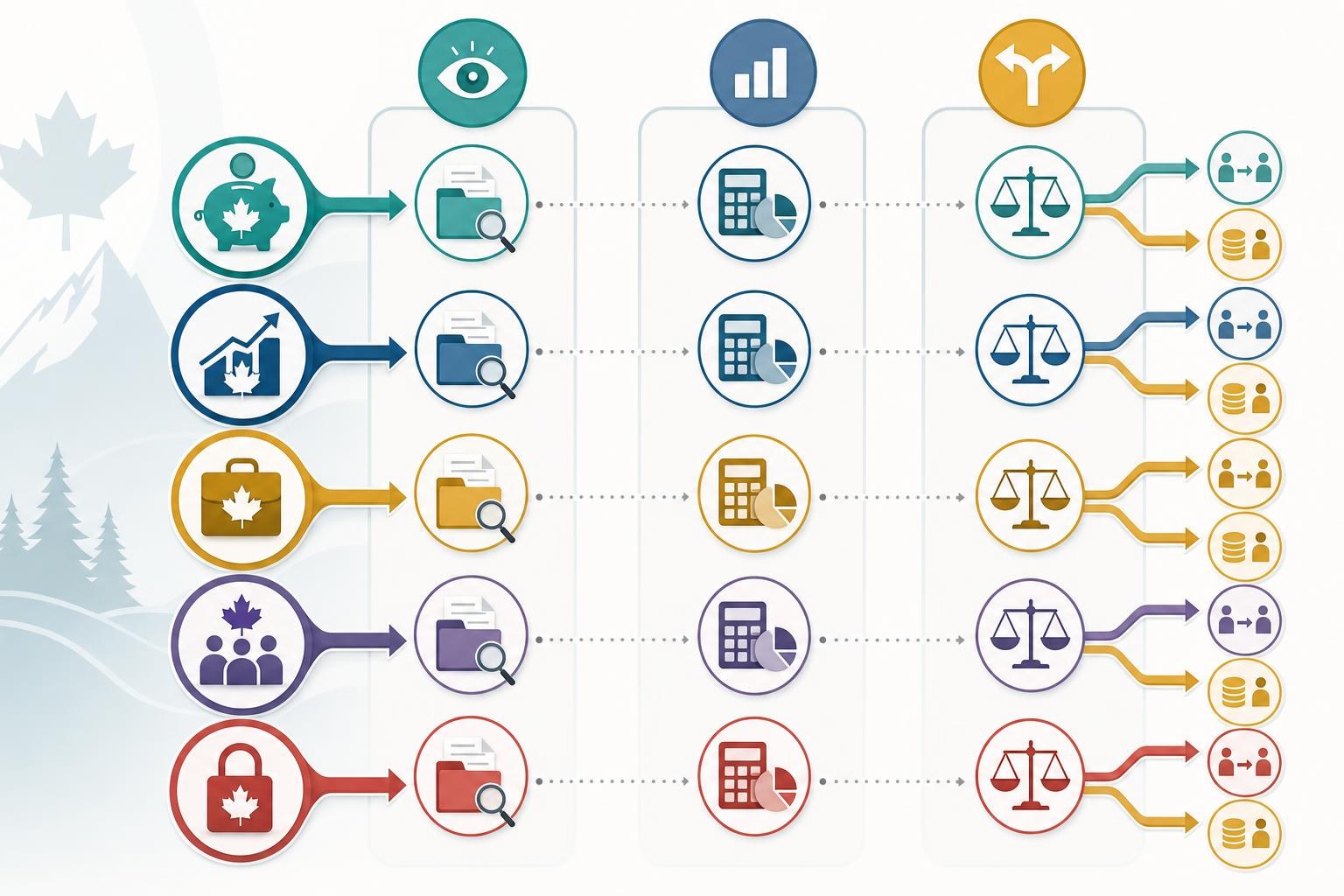
Default rules are provincial, so do not copy a U.S. prenup clause
Canada does not have one national rule for prenups or pension division. Each province has its own family property framework, and pension plans may be governed by provincial or federal pension legislation.
That means a pension clause copied from a U.S. template, or even from another Canadian province, may miss important details.
For a broader province-by-province foundation, see Prenuply’s guide to prenup laws by province in Canada.
Ontario example: pension value can form part of net family property
In Ontario, married spouses generally use an equalization system based on net family property. Pension rights can be included in that calculation. Ontario’s Family Law Act refers to the imputed family law value of a spouse’s pension interest for the marriage period, meaning the pension is not ignored just because it is not a bank account.
Ontario marriage contracts can deal with ownership or division of property, and domestic contracts must be in writing, signed by the parties, and witnessed. Ontario courts may set aside a domestic contract in situations that include failure to disclose significant assets, debts, or liabilities, lack of understanding, or general contract law problems. You can review the Ontario Family Law Act on CanLII.
For workplace pensions, Ontario’s pension regulator, FSRA, explains that the plan administrator calculates the Family Law Value after receiving the required application. FSRA also notes that the Family Law Value is a gross amount and tax advice may be needed. An annual statement may be helpful disclosure, but it is not always the family law value.
British Columbia example: family property includes pension and retirement savings entitlements
In BC, family property can include a spouse’s entitlement under a pension plan, retirement savings plan, annuity, or income plan, as well as money in financial accounts. BC also has excluded property rules, which can include property acquired before the relationship began. However, increases in value may be family property unless addressed by agreement or court order.
This is especially important for RRSPs and workplace pensions. A spouse may want to exclude the pre-relationship RRSP balance while sharing, excluding, or differently valuing growth after the relationship begins. That requires records. Without starting values, it may be harder to show what was already owned.
BC spouses may make agreements about division of property and debt, including excluding property that would otherwise be family property or valuing property differently. BC courts can review agreements for issues such as nondisclosure, vulnerability, lack of understanding, and significant unfairness. The BC Family Law Act is available through BC Laws.
Alberta example: agreements can set property rules, but pension legislation still controls transfers
Alberta allows spouses and adult interdependent partners to make written agreements about the status, ownership, valuation, and division of property. For premarital agreements, the agreement should clearly state that it is intended to apply after marriage. Alberta also has specific lawyer acknowledgement requirements, including separate acknowledgements that each person understands the agreement and is signing freely and voluntarily.
For pensions, Alberta’s Family Property Act also cautions that the property legislation does not itself authorize pension transfers or retirement account payouts unless the applicable pension or retirement legislation permits them. In plain language: a prenup may allocate value, but pension law may still control how, when, and whether a transfer can occur.
Quebec example: family patrimony is a special caution
Quebec requires separate attention. It is not simply a different version of Ontario, BC, or Alberta.
Quebec family patrimony can include retirement benefits accumulated during marriage or civil union, including certain pension plans, RRSPs, LIRAs, LIFs, RRIFs, annuities, and QPP or CPP-related rights. The Civil Code of Quebec provides that spouses may not generally renounce family patrimony rights by marriage contract before the issue arises. Retraite Quebec provides a plain-language overview of pension plans and family patrimony.
If you live in Quebec, are marrying in Quebec, or have Quebec-based retirement assets, speak with a Quebec notary or family lawyer before assuming a prenup can exclude all retirement savings accumulated during marriage.
Workplace pensions: defined contribution versus defined benefit plans
Workplace pensions need careful drafting because “pension” can mean very different things.
Defined contribution pensions
A defined contribution plan is often easier to understand because there is usually an account balance. Contributions go in from the employee, employer, or both. Investment returns increase or decrease the balance.
Even so, the prenup should address:
- The balance at marriage
- Employee contributions after marriage
- Employer contributions and matching
- Investment growth
- Locked-in status
- Tax adjustments
- Whether division would happen by transfer, offset, or another method
Defined benefit pensions
A defined benefit pension is more complex. It usually promises future retirement income based on a formula involving service, salary, age, and plan terms. Public sector employees, hospital workers, teachers, transit workers, university employees, and some unionized employees may have valuable defined benefit pensions.
A defined benefit pension may require a specialized family law valuation or actuarial calculation. The value can depend on assumptions about retirement age, interest rates, survivor benefits, bridge benefits, indexing, early retirement subsidies, and salary history.
A regular annual pension statement is useful, but couples should not assume it gives the number that would be used for family property purposes.
What a pension clause should usually clarify
A pension clause should be specific enough that a future lawyer, mediator, court, or plan administrator can understand the intention. Without giving legal advice, topics to discuss with counsel may include:
- The pension plan name and plan jurisdiction
- The member spouse and plan administrator
- The relationship start date and marriage date
- The date used for pre-marriage value
- How the value at separation would be determined
- Whether pre-marriage value is excluded
- Whether growth during marriage is shared, excluded, or divided by another formula
- How employee contributions are treated
- How employer contributions and matching are treated
- Whether pension buybacks are included
- How survivor benefits, disability benefits, bridge benefits, and early retirement subsidies are treated
- Whether tax will be adjusted before comparing values
- Whether division will happen through transfer, offset, or payment from other assets
- What documents each spouse must provide
This is also where independent legal advice matters. Pension clauses can be high value, technical, and easy to misunderstand. For more on process risks, see Are prenups enforceable in Canada?.
RRSPs and spousal RRSPs: do not forget tax and attribution issues
RRSPs are often easier to see than pensions, but they still need careful treatment.
A prenup can often state how RRSP balances are treated, such as:
- Each spouse keeps the RRSP balance they had before marriage
- Growth during marriage is shared or excluded
- New contributions during marriage are separate or shared
- Spousal RRSPs are addressed separately
- Transfers on separation are handled in a tax-aware way
The tax point matters. Ordinary RRSP withdrawals can trigger tax. CRA Form T2220 may be used to directly transfer all or part of an RRSP, RRIF, PRPP, or SPP to a current or former spouse or common-law partner in specific relationship breakdown situations. That kind of transfer generally requires the right legal documents and process at the time.
Spousal RRSPs deserve special care because the contributor and annuitant may be different people. Attribution rules and future tax consequences should be reviewed with a tax professional.
TFSAs: tax-free does not mean invisible
TFSAs are not pensions, but many couples use them as retirement savings. They should be disclosed and addressed separately from RRSPs.
A TFSA clause might address:
- The TFSA balance at marriage
- Future contributions during marriage
- Investment growth
- Contribution room effects
- Whether one spouse’s TFSA is being used for joint retirement planning
- Whether a future transfer or offset is intended
CRA guidance recognizes qualifying TFSA transfers between current or former spouses or common-law partners in certain relationship breakdown property division situations, where the transfer relates to a court order or written agreement and the parties are living separate and apart. But a prenup should not assume that a transfer will be automatic without the correct future documents.
CPP and QPP: a prenup may not control everything
CPP and QPP are not ordinary investment accounts.
The Government of Canada explains that CPP contributions made while spouses or common-law partners lived together can be equally divided after divorce or separation, and that the division is permanent. It also states that a spousal agreement generally does not prevent CPP credit splitting, subject to specific exceptions for certain agreements and provinces. Current rules should be checked before signing and again if separation occurs.
QPP has its own Quebec process. If CPP or QPP credits are important to your retirement plan, do not rely on a simple “no pension sharing” clause without legal advice.
Offsetting pension value against other property
Sometimes couples do not want to divide a pension directly. Instead, one spouse keeps the pension and the other receives more of another asset.
Example: Priya has a defined benefit pension. Marcus has larger non-registered investments. Their agreement might state that Priya keeps her pension growth, while Marcus keeps a larger share of his investments, subject to valuation and tax review at separation.
Offsets can work in some situations, but they are not simple. A pension dollar is not always the same as a cash dollar. Pensions may be taxable later, locked in, paid over time, or subject to survival assumptions. Offsets should consider valuation, tax, liquidity, and fairness.
Disclosure before marriage: retirement documents to gather
As of this article’s research date of July 4, 2026, pension rules, forms, and administrative procedures can change. Before signing, couples should gather current documents and ask lawyers or plan administrators what else is needed.
Retirement-specific documents may include:
- Most recent RRSP statements
- Most recent TFSA statements
- Spousal RRSP contribution history
- Group RRSP, DPSP, PRPP, LIRA, LIF, RRIF, and annuity statements
- Annual workplace pension statements
- Defined benefit plan booklet or member guide
- Plan administrator contact information
- Pension registration jurisdiction, if known
- Employment offer letters or pension enrollment documents
- Pension buyback quotes
- CPP or QPP contribution records
- CRA RRSP deduction limit and TFSA contribution room records
- Beneficiary designation confirmations
- Any pension estimate, family law value, or actuarial report already obtained
Common mistakes couples make with retirement savings clauses
Retirement clauses often fail because they are too broad. Common mistakes include:
- Using “pension” to mean every retirement asset, including RRSPs, TFSAs, and LIRAs.
- Ignoring defined benefit pensions because there is no visible account balance.
- Forgetting employer contributions and matching.
- Failing to value the pre-marriage balance.
- Mixing pre-marriage and post-marriage savings without records.
- Assuming annual statements equal family law values.
- Ignoring tax on RRSPs, RRIFs, and pension payments.
- Assuming CPP or QPP can always be waived.
- Forgetting Quebec family patrimony rules.
- Failing to update beneficiary designations and estate planning documents.
Related clauses may also matter, including tax allocation, debt, estate planning coordination, and record keeping. See Prenuply’s guide to important prenup clauses Canadian couples often miss.
How Prenuply fits into the process
Prenuply is a technology company, not a law firm. Prenuply can help couples organize information, prepare a draft agreement, and create a clearer disclosure package for lawyer review.
That can be especially useful where one or both partners has RRSPs, TFSAs, a public sector pension, a workplace pension, or locked-in retirement accounts. A structured process helps couples identify what exists before they speak with lawyers.
If you are ready to start organizing your agreement, you can create a Prenuply account and begin building your draft. Each partner should still consider independent legal advice, especially where pensions, Quebec family patrimony, tax issues, or high-value retirement savings are involved.
FAQ
Can a prenup protect my pension in Canada?
It can often set expectations for how pension value is treated, including pre-marriage value and growth during marriage. It cannot guarantee a result in every province or override pension legislation, tax rules, disclosure requirements, or court review.
Can my spouse get part of my RRSP?
Possibly. RRSPs can be relevant property in a separation, depending on the province, timing, source of contributions, and any agreement. A prenup can often address whether pre-marriage balances, growth, and future contributions are shared or separate.
Are TFSAs included in divorce property division?
They can be. TFSAs are not pensions, but they are financial accounts and may be treated as property under provincial family law. If you use a TFSA for retirement savings, disclose it and address it in the agreement.
Can we agree not to split CPP?
Be careful. CPP credit splitting is governed by public rules. Government guidance says a spousal agreement generally does not prevent CPP credit splitting, with specific exceptions. QPP has separate Quebec rules. Get advice before relying on any no-split clause.
What if I had the pension before marriage?
The pre-marriage portion may be treated differently from growth during marriage, depending on the province and the agreement. Records are essential. Keep statements showing the value at or near the marriage date, and get advice on whether a formal valuation is needed.
How do defined benefit pensions get valued?
Defined benefit pensions may require a family law value or actuarial calculation. The value can depend on salary, service, age, retirement assumptions, indexing, survivor benefits, bridge benefits, and interest rates. Do not rely only on a regular annual statement.
Do we need lawyers for a pension clause?
Strongly consider it. Pension clauses can involve provincial family law, pension legislation, tax, valuation, and plan administrator requirements. Independent legal advice can help each spouse understand the nature and effect of the agreement.
Legal disclaimer
This article is general information for Canadian couples and is not legal, tax, financial, or actuarial advice. Laws, pension forms, plan rules, and administrative processes can change, and the correct approach depends on your province, pension plan, documents, and facts. Prenuply AI Inc. is not a law firm and does not provide legal services.