
If you live together in Alberta and are not married, a cohabitation agreement can answer questions couples often leave until the relationship is already under pressure: who owns the home, what happens to debt, how shared costs are handled, and whether either partner expects financial support if the relationship ends.
Alberta is different from provinces that use common-law language more casually. The legal term you will see in Alberta law is adult interdependent partner. That matters because adult interdependent partners can have property rights under Alberta's Family Property Act, and the signing rules for property agreements are more formal than many couples expect.
This guide explains how Alberta cohabitation agreements work, how adult interdependent partner status can arise, what a good agreement should cover, and when to involve lawyers before signing.
What is a cohabitation agreement in Alberta?
A cohabitation agreement is a private contract between two people who live together, or plan to live together, and want written rules for their financial life. It is usually used by unmarried partners, including couples who are often described as common law.
A well drafted Alberta cohabitation agreement can cover practical issues such as:
- ownership of a home, condo, rental lease, or household contents
- down payment contributions and mortgage responsibility
- who pays debts, credit cards, tax balances, student loans, or business loans
- how shared expenses are handled while living together
- what happens to savings, investments, vehicles, pets, and valuable personal property
- whether one partner expects support if the relationship ends
- how the agreement should change if the couple later marries
If you are still building your issue list, Prenuply's cohabitation agreement checklist for Canada is a useful starting point. For price planning, see the guide to cohabitation agreement cost in Canada.
Adult interdependent partners: Alberta's common-law concept
In everyday conversation, people say common law. In Alberta law, the more precise term is adult interdependent partner.
Alberta's Adult Interdependent Relationships Act applies to unmarried people in a relationship of interdependence. Alberta's public guidance says two people can become adult interdependent partners if they live together in a relationship of interdependence:
- for a continuous period of at least 3 years
- for less than 3 years if the relationship has some permanence and they have a child together
- by entering into an adult interdependent partner agreement
A relationship of interdependence generally involves sharing one another's lives, emotional commitment, and functioning as an economic and domestic unit. Alberta's guidance also lists practical factors such as exclusivity, household arrangements, how the partners present themselves to others, financial interdependence, care of children, and ownership or use of property.
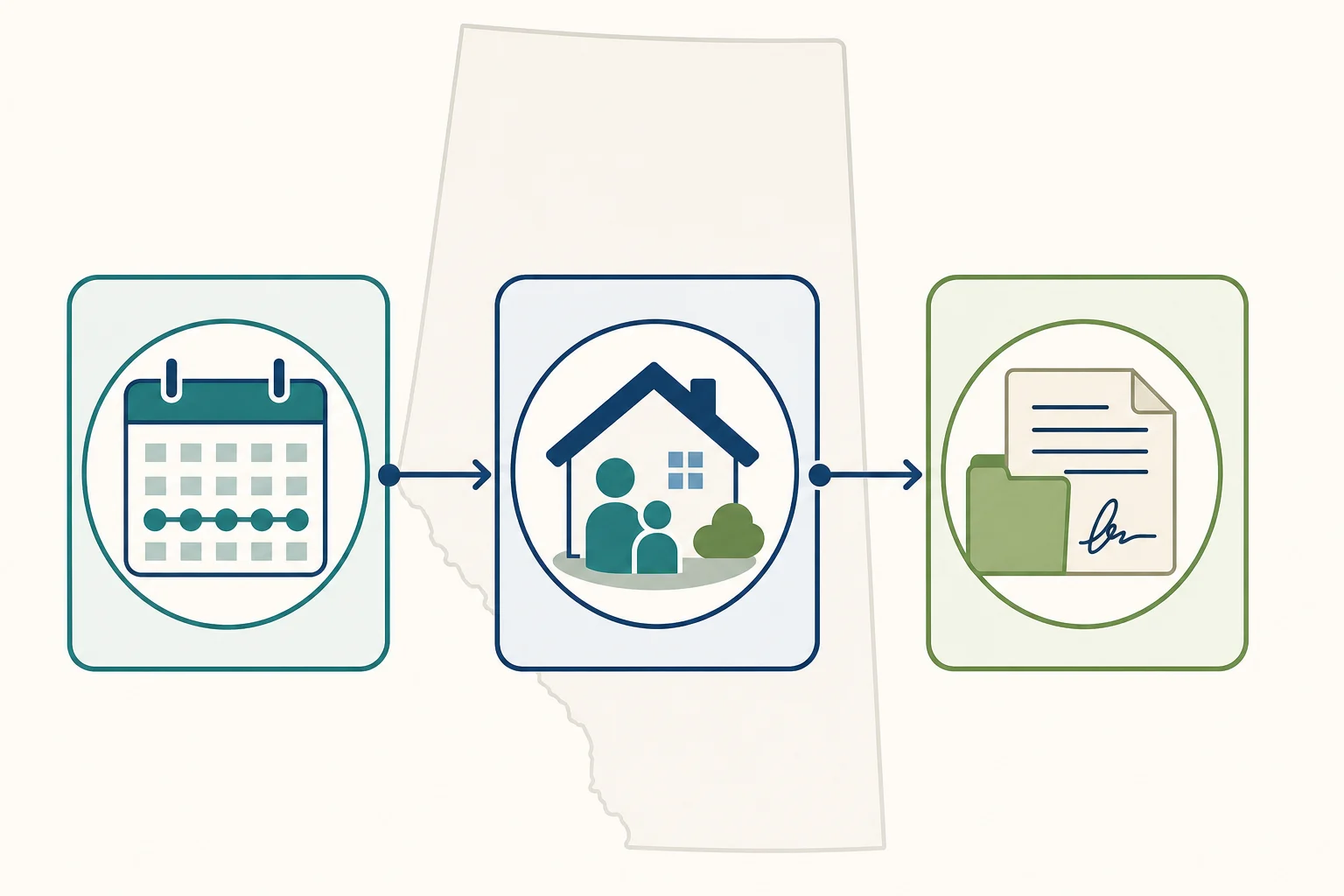
This is why timing matters. A couple may move in together thinking they are only sharing rent, then later discover they have crossed into a legal category with real financial consequences.
Why adult interdependent partner status matters for property
Alberta changed its family property rules for unmarried partners in 2020. The Government of Alberta's page on dividing property between unmarried partners explains that the Family Property Act applies to adult interdependent relationships, not only married spouses.
That does not mean every asset is automatically split 50/50. It does mean you should not assume that title alone decides everything. Alberta's Family Property Act deals with property distribution when adult interdependent partners end their adult interdependent relationship. The Act includes rules for property acquired during the relationship, exempt categories, family home issues, disclosure, timing for applications, and written agreements.
For couples, the practical takeaway is simple: if you want a different result from the default property rules, write it down early and get proper legal review.
Adult interdependent partner agreement vs cohabitation agreement
This is one of the most important Alberta-specific distinctions.
An adult interdependent partner agreement is a statutory form that can create adult interdependent partner status. The Adult Interdependent Partner Agreement Regulation sets out the form. The regulation also says the statutory agreement may be part of or attached to another agreement between the parties, and it flags legal advice where property provisions are involved.
A cohabitation agreement is broader. It is usually the financial agreement that says what happens to property, debts, the home, support expectations, and separation logistics.
The two can overlap, but they are not the same thing. Signing the statutory adult interdependent partner form can create legal status. Signing a cohabitation agreement can set financial rules. If you are thinking about combining them, attaching one to the other, or using an agreement before the 3-year mark, get Alberta legal advice before signing.
What an Alberta cohabitation agreement can cover
The strongest agreements are specific. They do not just say each person keeps what is theirs. They explain what that means for the actual home, bank accounts, debts, and family contributions in front of the couple.
The home
The home is usually the largest financial issue. Your agreement can address:
- who owns the home now
- whether title will be joint or in one partner's name
- who contributed the down payment
- whether down payment help from parents is a gift, loan, or separate contribution
- who pays the mortgage, condo fees, property tax, utilities, repairs, and insurance
- whether a non-owner partner builds equity through contributions
- how a buyout or sale would work if the relationship ends
If you are buying together, the dedicated guide on cohabitation agreements for buying a house in Canada goes deeper on down payments, title, mortgage liability, and exit plans.
Debts and credit
Debt clauses are especially important where one partner has student loans, tax debt, business debt, or credit card balances. A cohabitation agreement can clarify which debts are separate, which debts are joint, and whether one partner can bind the other to new borrowing.
The agreement should also address how household expenses are paid. Some couples split 50/50. Others contribute proportionally based on income. The key is to choose a method before resentment builds.
Business interests and professional practices
If one partner owns a business, farm, incorporated practice, rental property, or partnership interest, the agreement should say how that asset is treated. It may also address future increases in value, reinvested earnings, shareholder loans, retained earnings, and whether the other partner has any claim based on unpaid labour or household support.
Gifts, inheritances, and family help
Family gifts and inheritances often become complicated when money is mixed into a shared home or joint account. The agreement can require documentation, separate accounts, tracing records, and written confirmation when parents provide money for a down payment.
Support expectations
A cohabitation agreement may address support expectations between partners, but this is an area for careful legal advice. Courts can scrutinize support terms, especially where the facts later become very different from what the couple expected. A safer drafting process explains each partner's income, financial dependence, career sacrifices, childcare plans, and reason for the clause.
Signing rules and lawyer review in Alberta
For Alberta property agreements, signing process matters.
Section 37 of the Family Property Act says Part 1 of the Act does not apply to property covered by a subsisting written agreement between spouses or adult interdependent partners if the agreement is enforceable under section 38 and provides for the status, ownership, and division of that property. Section 38 says each party must acknowledge in writing, apart from the other party, that they understand the nature and effect of the agreement, understand possible future property claims they may be giving up, and are signing freely and voluntarily. The acknowledgment must be made before a lawyer who is not acting for the other party.

That is why an Alberta cohabitation agreement should not be treated like a casual template. If the agreement is meant to change property rights under the Family Property Act, each partner should have separate legal review and the proper acknowledgments.
This also helps the relationship. Separate review gives each partner private space to ask questions, understand the tradeoffs, and request changes before signing.
When Alberta couples should make a cohabitation agreement
The best time is before the financial stakes are tangled.
Consider making one if:
- you are moving in together and one partner owns the home
- you are buying property together before marriage
- one partner is contributing more to the down payment or renovations
- one partner has significant debt or business risk
- one partner owns a business, farm, professional practice, or rental property
- a parent is helping with a down payment
- you expect one partner to reduce work for childcare or family reasons
- you have been together close to 3 years and want clarity before adult interdependent partner status is obvious
- you may marry later and want the agreement to continue or convert into a marriage contract
That last point is important. Section 37 of the Family Property Act says an agreement entered into before marriage is unenforceable after marriage unless it is clear that the parties intended it to apply, or continue to apply, after marriage. If marriage is on the horizon, discuss whether you need a cohabitation agreement, a prenup, or a document designed to bridge both stages. Prenuply's guide to prenup vs cohabitation agreement in Canada can help you frame that conversation.
A practical Alberta cohabitation agreement checklist
Use this checklist before drafting or meeting lawyers:
- Confirm your relationship status. Are you already adult interdependent partners, approaching the 3-year point, living together with a child, or considering the statutory adult interdependent partner agreement form?
- List property owned now. Include real estate, vehicles, bank accounts, investments, pensions, business interests, crypto, valuable personal property, and expected family gifts.
- List debts and liabilities. Include mortgages, lines of credit, credit cards, tax balances, student loans, business debts backed personally, and personal surety obligations.
- Document the home plan. Note title, mortgage liability, down payment sources, monthly costs, renovations, buyout rules, and what happens if one partner moves out.
- Decide how expenses are shared. Choose a clear method for rent, mortgage payments, utilities, groceries, subscriptions, insurance, repairs, and emergency costs.
- Address support carefully. If one partner may depend financially on the other, explain the circumstances and get advice on any support clause.
- Plan for future marriage. Say whether the agreement should continue after marriage, be replaced by a prenup, or trigger a review.
- Book separate legal advice. Do this before signing, not after one partner has already treated the document as final.
Can you start with an online draft?
Yes, if you use it for the right job.
An online cohabitation agreement tool can help couples organize facts, identify decisions, and create a first draft more efficiently. It should not be used to skip Alberta-specific legal review, especially for property rights under the Family Property Act.
Prenuply helps Canadian couples create structured cohabitation agreement templates that they can take to lawyers for review. If you already know the main issues, such as the home, debt, support, or family money, you can start a cohabitation agreement draft and use it as a working document for your legal review.
FAQ
Is common law the same as adult interdependent partner in Alberta?
Not exactly. Common law is the phrase many people use in conversation. Alberta law uses adult interdependent partner. The legal category can arise after at least 3 years of living together in a relationship of interdependence, sooner if there is a child and some permanence, or through an adult interdependent partner agreement.
Do Alberta common-law couples automatically split property 50/50?
Do not assume either answer. Alberta's Family Property Act applies to adult interdependent partners and includes rules for property distribution, exempt property, and factors a court may consider. The result can depend on when property was acquired, how it was used, contributions, agreements, and other facts. A cohabitation agreement can create clearer rules in advance.
Do both partners need lawyers for an Alberta cohabitation agreement?
If the agreement is meant to deal with property rights under the Family Property Act, separate lawyer acknowledgments are central to enforceability under section 38. Even where a clause is not strictly about property division, separate legal advice is still a strong risk-reduction step.
Can a cohabitation agreement continue after marriage?
It can be drafted to do that, but the intention should be clear. Alberta's Family Property Act specifically warns that an agreement entered into before marriage is unenforceable after marriage unless it is clear the parties intended it to apply or continue after marriage. If you may marry, ask lawyers whether you should update the agreement or create a prenup.
Is an adult interdependent partner agreement required?
Not always. Some couples become adult interdependent partners through time and relationship facts. Others may use the statutory adult interdependent partner agreement form. A cohabitation agreement is different because it focuses on financial rules. If you are unsure which document you need, get Alberta legal advice before signing.
Can a cohabitation agreement decide child support or parenting?
Be careful. Child support and parenting are treated differently from adult property arrangements. Courts focus on the child's rights and best interests. Do not rely on a cohabitation agreement to lock in child-related outcomes without legal advice.
Sources checked
This article was prepared with reference to Alberta's Adult Interdependent Relationships Act, Alberta's guidance on dividing property between unmarried partners, Alberta's Family Property Act, the Adult Interdependent Partner Agreement Regulation, and the King's Printer versions of the Family Property Act sections 37 and 38 and Adult Interdependent Relationships Act. It is general information only.
Bottom line
An Alberta cohabitation agreement is not just paperwork for couples who are worried about breaking up. It is a planning tool for people who want to live together with financial clarity.
The Alberta-specific issue is adult interdependent partner status. Once that status exists, property rules and signing formalities can matter. The most practical next step is to organize your assets, debts, home plans, and support expectations, then create a draft that each partner can review with their own Alberta lawyer.
This article provides general information about cohabitation agreements in Alberta. It is not legal advice. Prenuply AI Inc. is not a law firm and does not provide legal services. For advice about your specific situation, consult a qualified family lawyer in Alberta.