
If you live together in British Columbia, or plan to move in together soon, a cohabitation agreement can do more than divide property. It can turn assumptions about the home, savings, debt, support, pets, and future marriage into written rules before there is pressure or conflict.
That matters in B.C. because common-law partners can become spouses under the Family Law Act without a wedding. Once the rules apply, property and debt division can look much closer to marriage than many couples expect.
This guide explains how a cohabitation agreement in BC works, what common-law rights can arise, what to include in the agreement, and what to prepare before independent legal advice.
Quick answer: what is a cohabitation agreement in BC?
A B.C. cohabitation agreement is a written agreement between partners who live together, or plan to live together, in a marriage-like relationship. It can set out how they want to handle property, debt, spousal support, dispute resolution, and other financial issues if the relationship ends.
In practical terms, a cohabitation agreement can answer questions like:
- Who keeps property owned before moving in together.
- Whether growth in value of a home, business, investment account, or pension will be shared.
- How mortgage payments, rent, renovations, utilities, and household expenses are handled.
- Whether family debt will be shared equally, unequally, or kept separate.
- Whether one partner may seek spousal support, subject to B.C. law and court review.
- What happens if the couple later marries.
- How pets, vehicles, furniture, and joint accounts will be dealt with.
Legal Aid BC explains that couples can make a cohabitation agreement before or while living together, and that legal advice is important because the agreement changes how the law applies if the couple separates.
Why common-law couples in BC should pay attention
B.C. does not treat every dating relationship as a family law partnership. But the legal threshold can arrive earlier than couples expect.
Under the B.C. Family Law Act, a person is a spouse if they are married, or if they have lived with another person in a marriage-like relationship for a continuous period of at least two years. For some issues outside property and pension division, having a child together can also matter.
The B.C. government states that property division rules apply to unmarried couples who have lived together in a marriage-like relationship for at least two years. Those couples generally share property acquired during the relationship, but not property brought into it, unless an agreement says something different.
The key point is simple: if you are unmarried but living together in B.C., the two-year mark can have real financial consequences.
BC property division rules in plain English
B.C. family property rules are built around two broad categories: family property and excluded property.
Under Part 5 of the Family Law Act, spouses are generally entitled to family property and responsible for family debt, unless an agreement or order provides otherwise. Family property can include real estate, bank accounts, business interests, pensions, investments, and the increase in value of excluded property.
Excluded property usually includes:
- Property one partner owned before the relationship began.
- Inheritances received by one partner.
- Gifts from a third party to one partner.
- Certain settlements, insurance proceeds, trust interests, and property derived from excluded property.
But there is a catch that surprises many couples: the increase in value of excluded property during the relationship can be family property.
For example, if one partner owns a condo before cohabitation and it rises in value during the relationship, the starting value may be excluded, but the growth may be shareable. A cohabitation agreement can clarify whether that growth should be shared, partly shared, reimbursed through a formula, or treated differently.
If one partner is bringing significant assets into the relationship, read Prenuply's guide to protecting inheritance with a Canadian agreement. The tracing and disclosure ideas are useful for cohabitation agreements too.
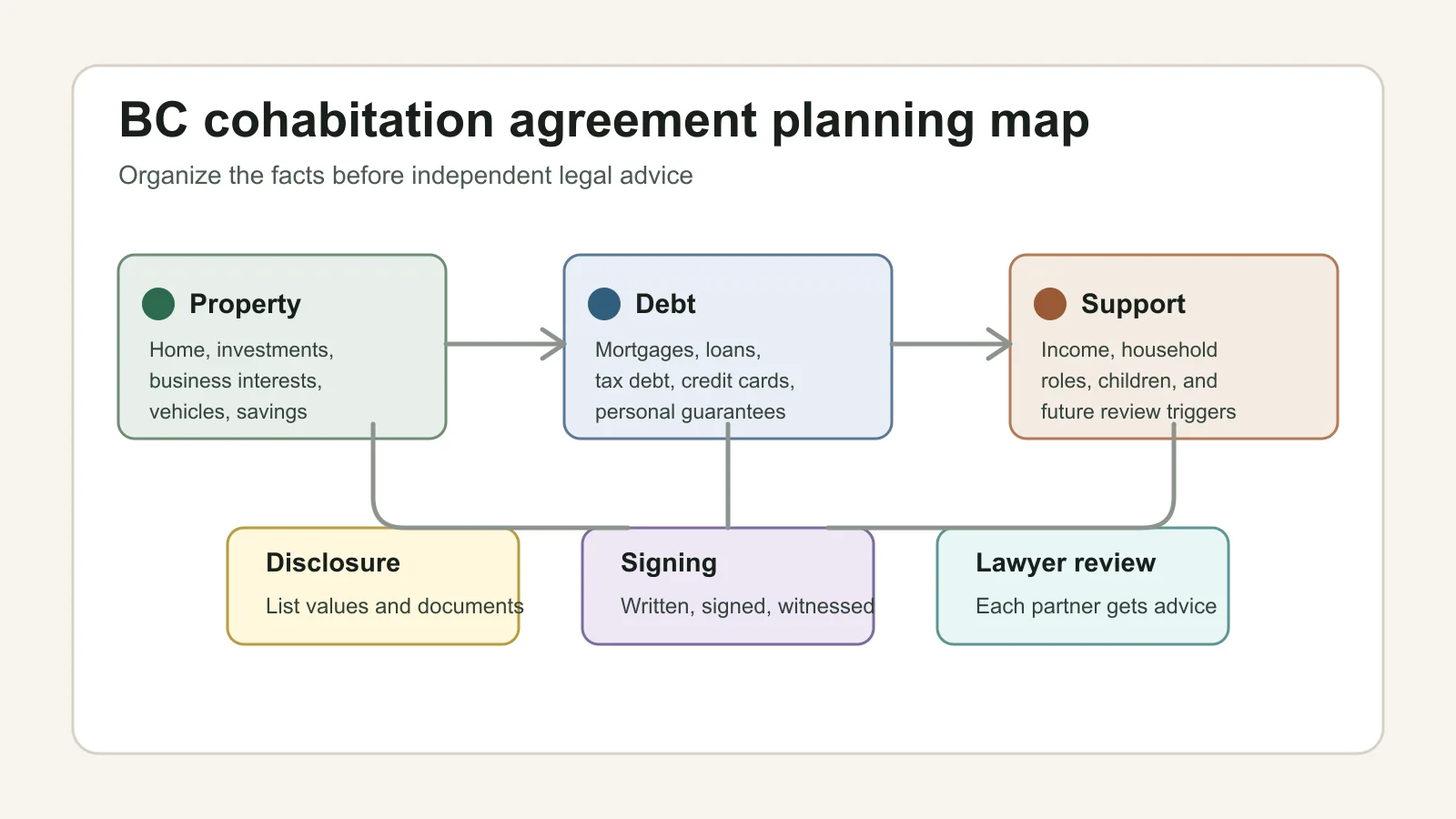
What a BC cohabitation agreement can include
A strong agreement is not just a paragraph saying each person keeps their own things. It should match the couple's real finances and the B.C. legal issues that could come up later.
1. The home
The home is usually the largest issue for B.C. common-law couples.
Your agreement should say:
- Who owns the home now.
- Whether the other partner is paying rent, contributing to equity, or being reimbursed later.
- How mortgage principal, mortgage interest, strata fees, property taxes, insurance, repairs, and renovations are split.
- What happens if the couple separates and both partners are on title.
- Whether one partner has a buyout option.
- How sale proceeds are divided.
- How long a partner has to move out after separation, where lawful and practical.
If you are buying a property together, also read Prenuply's guide to a property investment prenup for Canadian couples buying property together. The same ownership questions often appear before marriage.
2. Property each partner brings in
Each partner should list what they own before cohabitation starts, ideally in a schedule attached to the agreement.
Common examples include:
- Bank accounts, TFSAs, RRSPs, and non-registered investments.
- A home, condo, cottage, or rental property.
- Business shares or professional practice interests.
- Vehicles, tools, equipment, jewelry, collectibles, and furniture.
- Cryptocurrency, private company shares, and other harder-to-value assets.
Where practical, include approximate values and supporting documents. For excluded property, the person claiming the exclusion may need to prove it later. Screenshots, account statements, appraisals, purchase documents, and closing records can matter.
3. Debt and credit risk
B.C. family debt can include debts incurred during the relationship and certain debts after separation if they maintain family property. It does not always matter whose name is on the debt as between the spouses, although lenders and creditors are still governed by their own contracts.
Your agreement can address:
- Student loans, credit cards, tax debt, and personal loans.
- Mortgages, lines of credit, and renovation financing.
- Business debt and personal guarantees.
- Joint credit cards and joint bank accounts.
- Whether one partner indemnifies the other for specific debt.
- How debt tied to a jointly owned home will be paid on sale or buyout.
Do not rely on a private agreement to change a creditor's rights. If both partners sign a mortgage or line of credit, the lender may still pursue both of them even if the cohabitation agreement says one partner is responsible as between the couple.
4. Spousal support
Spousal support is different from property division. A person may have a property claim, a support claim, both, or neither, depending on the facts.
A cohabitation agreement can say how the couple intends to handle support if they separate. It might waive support, set a formula, define review triggers, or say support will be negotiated later. But support terms can be reviewed by a court, especially if circumstances change or the agreement is unfair.
This is one reason independent legal advice matters. A lawyer can help each partner understand what they may be giving up and whether the support language is realistic.
5. Pets, vehicles, furniture, and shared accounts
The expensive assets get most of the attention, but day-to-day items cause real conflict.
Consider adding terms for:
- Pets and companion animals.
- Vehicles, bikes, tools, furniture, and electronics.
- Joint bank accounts and household budgets.
- Subscriptions, insurance policies, and shared memberships.
- Moving costs and deposits.
- Final utility bills, cleaning costs, and damage deposits.
B.C.'s Family Law Act now specifically allows agreements about some companion animal issues in property division. If a pet is important to you, do not leave it to a vague verbal understanding.
What a BC cohabitation agreement should not try to control
A cohabitation agreement is useful, but it cannot do everything.
Legal Aid BC says a cohabitation agreement made before or while living together cannot deal with parenting issues after separation, such as parenting time and parental responsibilities, and cannot settle child support in a way that binds the court after separation.
That does not mean children are irrelevant. Children can affect housing needs, support, budgets, and future planning. But child support and parenting arrangements are treated differently because the law focuses on the child's best interests and right to support.
Avoid clauses that try to:
- Prevent a child from receiving child support.
- Decide final parenting arrangements before separation.
- Punish a partner for leaving the relationship.
- Hide assets or avoid creditors.
- Force one partner to sign future documents without review.
- Replace wills, beneficiary designations, tax advice, or estate planning.
If your situation includes children, prior spouses, blended family planning, or estate concerns, have a B.C. family lawyer and estate lawyer review the overall plan.
Signing rules and enforceability in BC
For property and debt agreements, the Family Law Act says the agreement is a written agreement with each spouse's signature witnessed by at least one other person. The same person may witness each signature.
But enforceability is not only about signatures. A court may set aside or replace an agreement if certain problems existed when the parties entered into it. The statute lists issues such as:
- Failure to disclose significant property, debts, or other relevant information.
- One spouse taking improper advantage of the other spouse's vulnerability.
- A spouse not understanding the nature or consequences of the agreement.
- Other circumstances that would make a contract voidable.
A court can also review an agreement for significant unfairness based on factors such as how much time has passed, what certainty the spouses intended to achieve, and how much they relied on the terms.
In plain English, a stronger agreement usually has:
- Full financial disclosure from both partners.
- Enough time for review before signing.
- Separate lawyers, not one lawyer advising both people.
- Clear schedules for property and debt.
- Terms that match the facts and are not wildly one-sided without explanation.
- Witnessed signatures and careful recordkeeping.
Prenuply's guide to whether prenups are enforceable in Canada covers similar risk factors that also matter for many cohabitation agreements.

How a cohabitation agreement changes if you later marry
Many B.C. couples start with a cohabitation agreement because they are moving in together, then later decide to marry.
That does not mean you should ignore marriage planning. Your agreement should say what happens if you get married. Options include:
- The agreement continues as a marriage agreement.
- The couple must review it before the wedding.
- Certain cohabitation-only terms expire.
- The agreement is replaced by a new marriage agreement.
If marriage is likely, review the agreement well before the wedding. Do not leave the conversation until invitations are sent, deposits are paid, and one partner feels pressured. For more context, see Prenuply's B.C. prenuptial agreement guide and the national guide to prenup vs cohabitation agreement in Canada.
BC cohabitation agreement checklist
Before you create a draft or speak with lawyers, gather the information that makes the review useful.
| Category | What to prepare |
|---|---|
| Relationship details | Names, addresses, cohabitation date, province, children, future marriage plans |
| Home | Lease, title, mortgage, down payment source, renovation plans, strata fees |
| Assets | Bank accounts, investments, RRSPs, TFSAs, pensions, vehicles, business interests |
| Excluded property | Property owned before cohabitation, inheritances, gifts, tracing documents |
| Debts | Credit cards, loans, tax debt, mortgages, guarantees, business liabilities |
| Income | Employment income, self-employment income, dividends, bonuses, expected changes |
| Support | Income gap, caregiving roles, career sacrifices, possible review dates |
| Practical items | Pets, vehicles, furniture, moving costs, joint accounts, emergency expenses |
| Review process | Separate lawyers, disclosure package, witness plan, final signed copy |
For a broader national list, use Prenuply's cohabitation agreement checklist for Canada.
How much does a cohabitation agreement cost in BC?
Costs vary by complexity. A simple agreement with clean disclosure and limited assets will usually cost less than an agreement involving a home, business, inherited assets, children, significant debt, or support terms.
The main cost drivers are:
- Whether both partners have organized financial disclosure.
- Whether the couple agrees on the main terms before lawyers start revising.
- Whether one or both partners own real estate.
- Whether business interests or private company shares need review.
- Whether support language needs careful negotiation.
- Whether the agreement is being signed close to a move-in date or wedding.
An online tool can help you create a structured first draft and organize the facts before lawyer review. It should not replace independent legal advice. For price context across Canada, read Prenuply's guide to cohabitation agreement cost in Canada.
Common questions about BC cohabitation agreements
Do common-law partners in BC need a cohabitation agreement?
Not every couple needs one, but many should consider it. It is especially useful if one partner owns a home, one partner has significantly more savings or debt, the couple is buying property together, either partner owns a business, one partner expects an inheritance, or there is a large income gap.
Are common-law partners treated the same as married spouses in BC?
For many property and debt issues, unmarried spouses who have lived together in a marriage-like relationship for at least two years can be treated similarly to married spouses. The exact issue matters, so do not assume that tax, estate, support, and property rules all use the same test.
Can a BC cohabitation agreement protect a home owned before the relationship?
It can help, but the drafting needs care. The agreement can address the starting value, growth in value, contributions to mortgage principal, renovation payments, buyout rights, sale timing, and reimbursement. A lawyer should review the title, mortgage, source of funds, and any planned contributions.
Can we write our own BC cohabitation agreement?
You can prepare a draft yourselves, and that can save time. But each partner should get independent legal advice before signing. Legal Aid BC specifically warns that a cohabitation agreement can change legal rights and that partners should use different lawyers.
Should we sign before or after moving in together?
Earlier is usually cleaner. Signing before moving in can make the starting point easier to document, reduce pressure, and create a clearer record of each partner's property and debt. If you already live together, you can still make an agreement, but disclosure and timing become even more important.
A practical next step
If you are preparing a cohabitation agreement in B.C., start by organizing the facts: home details, assets, debts, income, relationship timeline, and the issues you want the agreement to solve. Then create a draft that a lawyer can review instead of starting from a blank page.
Prenuply can help you create a cohabitation agreement template for Canada based on your situation, then you can take the draft to independent B.C. family lawyers for advice before signing.
This article provides general information about cohabitation agreements in British Columbia. It is not legal advice. Prenuply AI Inc. is not a law firm and does not provide legal services. For advice about your specific situation, consult a qualified B.C. family lawyer.