Quick answer: A cohabitation agreement in Manitoba is a written agreement that lets unmarried partners decide how property, debts, the home, support, and related financial issues should be handled. It can replace some of the default rules that may otherwise apply after partners register their relationship or live together in a conjugal relationship for at least three years.
Manitoba is unusual because qualifying common-law partners have property-sharing rights that are much closer to those of married spouses than in some other provinces. A careful agreement can be useful before moving in, before the three-year point, after buying a home, or even after the couple already qualifies as common-law.
Not legal advice: Manitoba uses different common-law definitions for property, support, taxes, benefits, and other purposes. This guide focuses on provincial family property and related planning. Each partner should consider advice from a separate Manitoba family lawyer before signing.
Cohabitation agreement Manitoba rules at a glance
| Question | Short Manitoba answer |
|---|---|
| When do provincial family property rules generally apply? | After the couple registers a common-law relationship with Manitoba Vital Statistics, or after at least three years of cohabitation in a conjugal relationship |
| Does the CRA use the same three-year rule? | No. The CRA generally uses a 12-month rule, or an earlier date when a partner is the parent of the other partner's child |
| Can partners opt out of Manitoba's family property rules? | Yes. Manitoba recognizes a written common-law relationship agreement that can address property in a different way |
| Can an agreement be signed before moving in? | Yes. The legislation recognizes agreements made in contemplation of cohabitation, during the relationship, or after cohabitation ends |
| Does one partner automatically receive half the title to the other's home? | No. Property division usually involves an accounting and equalization of value. Title, occupation rights, homestead protection, and debt are separate questions |
| Should both partners use the same lawyer? | Each partner should consider independent advice from a different lawyer, especially where rights are being waived or the terms are unequal |
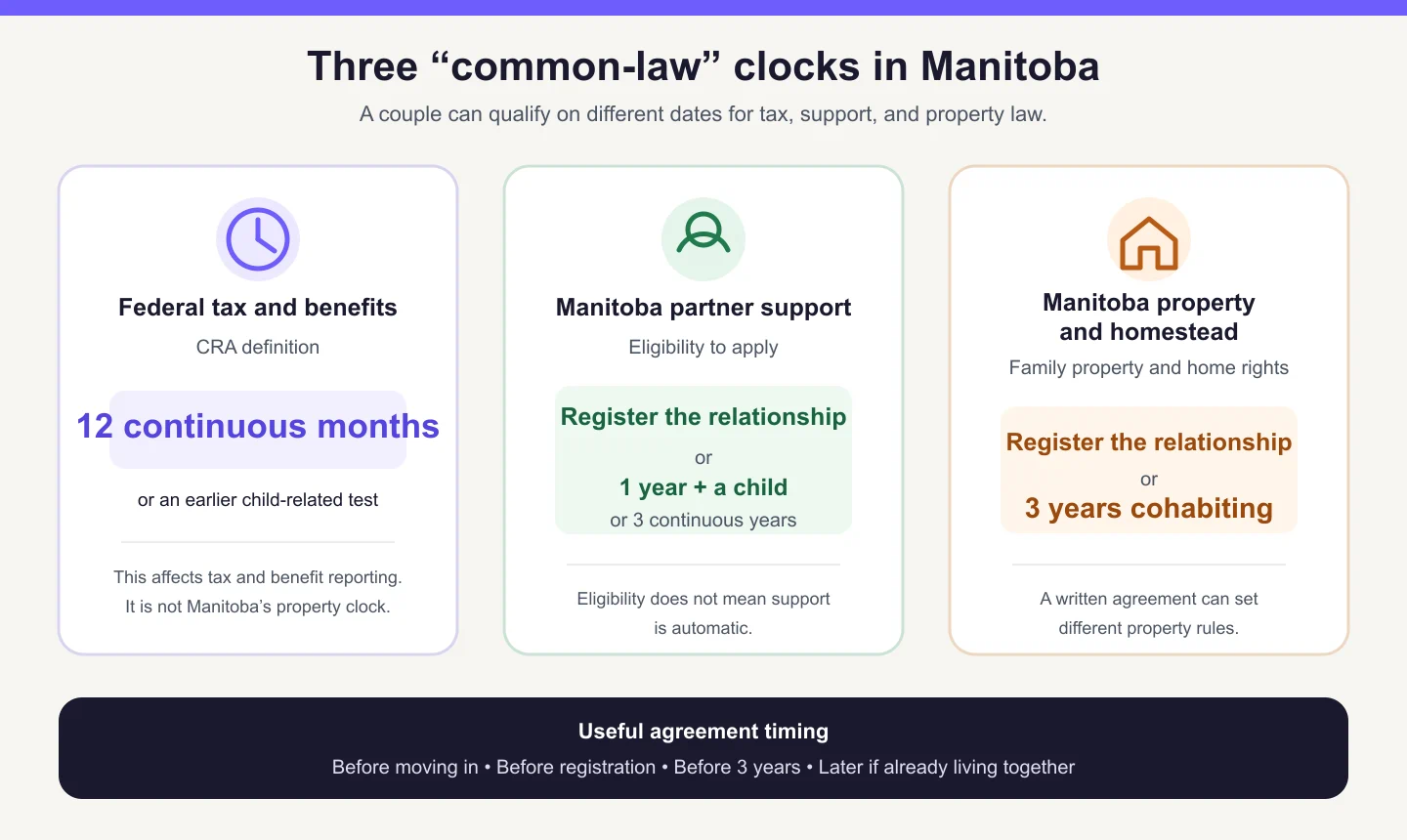
The most important planning point is that "common-law" does not have one universal start date. A couple can be common-law for one legal purpose and not yet qualify for another.
What is a cohabitation agreement in Manitoba?
Manitoba's Family Property Act uses the term common-law relationship agreement. Its definition includes a written agreement signed by common-law partners that deals with some or all of their assets. The agreement may be made before the partners live together, while they are cohabiting, or after cohabitation ends.
People often call the same document a cohabitation agreement, common-law agreement, or common-law prenup. The practical purpose is to let the partners write financial rules that fit their relationship instead of relying entirely on Manitoba's defaults.
An agreement can be narrow. For example, it might protect the value and future growth of a house that one partner already owns. It can also be comprehensive and address investments, pensions, a farm, business interests, debts, support, estate planning, and the consequences of a future marriage.
Prenuply's broader Canadian cohabitation agreement guide explains the national starting point. The Manitoba details below matter because property rights for unmarried partners vary significantly by province.
The three common-law clocks Manitoba couples often confuse
1. The Manitoba family property clock
The Government of Manitoba explains that The Family Property Act applies when partners have registered their common-law relationship or have lived together in a conjugal relationship for at least three years.
Once the Act applies, the basic rule is that each partner has a right to an equal share of the value of family property accumulated during the relationship. That can include real estate, money, investments, vehicles, pensions, and other assets, even if only one partner holds title.
Registration can make these rights apply before a couple has lived together for three years. Manitoba Vital Statistics provides a registration form for common-law relationships. The form itself recommends legal advice because registration can affect property rights.
2. The Manitoba support clock
Spousal or common-law partner support uses a broader definition. According to the province's support guidance, a partner may be eligible to apply if the couple:
- registered the relationship;
- lived together for at least one year and had a child together; or
- lived together continuously for at least three years.
Eligibility to apply does not mean support is automatic. Entitlement, amount, and duration depend on the couple's circumstances, including financial need, relationship length, roles, and the effect of the relationship on each partner's finances.
3. The federal tax clock
For income tax and federal benefit purposes, the Canada Revenue Agency generally treats partners as common-law after 12 continuous months of living together in a conjugal relationship. The definition may apply earlier when one partner is the parent of the other's child. The current details are on the CRA's marital status page.
This tax definition does not create the same property-sharing rights as Manitoba's Family Property Act. It also does not delay tax reporting until the provincial three-year mark.
What happens without a cohabitation agreement?
If the Family Property Act applies and the couple has not made a different written agreement, the starting point is equal sharing of the value of family property.
That statement needs three qualifications.
First, equalization is not the same as automatically adding a partner to a land title, bank account, or business registry. The law looks at the value each partner owns and calculates an accounting. One partner may owe an equalization payment without transferring a one-half interest in every asset.
Second, not every dollar of property is necessarily family property. Manitoba's What's Covered? guidance says property acquired before cohabitation is generally outside the sharing pool, unless it was acquired in contemplation of the relationship. However, an increase or decrease in the value of pre-relationship property during the relationship may be shared. Gifts and inheritances can also require separate analysis.
Third, debts, taxes, valuation dates, ownership documents, and exemptions can change the result. A home worth $500,000 with a $350,000 mortgage does not create the same net value as a mortgage-free home worth $500,000.
Couples who want a broader comparison can read Common-Law Property in Canada: Is It 50/50?.
What can a Manitoba cohabitation agreement cover?
A useful agreement translates the couple's intentions into specific rules. It may address:
Property owned before the relationship
The agreement can identify each partner's starting property and its value, then state whether future growth remains separate, is shared, or follows a custom formula. This is often important for a house, cottage, farm, rental property, investment account, or private company.
Property acquired while living together
Partners can decide whether new assets are separate, joint, or shared in proportion to contributions. The agreement should explain how title, purchase money, mortgage payments, renovations, and sale proceeds interact.
The family home
Home clauses may cover:
- who owns the home and the starting equity;
- whether monthly payments are rent, household contributions, mortgage contributions, or equity-building payments;
- who pays for repairs, property tax, insurance, and renovations;
- whether a contribution creates reimbursement or ownership;
- how a buyout price will be calculated;
- how long either partner may remain after separation; and
- when the home must be listed for sale.
If one partner already owns the property, see Cohabitation Agreement When One Partner Owns the House.
Debts and guarantees
An agreement can list student loans, credit cards, tax debt, business debt, mortgages, and personal guarantees. It can allocate responsibility between the partners, although an agreement between the couple does not remove a lender's contractual rights against a borrower or guarantor.
Pensions, investments, and businesses
Manitoba property sharing can include pensions and investment growth. An agreement may define how pension credits, registered accounts, stock compensation, business shares, retained earnings, or professional practices will be valued and treated.
Partner support
Partners may address support through a waiver, a fixed term, a formula, a cap, or a review trigger. Support provisions deserve careful legal advice because a court may consider the circumstances in which the agreement was made and because life can change substantially through disability, caregiving, unemployment, or the birth of a child.
Death and estate planning
A cohabitation agreement can coordinate with wills, beneficiary designations, life insurance, and rights in the home. It does not replace those documents. Manitoba's rights on death guidance notes that qualifying common-law partners may have rights under The Homesteads Act, The Family Property Act, intestate succession law, pension law, and dependant-relief legislation.
The Manitoba home and farm rule deserves its own clause
The family home is not just another asset.
Under Manitoba's Family Home and Farm guidance, The Homesteads Act can give a qualifying non-owner partner special rights in the family home. If one partner owns the home alone, the other may need to consent in writing before it is sold, mortgaged, or leased for more than three years.
The same page explains that the protection can extend to a family farm, including the dwelling and up to 320 acres of land. On death, a qualifying surviving partner may also have a right to live in the homestead for life, subject to the law and circumstances.

A generic sentence saying "the owner keeps the house" may not be enough. A Manitoba lawyer should assess how the proposed property terms, homestead rights, land title, mortgage, will, and any required releases work together.
What should not be treated as a final private bargain?
Property and adult support are the core subjects of a cohabitation agreement. Parenting and child support are different.
Parents can record their current intentions, but they cannot use a private agreement to permanently remove a court's responsibility to protect a child's interests. Manitoba says a written agreement cannot change a parent's legal rights to exercise parental responsibilities. Both parents also continue to have a duty to support their children.
An agreement should not attempt to:
- trade child support for a larger property share;
- make parenting time depend on property payments;
- predetermine parenting arrangements without regard to the child's future best interests; or
- treat a child-support waiver like an ordinary debt waiver.
These topics need child-focused advice if the couple has children or expects to have them.
When should Manitoba partners sign?
The best time is usually when both partners have enough information and enough space to make a voluntary decision.
Common planning moments include:
- Before moving in: Useful when one partner owns the home, a family member contributed money, or the couple wants household-payment rules from day one.
- Before registration: Registration can accelerate provincial property and homestead consequences, so legal advice before filing is sensible.
- Before the three-year mark: This creates time to compare the default law and negotiate without an artificial deadline.
- Before buying a home or farm: Title, down payments, debt, improvements, and exit terms are easier to document before closing.
- After moving in: It is not automatically too late. Manitoba recognizes agreements made during cohabitation. See the guide to signing a cohabitation agreement after moving in.
- Before marriage: The agreement should say what happens if the partners marry and whether a new marriage contract or review will be required.
Avoid presenting an agreement as a surprise before a closing, registration filing, major move, or wedding. Pressure and rushed review can undermine the quality of the process.
How to make a Manitoba cohabitation agreement
1. Write down the couple's decisions
Start with plain-language choices. What stays separate? What is shared? How are household costs treated? What happens to the home if the relationship ends? What would feel fair after caregiving, disability, or a large renovation?
The Canadian cohabitation agreement checklist can help organize the discussion.
2. Exchange financial disclosure
Each partner should prepare an accurate list of assets, debts, income, pensions, business interests, guarantees, and material obligations. Attach values and supporting records where appropriate.
Disclosure is not busywork. A partner cannot make an informed decision about waiving a share of investment growth, home equity, or pension value without knowing what exists.
3. Prepare a Manitoba-specific draft
The draft should use Manitoba terminology, address The Family Property Act and The Homesteads Act where relevant, and describe exactly which defaults the couple intends to change.
An online service can help organize information and produce a first draft. It should still be treated as a template for legal review, not as personalized legal advice.
4. Obtain separate legal advice
Each partner should have the opportunity to consult a different Manitoba family lawyer. Separate advice helps each person understand:
- the rights Manitoba law would otherwise provide;
- the assets and debts disclosed;
- the practical effect of every waiver or formula;
- whether the agreement works with the home, farm, pension, business, and estate documents; and
- whether changes are needed before signing.
Prenuply can help couples request independent lawyer review.
5. Revise, sign, and store the complete package
The partners should sign the same final version and keep:
- the signed agreement;
- all schedules;
- financial statements and valuation records;
- proof of signing and legal advice;
- related wills, beneficiary designations, or releases; and
- a note of any future review date.
Review triggers may include marriage, a child, a home purchase, a move outside Manitoba, a business sale, disability, a major inheritance, or a long period of caregiving.
How much does a cohabitation agreement cost in Manitoba?
The price depends on the complexity of the assets, the amount of negotiation, and whether each partner needs separate legal advice.
Public Manitoba examples show how wide the range can be. In July 2026, one Manitoba lawyer published a price of $1,500 plus tax for a straightforward limited-scope drafting service. Another Winnipeg firm listed $2,000 for a basic agreement and $4,000 for an advanced agreement, before tax and subject to its stated conditions. These are examples, not province-wide averages, and prices can change.
A Prenuply cohabitation agreement template costs $49 CAD. Separate lawyer review is not included. The full cost guide compares lawyer fees and online cohabitation agreement options.
The cheapest first document is not always the lowest-cost path. Missing disclosure, vague home terms, conflicting wills, or a second draft built from scratch can add cost later.
Three Manitoba examples
One partner owns a Winnipeg home
Alex owns a house with $220,000 of equity when Morgan moves in. They agree that Alex will retain the starting equity, Morgan's monthly household contribution will not create ownership by itself, and documented capital renovations will be reimbursed under a formula. They also set an appraisal process and a move-out period.
The agreement should distinguish title, equity growth, reimbursement, homestead rights, and occupancy. Treating all five as the same issue can create ambiguity.
Partners buy a Brandon home together
Jamie contributes 70% of the down payment and Taylor contributes 30%. They plan to split the mortgage equally. Their agreement records the initial contributions, describes whether mortgage principal changes their ownership shares, allocates repairs, and provides a sale or buyout process.
The land title, mortgage, and agreement should tell a consistent story.
A Manitoba farm stays in the family
Riley expects to inherit shares in a family farm corporation and may later live on the farm with Casey. The couple wants the inherited shares and future business growth to remain separate, while recognizing Casey's possible labour, caregiving, or capital contributions.
This situation may require coordinated family, corporate, tax, estate, and homestead advice. A one-line inheritance exclusion is unlikely to answer every issue.
Frequently asked questions
Is common-law automatically three years in Manitoba?
Not for every purpose. Three years is the usual cohabitation threshold for The Family Property Act and The Homesteads Act when the relationship is not registered. Support can also apply after one year when the partners have a child together. The CRA generally uses 12 continuous months or an earlier child-related test.
Can I get a cohabitation agreement after three years?
Yes. Manitoba's statutory definition recognizes a common-law relationship agreement made during cohabitation or even after cohabitation ends. Existing rights and past values may make the analysis more complex, so both partners should obtain legal advice.
Does my partner own half my house after three years?
Not automatically. The partner does not simply appear on title. However, qualifying common-law partners may have equalization rights in family property value, rights relating to growth during the relationship, and homestead protections. The answer depends on timing, value, debt, use of the property, and any agreement.
Do we need to register our common-law relationship?
Registration is optional for many couples, but it has legal consequences. It can make provincial property and homestead rules apply before three years. Get advice about property, support, pensions, estates, and the dissolution process before registering.
Can one lawyer advise both partners?
One professional may prepare a draft from agreed instructions, but one lawyer cannot give independent advice to both partners where their interests may differ. Each person should consider a separate lawyer before signing.
Will a Manitoba cohabitation agreement still work if we marry?
It depends on the wording and the law that applies at that time. The agreement should state whether it continues, converts into a marriage agreement, or triggers a mandatory review. Couples planning to marry should update the document before the wedding.
A practical next step
Start by recording the move-in date, whether the relationship has been registered, what each person owns and owes, and the decisions that matter most. Then compare those choices with Manitoba's default property, home, support, and estate rules.
Prenuply helps Canadian couples turn that information into an organized cohabitation agreement template for lawyer review. Create a Manitoba cohabitation agreement template when you are ready.
Last reviewed: July 27, 2026. Laws, forms, prices, and public guidance can change.