
No, common-law couples do not automatically split all property 50/50 everywhere in Canada. The answer depends on the province or territory, how long the couple lived together, whose name is on an asset, whether the couple has a child, and whether they signed a cohabitation agreement.
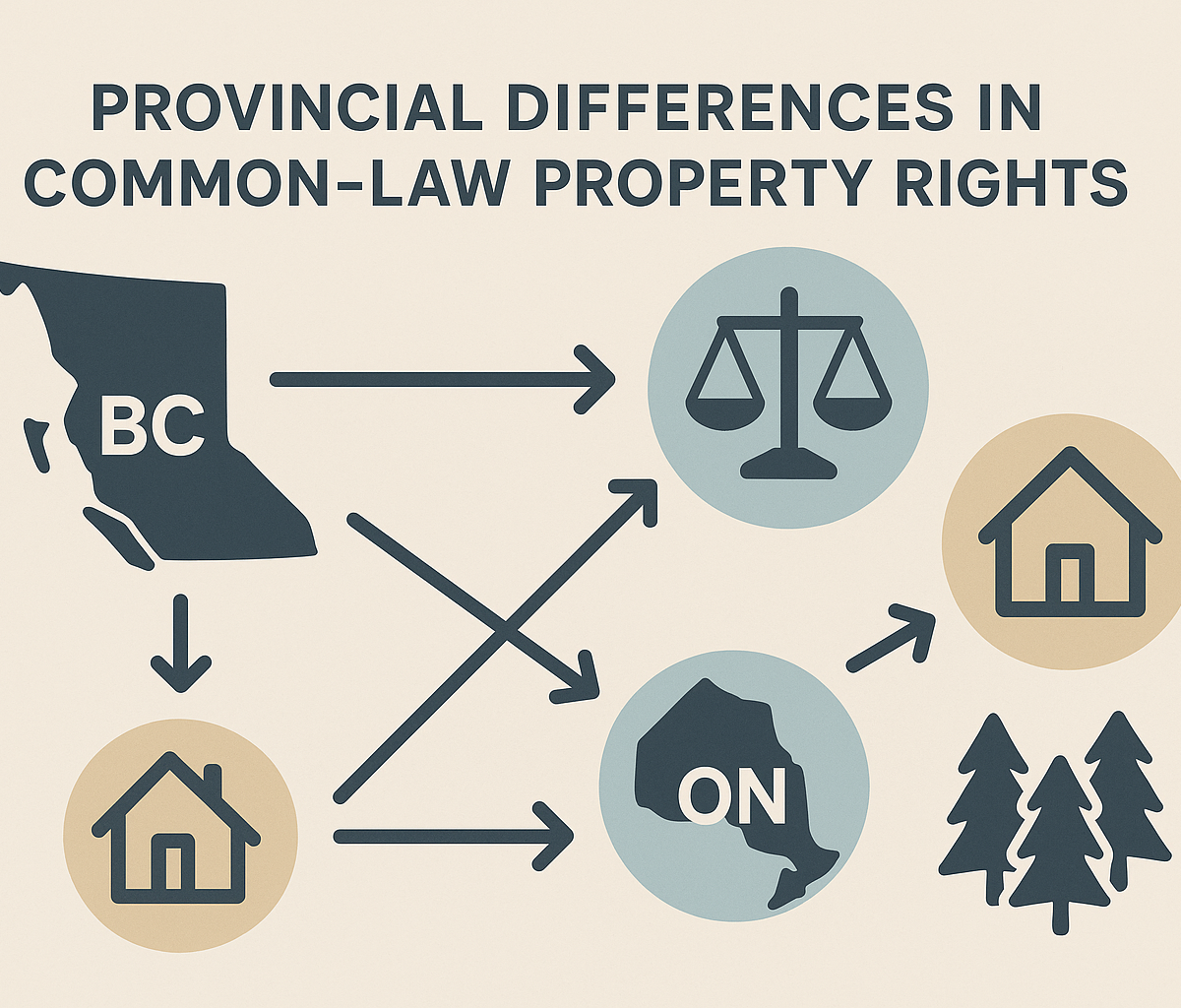
In British Columbia, Manitoba, Saskatchewan, and Alberta, qualifying unmarried partners can fall under statutory property-sharing rules. In Ontario, most common-law partners do not get the married-spouse equalization regime. In Quebec, most de facto spouses keep their own property, but the newer parental union regime creates a specific shared patrimony for some parents.
That is why the phrase “common-law means half of everything” is both too broad and sometimes dangerously wrong.
This article provides general legal information, not legal advice. Property rules and deadlines are province-specific. A family lawyer can explain how the law applies to your relationship, home, and other assets.
Quick answer by province
Canada has no single national law for dividing common-law property. The federal Department of Justice confirms that provinces and territories set their own property-division laws.
Here is a practical comparison of several major provincial regimes:
| Province | Is there an automatic 50/50 split for qualifying common-law partners? | Important threshold or exception |
|---|---|---|
| Ontario | No automatic equalization of property | Each partner generally keeps property in their own name, although joint ownership and equitable claims may matter |
| British Columbia | Often, for family property and family debt | The couple generally must have lived in a marriage-like relationship for at least two years |
| Alberta | Property-sharing rules can apply | The couple must qualify as adult interdependent partners, often after three years, sooner if they have a child or sign the prescribed agreement |
| Quebec | Usually no for ordinary de facto spouses | A parental union patrimony can apply to some parents of a common child born or adopted on or after June 30, 2025 |
| Manitoba | Often, for family property | The couple generally must register their relationship or live together for at least three years |
| Saskatchewan | Property legislation can apply | The statutory definition of spouse includes people who cohabit as spouses continuously for at least two years |
Even where equal sharing rules apply, “50/50” rarely means cutting every object or account in half. The law may share the net value of defined family property, exclude some pre-relationship property or gifts, account for debts, and allow agreements or court orders to change the result.
Why “common-law” does not have one legal meaning
Statistics Canada reported that 23% of Canadian couples lived common law in 2021, the highest share among G7 countries. Yet being common-law for one purpose does not automatically make you common-law for every purpose.
Different rules can use different definitions:
- the Canada Revenue Agency uses a federal definition for tax and benefit purposes
- provincial family law may use another threshold for support
- property legislation may use a different period of cohabitation
- pension, estate, insurance, and employment-benefit rules can each have their own tests
For example, filing taxes as common-law does not, by itself, give an Ontario partner a right to half the other partner's home. Reaching two years of cohabitation in British Columbia can have a very different property consequence.
Before asking “Are we common-law?”, ask the more precise question: “Are we spouses under the property law that applies in our province?”
Four things determine who gets what
When an unmarried couple separates, the result usually comes from some combination of four legal sources.
1. Legal ownership
The name on title, the account registration, and the purchase documents matter. A home owned by both partners is different from a home owned by only one. A joint bank account is different from a personal account.
Title is not always the whole answer, but it is the first document a lawyer will usually want to see.
2. Provincial family-property law
Some provinces extend their family-property regime to qualifying unmarried partners. Others reserve the married-spouse equalization regime for married couples.
Where a statute applies, it may define family property, excluded property, family debt, valuation dates, limitation periods, and the court's power to depart from equal sharing.
3. A cohabitation agreement
A properly prepared cohabitation agreement can set rules for ownership, contributions, debt, home equity, appreciation, buyouts, and separation. Depending on the province, it may supplement or contract out of default property rules.
If you are new to the topic, start with Prenuply's Canadian cohabitation agreement guide.
4. Equitable and trust claims
In provinces without automatic equalization for unmarried partners, a person who contributed money or work to property owned by the other partner may still have a claim.
The Supreme Court of Canada explained the role of unjust enrichment and a “joint family venture” in Kerr v. Baranow, 2011 SCC 10. These claims are fact-specific. They are not an automatic substitute for a statutory 50/50 division and often require litigation evidence about contributions, benefits, expectations, and the parties' economic integration.
Ontario: common-law partners do not automatically equalize property
Ontario draws a major distinction between married and unmarried couples.
The Ontario government states that common-law couples are not legally required to split property acquired while they lived together. Property and household items generally belong to the person who bought them. Common-law partners also do not automatically share the increase in value of property one partner brought into the relationship.
That does not mean the non-owner can never have a claim. A partner may be able to seek compensation or an interest based on contributions to the other person's property, but that is not the same as the married-spouse equalization calculation.
An Ontario cohabitation agreement can set out ownership, property division, support, and who will move out if the relationship ends. Under Ontario's Family Law Act, the agreement must be in writing, signed by both parties, and witnessed to meet the statutory form requirement.
Read the Ontario common-law and cohabitation agreement guide for a deeper province-specific explanation.
British Columbia: family property may be shared after two years
British Columbia is one of the clearest examples of why a Canada-wide answer fails.
The province explains that its property and debt rules apply to unmarried couples who have lived together in a marriage-like relationship for at least two years. Couples generally share family property acquired during the relationship and family debt. Property brought into the relationship is usually excluded at its original value, although increases in value can be divided.
Couples can make an agreement to divide property or debt differently. That makes a cohabitation agreement particularly useful where one partner owns a home, the partners are making unequal contributions, or either partner wants to preserve a different treatment for business interests or investments.
See Prenuply's BC cohabitation agreement and common-law rights guide.
Alberta: adult interdependent partners enter the property regime
Alberta uses the term “adult interdependent partner.” A relationship of interdependence can arise when two people live together in an interdependent relationship:
- continuously for at least three years
- for less than three years if they have a child together, or
- after they enter into an adult interdependent partner agreement in the prescribed form
The Alberta government says that adult interdependent partners have the same property-division rules and protections as married spouses. The Family Property Act applies to property acquired after the relationship of interdependence began, subject to the Act's exclusions, deductions, agreements, and court powers.
This is not the same as saying that every asset is automatically half-owned the moment the threshold is reached. Classification, valuation, exemptions, and the relationship start date still matter.
Read the Alberta adult interdependent partners guide before relying on a generic common-law rule.
Quebec: most de facto spouses keep their own property, with a new parental union exception
Quebec traditionally gives de facto spouses fewer automatic property rights than married or civil-union spouses. The province states that if an ordinary de facto union ends, each spouse generally keeps their own property.
The law changed for some parents on June 30, 2025. De facto spouses who become parents of the same child born or adopted on or after that date may automatically enter a parental union. The parental union patrimony can include family residences, household furniture, and vehicles used for family travel.
When the parental union ends, the net value of that defined patrimony is generally divided equally, with statutory deductions and exceptions. It does not make all property owned by the partners 50/50.
Quebec couples should identify whether they are ordinary de facto spouses, parental union spouses, married spouses, or civil-union spouses before applying any property rule. Prenuply's Quebec cohabitation agreement and parental union guide explains the distinction.
Manitoba and Saskatchewan: qualifying partners can enter family-property rules
Manitoba extends family-property laws to qualifying common-law partners. The province says the basic rule is that both partners have an equal share in the value of family property when they separate. The Family Property Act generally applies after partners register their relationship or live together in a conjugal relationship for at least three years.
Partners can sign an agreement to opt out of some default property-sharing rules, but technical requirements may apply.
Saskatchewan's Family Property Act defines spouse to include a person who has cohabited with another as spouses continuously for at least two years. Qualifying partners can therefore enter the Act's family-property regime, subject to its definitions, exemptions, agreements, and court discretion.
These examples are not a complete summary of every province and territory. Atlantic Canada and the territories have their own statutes and definitions. If you have recently moved, own property in another province, or live on reserve, get advice about which law applies.
Does paying the mortgage give you half the house?
Not automatically.
Mortgage payments can be relevant, but the result depends on title, the applicable statute, the purpose of the payments, the couple's agreement, and the evidence of their intentions.
Consider three different situations:
- Both partners are on title as equal owners. The registered ownership is an important starting point, even if the down payments were unequal.
- One partner owns the home and the other pays household expenses. In Ontario or Quebec, those payments do not automatically convert into half ownership. In BC or Alberta, statutory family-property rules may apply if the relationship qualifies.
- One partner funds major renovations or mortgage principal on the other's home. That can create a dispute about repayment, beneficial ownership, unjust enrichment, or the sharing of appreciation.
If one person already owns the property, read cohabitation agreements when one partner owns the house. If you are purchasing together, use the cohabitation agreement for buying a house guide.
What if the down payments are unequal?
Unequal down payments are one of the most common reasons couples want a written agreement.
Before closing, decide whether the extra contribution is:
- a larger ownership share
- a loan to the couple or the other partner
- an amount returned first on sale before the remaining equity is divided
- a gift with no repayment right
Then address mortgage principal, renovations, carrying costs, appreciation, losses, sale expenses, and a buyout formula. A title percentage alone may not answer all of those questions.

What a cohabitation agreement can clarify
A cohabitation agreement replaces assumptions with written rules. Depending on the province and the couple's goals, it can address:
- property each partner owned before living together
- ownership of a current or future home
- down payment credits and unequal contributions
- mortgage principal, interest, taxes, repairs, and renovations
- whether appreciation is shared
- bank accounts, investments, pensions, businesses, and personal property
- responsibility for existing and future debt
- buyout, sale, valuation, and move-out procedures
- spousal support, subject to legal limits and later court review
- what happens if the couple marries
- review dates after a home purchase, child, move, inheritance, or business change
The agreement should be based on meaningful financial disclosure. Each partner should have time to review it and the freedom to obtain separate legal advice. The signing requirements and the court's power to review an agreement vary by province.
Use the cohabitation agreement checklist to organize the information before drafting.
Seven mistakes that create common-law property disputes
1. Treating CRA status as a property rule
Tax status and provincial property rights are different legal questions.
2. Assuming time alone always creates half ownership
Two years matters in BC and Saskatchewan. Three years can matter in Alberta and Manitoba. The same passage of time does not create Ontario's married-spouse equalization regime.
3. Calling every payment “rent” without documenting it
A label in an e-transfer memo may not resolve what the couple intended over several years.
4. Relying only on title
Title is important, but a family-property statute, written agreement, or equitable claim can alter the analysis.
5. Ignoring debt
Credit cards, lines of credit, tax debt, and renovation loans can be as important as the home value.
6. Waiting until separation to discuss the rules
An agreement is easier to negotiate while the relationship is cooperative and before a dispute has crystallized.
7. Using a form from another province
Definitions, formalities, and default property regimes differ. A document designed for Ontario may not address BC's two-year spouse definition or Quebec's parental union rules.
Practical checklist before moving in, buying a home, or signing
- Confirm the province whose law is likely to apply.
- List each partner's assets, debts, income, pensions, business interests, and expected inheritances.
- Obtain current title, mortgage, investment, and loan records.
- Decide how monthly expenses differ from equity-building contributions.
- Document unequal down payments and family gifts or loans.
- Agree on how appreciation, losses, renovations, and sale costs will be treated.
- Plan for a buyout, sale, or move-out if the relationship ends.
- Create a province-aware cohabitation agreement.
- Give each partner time and access to separate legal advice.
- Sign with every formality required by the applicable law.
- Keep the signed agreement, schedules, and supporting disclosure together.
- Review the agreement after major life changes.
You can compare typical lawyer and online options in Prenuply's cohabitation agreement cost guide.
Frequently asked questions
Does a common-law partner automatically get half the house in Canada?
No. In Ontario and for most ordinary de facto spouses in Quebec, living together does not automatically give a partner half of a solely owned home. In BC, Alberta, Manitoba, and Saskatchewan, qualifying partners may enter statutory family-property regimes. Title, exclusions, contributions, agreements, and province-specific rules still matter.
How long do you have to live together before property is shared?
There is no Canada-wide period. Two years is important for BC and Saskatchewan property law. Three years is a common threshold in Alberta and Manitoba, with exceptions for children or registered agreements. Ontario does not extend married-spouse equalization to a couple simply because they have lived together for three years.
If both names are on the house, is it always split equally?
Joint ownership is a strong starting point, but the form of title, ownership percentages, trust claims, written agreements, mortgage obligations, and provincial family law can affect the final result. Couples with unequal contributions should document what they intend before a dispute arises.
Can a cohabitation agreement prevent a 50/50 split?
It can often set a different property arrangement or opt out of some statutory defaults, but the agreement must comply with the applicable province's law. Disclosure, informed consent, legal advice, clear drafting, and proper signing can all affect how reliable it is.
Can we sign a cohabitation agreement after moving in together?
Often, yes. Couples commonly sign before moving in, after moving in, or before buying a home. Do not delay if a statutory threshold is approaching, major money is changing hands, or the relationship is already under strain. Get province-specific advice about existing rights and any retroactive terms.
What happens to a cohabitation agreement if we marry?
The effect varies. Ontario's Family Law Act says a cohabitation agreement is deemed to become a marriage contract when the parties marry, but not every province uses the same rule or terminology. Review the agreement before the wedding to confirm that it still fits the couple's finances and the law that will apply.
Bottom line
Common-law property is not automatically 50/50 across Canada.
It can be close to an equal-sharing regime for qualifying partners in British Columbia, Alberta, Manitoba, and Saskatchewan. It is very different for most common-law partners in Ontario and ordinary de facto spouses in Quebec. Even within one province, title, relationship length, children, exclusions, debt, contributions, and written agreements can change the result.
The safest approach is to identify the law before a home purchase or separation forces the question. Prenuply helps Canadian couples organize their financial information and create a customized cohabitation agreement template as a starting point for independent legal review.
Start your cohabitation agreement while the decisions are still cooperative and the records are easy to find.