
A fair prenup is not necessarily a 50/50 split, and it is not automatically fair just because both people signed it. For Canadian couples, fairness usually starts with a sound process and continues into the actual terms.
That means both partners know the rights they would have without an agreement, exchange honest financial disclosure, have a real chance to negotiate, and understand how the proposed rules could affect them years later. The result may protect one person's house or business while also recognizing debt, caregiving, career sacrifices, disability, and the wealth the couple builds together.
This guide explains what a fair prenup can look like in Canada, which terms are worth testing, and which warning signs deserve a pause. It provides general legal information, not legal advice.
Quick answer: what is a fair prenup in Canada?
A fair prenup is an agreement that both partners enter voluntarily and with enough information, time, and independent advice to make an informed choice. Its terms should address both partners' real risks, not only the assets of the wealthier partner.
Fair does not always mean equal. One person may keep a home, business, inheritance, or investment account they brought into the marriage. A balanced agreement can still recognize the other person's contributions and protect against outcomes that become extreme after children, illness, relocation, or years outside the workforce.
The province matters. In Ontario, British Columbia, Alberta, and Quebec, the legislation, terminology, formalities, and court powers differ. For example, the Government of Quebec says a marriage contract must be signed before a notary. No online checklist can guarantee that a particular term will be enforced.
Fairness is not one Canadian formula
People often ask whether a prenup must be "fair" to be valid. The careful answer is that Canadian provinces do not all use the same test, and fairness is not a single percentage.
Ontario's Family Law Act allows a court to set aside a domestic contract or a provision if one party failed to disclose significant assets or debts, did not understand the nature or consequences of the contract, or if general contract law provides another reason. Other rules can apply to support, the matrimonial home, and child-related terms.
British Columbia's Family Law Act has a more express framework for property and debt agreements. Section 93 addresses significant non-disclosure, improper advantage of vulnerability, lack of understanding, other contract-law concerns, and significant unfairness in the statutory circumstances.
Alberta adds important formalities. Under sections 37 and 38 of the Family Property Act, each partner must make a written acknowledgment before a different lawyer, apart from the other partner, for certain agreements that contract out of the Act.
The practical lesson is simple: do not use "fair" as a substitute for learning the law that would otherwise apply. A balanced prenup begins with the legal baseline in the province where the couple lives and expects the agreement to operate.
Process fairness and outcome fairness
A useful way to evaluate a prenup is to separate the process from the result.
| Fairness question | What to look for |
|---|---|
| Did both people know the relevant facts? | Complete, current disclosure of assets, debts, income, ownership, and material future interests |
| Did both understand the legal baseline? | A plain explanation of what could happen without the agreement |
| Could both negotiate? | Enough time, no wedding-day pressure, and meaningful changes where concerns were raised |
| Did each receive separate advice? | Different legal professionals who can explain the agreement from each partner's perspective |
| Do the terms work in realistic scenarios? | Tested outcomes for separation after 2, 10, and 25 years, with and without children |
| Does the agreement address both partners' risks? | Property protection plus debt, support, caregiving, housing, disability, and record-keeping |
A polished document cannot fix a rushed or one-sided negotiation. At the same time, a careful process does not make every possible result sensible. Both sides of the table matter.
10 balanced terms to consider
There is no universal set of fair clauses. These 10 topics give couples and their lawyers a practical way to test whether the agreement reflects the life they are actually planning.
1. Define separate, shared, and future property
Start by identifying three categories:
- property each partner brings into the relationship
- property the couple already owns together
- property either partner may acquire after the wedding
Avoid treating "everything is separate" as a complete plan. The agreement should explain what happens to income earned during marriage, joint accounts, a future home, reinvested profits, replacement assets, and money moved between separate and shared accounts.
Both partners should be able to point to something the agreement protects for them. That might be a home for one person and pension savings or family gifts for the other.
2. Protect premarital assets on both sides
It can be reasonable for each partner to keep the assets they owned before marriage. Fairness improves when the rule is mutual, clearly documented, and paired with the debts attached to those assets.
For example, if one partner keeps a rental property, the agreement should also address its mortgage, tax liabilities, repair costs, and possible losses. A term that allocates every gain to one person while shifting the asset's risks to the household needs closer scrutiny.
Use schedules with account numbers partially masked, ownership details, values, and valuation dates. Prenuply's financial disclosure checklist explains what to gather before signing.
3. Decide who shares in growth during the marriage
Protecting the value an asset had at the start is different from protecting all future growth.
Couples commonly consider approaches such as:
- each person keeps both starting value and future growth
- starting value stays separate while relationship-era growth is shared
- active growth created by work is shared, while passive market growth stays separate
- a fixed percentage becomes shared after a set period
- documented household contributions create a reimbursement or other benefit
No option is automatically right. The wording should explain how growth is measured, which debts and taxes are deducted, and what happens when value falls.
4. Use a clear formula for a home and unequal down payments
A home clause should do more than say who "keeps the house."
If one person contributes a larger down payment, the agreement might return each documented contribution before dividing the remaining equity. Another couple may protect starting equity and split later appreciation. A third may use ownership percentages.
Test the formula with a rising market, a flat market, a loss, a major renovation, and a failed refinance. Include valuation, buyout, financing, and sale procedures.
Ontario matrimonial home rules require special care. Read Can a Prenup Protect a House in Canada? before assuming that title or a single sentence settles the issue.
5. Match debt responsibility with control and benefit
A balanced prenup can keep premarital student, business, tax, or consumer debt with the partner who incurred it. It should also address debts taken on after marriage.
Questions to ask include:
- Who approves new joint borrowing?
- Is debt for household expenses shared?
- What happens if one person's business credit line supports family spending?
- Who bears tax debt created by separate investments or a corporation?
- Does a joint guarantee create reimbursement rights between the partners?
The agreement cannot take away a lender's rights. A rule between spouses does not automatically release a co-borrower or guarantor.
6. Protect a business without ignoring family contributions
Keeping ownership and control of a premarital business separate can be a reasonable goal. The fairness question is what happens when family resources help the business grow.
Consider salary taken or deferred, personal guarantees, retained earnings, household money invested in the company, and unpaid work performed by the other partner. If one person takes a lower salary to build business value while the family lives on the other person's income, an agreement that ignores the arrangement may not reflect the couple's real economic partnership.
A business clause can protect shares and voting control while using other tools to address contributions, growth, or support. See Prenups for Entrepreneurs in Canada for the business-specific issues.
7. Recognize caregiving and career trade-offs
Many agreements are written as if both people will work full-time at their current incomes forever. Real marriages change.
A partner may take parental leave, move for the other's career, work fewer hours, care for a child with higher needs, support aging parents, or become disabled. Those choices can affect income, pension growth, professional seniority, and future employability.

A balanced agreement can anticipate these possibilities through a review clause, property-sharing adjustment, pension provision, housing protection, or carefully designed support terms. The right structure is fact-specific. The important point is to discuss the risk before one partner relies on a plan that the document does not recognize.
8. Treat spousal support as its own decision
Property and spousal support are related but different. A person who keeps less property may need more support, and a person who receives more property may need less.
Avoid assuming that a broad support waiver will always produce a reasonable result decades later. Consider income differences, relationship length, caregiving, illness, disability, and the standard of living the couple expects to build.
Possible structures include no waiver, a limited waiver with exceptions, a formula, a time-limited arrangement, or a requirement to review support after a major life event. Courts retain powers under provincial and federal law, so the clause should be reviewed locally.
Prenuply's guide to spousal support in a prenup explains the main planning choices and limits.
9. Coordinate separation terms with death and estate planning
A prenup should not accidentally conflict with wills, beneficiary designations, life insurance, trusts, or shareholder agreements.
If one partner waives claims to property on separation, does the couple still want the survivor to have housing, insurance, or estate protection after death? If children from a prior relationship are involved, how will the plan balance the surviving spouse's needs with the children's inheritance?
Family law and estate law use different documents and remedies. Ask the reviewing professionals to identify what needs to appear in the prenup and what belongs in a will, trust, designation, or insurance policy.
10. Add review triggers and workable records
A review clause does not have to make the agreement expire automatically. It can require the couple to revisit the document after events such as:
- the birth or adoption of a child
- one partner leaving the workforce
- a move to another province or country
- the purchase or sale of a home
- a major inheritance or business transaction
- disability or serious illness
- a significant change in income
- five or ten years of marriage
The agreement should also say which records matter. Keep the signed document, disclosure schedules, valuations, account statements, legal-advice certificates, and later amendments together.
Three examples of balanced structures
These are discussion models, not sample clauses.
Protect the starting point, share what comes next
Each partner keeps the documented net value of what they owned before marriage. Income earned during marriage and assets bought from that income are shared. Growth on premarital assets is addressed with a clear rule.
This model can appeal to couples who want to respect years of saving before the relationship while treating the marriage as an economic partnership.
Return unequal home contributions, then share equity
Each partner receives their documented down payment or capital contribution back from net sale proceeds. The remaining gain or loss is divided using an agreed percentage.
This can help couples buying together with different starting resources, but the formula must address mortgage principal, renovations, sale costs, and negative equity.
Protect ownership, add a caregiving adjustment
One partner keeps a business, inherited asset, or family property. If the other partner takes substantial time out of paid work for the family, a defined review or compensating mechanism applies.
This can preserve an asset while recognizing that a later career sacrifice may change what both partners consider balanced.
Red flags in an unfair prenup process
Pause and get separate advice if:
- the wedding or relationship is threatened unless the agreement is signed immediately
- one partner receives the draft only days before the wedding
- important assets, debts, trusts, or corporate interests are missing
- only one partner understands the financial records
- one lawyer appears to be advising both people
- the agreement protects gains for one partner but assigns losses to the other
- caregiving plans are discussed verbally but ignored in the document
- a partner is asked to waive support without seeing realistic future scenarios
- the document tries to predetermine child support or parenting as if a court has no role
- the numbers, formulas, or defined terms produce different answers when tested
An agreement does not need identical benefits for each person. It does need a process in which both can understand what they are giving and receiving.
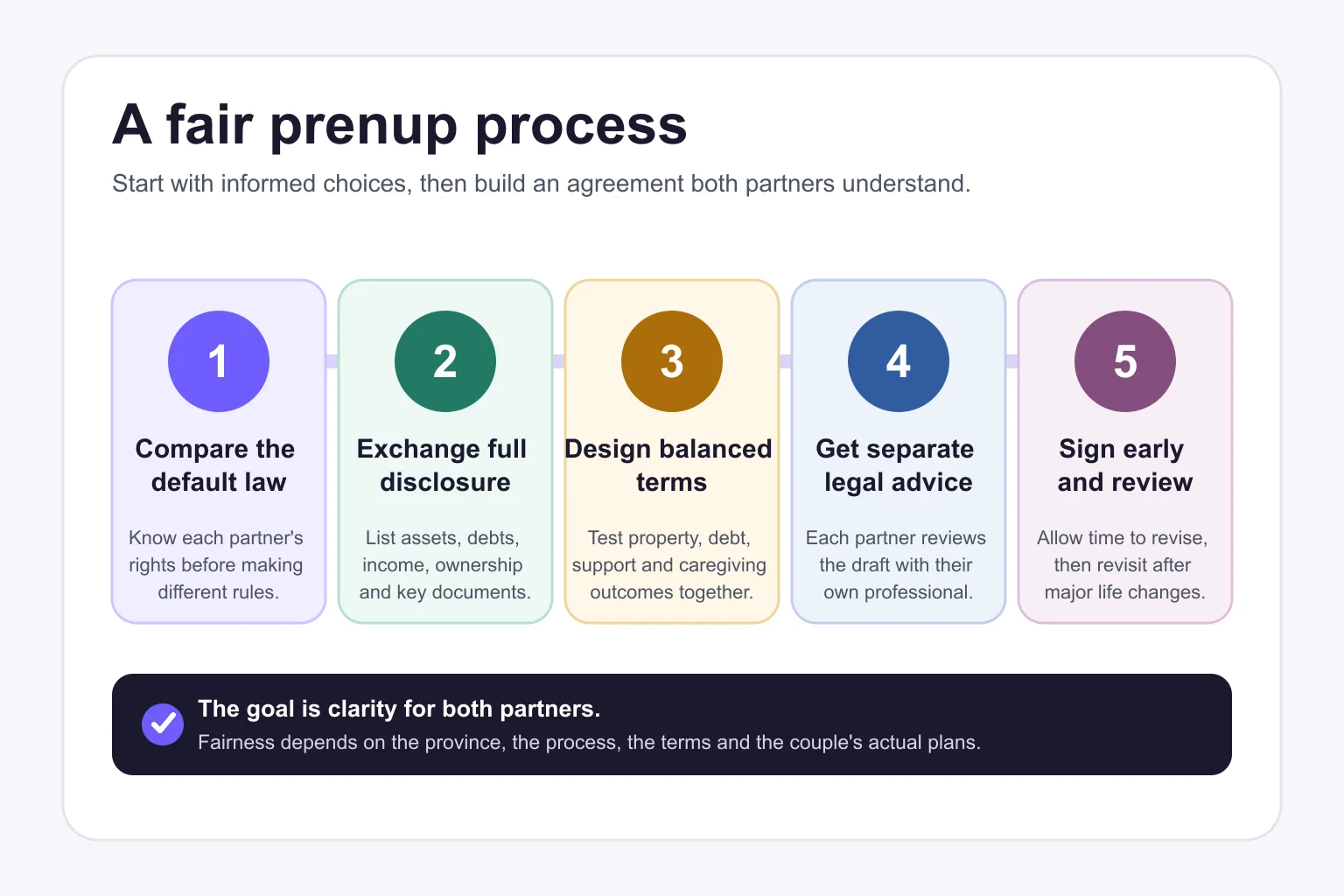
A practical fair-prenup process
1. Learn the default law first
You cannot assess a proposed prenup without knowing what would happen if you signed nothing. Identify the rules for property, debt, support, pensions, and the family home in your province.
2. Exchange financial disclosure
List significant assets, debts, income, corporate interests, trusts, expected inheritances where relevant, and supporting documents. Update values if the process takes several months.
3. Write down both partners' goals
Each partner should identify what they want to protect and what they are concerned about. Compare the lists before drafting.
4. Test the proposed rules
Run scenarios for a short marriage, a long marriage, children, no children, career interruption, illness, a home purchase, business growth, and market loss.
5. Use separate legal advice
Each partner should review the same complete draft and disclosure package with their own legal professional. Independent legal advice helps identify rights, risks, missing facts, and unclear language.
6. Leave time for real negotiation
Do not treat the first draft as final. Allow questions, revisions, valuations, and coordination with tax, corporate, real estate, or estate professionals where needed.
7. Sign correctly and keep the full file
Follow the formal requirements in the relevant province. Alberta and Quebec have particularly specific processes. Keep signed copies and all supporting schedules and certificates.
FAQ
Does a fair prenup have to be 50/50?
No. A fair prenup can produce unequal results when the couple knowingly chooses them through a sound process. The agreement should clearly explain which assets, growth, debts, or support rights are treated differently and why the structure fits the couple's plans.
Can one partner keep a house or business?
Often, an agreement can protect a defined interest in a house or business, subject to provincial law and court review. The document should also address debt, growth, contributions, valuation, tax, and practical sale or buyout rules.
Is a prenup unfair if one person gets more?
Not automatically. Starting assets, income, debt, caregiving, children, business risk, and estate plans can justify different outcomes. The concern is whether the process and overall result address both partners' rights and realistic risks.
Can a prenup leave one spouse with nothing?
An extreme outcome deserves careful, separate legal review. Provincial statutes and contract law may allow courts to scrutinize or set aside certain agreements or terms. Support and child-related rules also create separate limits. Do not assume a signature makes every outcome permanent.
What if one partner plans to stay home with children?
Model the effect on income, pension growth, employability, and housing. Discuss support, property sharing, insurance, and review triggers before the career change occurs.
Are sunset clauses fair?
A sunset clause ends or changes terms after a set period. It may fit some couples, while others prefer scheduled reviews or step-up sharing. The legal and tax effects should be reviewed in the relevant province.
Do both partners need their own lawyer?
Separate legal advice is strongly recommended and is built into certain provincial formalities. One lawyer cannot advise both partners about competing interests. Each person should understand the rights being changed and the consequences of the agreement.
Can we change a prenup later?
Couples can often amend or replace an agreement if they both consent and follow the required process. A rushed handwritten change or verbal promise may not have the intended effect. Use updated disclosure and separate advice.
Bottom line
A fair prenup in Canada is not a magic percentage. It is a transparent process and a set of terms designed around both partners' actual lives.
Start with the provincial legal baseline. Disclose the full financial picture. Test property, debt, support, caregiving, housing, and estate outcomes over time. Then give each partner enough space and separate professional advice to make an informed decision.
If you are ready to organize those decisions, create a personalized Canadian prenup draft with Prenuply. Use the draft as a structured starting point, then have each partner obtain independent legal review before signing.
Sources checked
This article was researched and checked on July 23, 2026 using the Ontario Family Law Act, the British Columbia Family Law Act, the Alberta Family Property Act, Government of Quebec marriage contract guidance, Rick v. Brandsema, 2009 SCC 10, and Hartshorne v. Hartshorne, 2004 SCC 22.
Prenuply AI Inc. is not a law firm and does not provide legal services or legal advice. Prenuply provides technology tools and general legal information to help users prepare agreement drafts for review with qualified legal professionals.