
If you own a home before marriage, plan to buy one together, or expect family help with the down payment, you may be asking one urgent question: can a prenup protect a house in Canada?
Often, a carefully prepared agreement can set important rules for a home. It may address ownership, starting equity, mortgage payments, renovations, appreciation, sale proceeds, and a future buyout. But a prenup does not change the name on title, rewrite the mortgage, remove a lender's rights, or override every family-home rule in every province.
The result depends on where you live, whether you are married or common-law, how the home is owned, what money goes into it, and how the agreement is created. Ontario's matrimonial home rules are not the same as British Columbia's excluded-property rules. Quebec uses a different civil-law system and requires marriage contracts to be notarized.
This guide explains what a Canadian prenup can realistically do for a house, what clauses to discuss, and what records to keep. It is general legal information, not legal advice. Have each partner obtain advice from a qualified professional in the province where you live.
Quick answer: can a prenup protect a house in Canada?
Yes, a prenup can often help protect a house or define how its value will be treated if the relationship ends. Depending on provincial law and the final wording, an agreement may:
- identify who owned the home before the relationship
- record the home's value and mortgage balance at the start
- preserve some or all of one partner's starting equity
- define whether future appreciation is separate or shared
- explain how mortgage principal, interest, taxes, and repairs will be handled
- create reimbursement rules for unequal down payments or renovations
- set out a sale, valuation, or buyout process
- coordinate family gifts or loans with the couple's property plan
There are important limits. The agreement cannot remove a bank's rights under the mortgage. It does not automatically transfer legal title. It cannot safely be used to hide property or defeat creditors. In Ontario, a marriage contract cannot limit the statutory rights in Part II of the Family Law Act, including both spouses' equal right to possess a matrimonial home while they are spouses.
So the useful question is not simply, "Can a prenup protect my house?" It is: "Which financial interests can our agreement define, and which ownership, possession, lender, or provincial rules still apply?"
Does a prenup change who owns the house?
Not by itself.
Legal title, the mortgage, and the family agreement are related documents, but they do different jobs.
| Document or record | What it usually shows | What it does not automatically decide |
|---|---|---|
| Land title or deed | Who holds the registered ownership interest | Every family-law claim between spouses |
| Mortgage | Who owes the lender and what secures the loan | How partners reimburse each other after separation |
| Prenup or marriage agreement | Rights and obligations between the partners | The lender's rights or an automatic title transfer |
| Appraisal and statements | Value, debt, and payment history | The legal outcome without an agreement or order |
If the home is in one partner's name, the agreement can say how the couple intends to treat its value. If both names are on title, the agreement can define unequal beneficial interests or reimbursement rules, subject to local property and registration advice. But if you intend to add or remove an owner, your family lawyer should coordinate with a real estate lawyer and the mortgage lender.
Do not assume that "my name is on title" ends the analysis. Also do not assume that a sentence in a prenup quietly changes title. The documents should be designed to work together.
Seven house issues a useful prenup should address
1. The starting value and mortgage balance
If one person already owns the home, record the home's fair market value, the mortgage and secured line-of-credit balances, and the resulting equity close to the agreement date.
For example, "Partner A owns the home" is less useful than a schedule showing:
- the municipal address and legal description
- the registered owner
- the purchase date and price
- a current independent appraisal or defensible valuation
- the outstanding mortgage and other secured debts
- the estimated net equity
Those records give the future calculation a starting point. Without them, the couple may agree that starting equity is protected and later disagree about what that equity was.
2. Appreciation and market losses
The agreement should say whether the home's change in value is separate, shared equally, or shared according to a formula.
Possible approaches include:
- the owner keeps the starting equity and all later appreciation
- the owner keeps the starting equity while later appreciation is shared
- appreciation is divided according to the partners' capital contributions
- a fixed percentage applies regardless of who paid each expense
- the result changes after a certain number of years or after a child is born
The formula should also deal with a decline in value. A clause that explains gains but ignores losses can fail when the mortgage is larger than the sale proceeds.
3. Down payments and money from family
When parents help with a home, state whether the money is:
- a gift to one partner
- a gift to both partners
- a loan that must be repaid
- an advance on inheritance
- a contribution intended to buy a specific ownership percentage
The prenup should match the gift letter, loan agreement, banking records, title instructions, mortgage application, and estate plan. Calling money a "loan" in one document and a "gift" in another creates avoidable uncertainty.
If family money is part of your plan, read Prenup for a Down Payment Gift in Canada before the funds move.
4. Mortgage, taxes, insurance, and routine costs
Not every housing payment builds equity. Mortgage principal reduces debt, while interest, property tax, insurance, utilities, and ordinary maintenance pay for the cost of living in the home.
A useful agreement distinguishes these categories. It may say that ordinary household payments do not create an ownership interest, while specified capital contributions do. Or the couple may decide that certain mortgage principal payments earn a reimbursement or percentage.
The right answer depends on the couple's intended bargain. The important point is to make the rule explicit before years of mixed payments make the history difficult to reconstruct.
5. Renovations and sweat equity
Renovations can be funded with cash, borrowed money, unpaid labour, or all three. Decide whether a major improvement creates:
- no additional ownership interest
- repayment of documented costs
- repayment plus an agreed return
- a share of the value added by the renovation
- a revised ownership percentage recorded in a later schedule

Keep invoices, permits, contractor agreements, bank statements, and before-and-after valuations for large projects. If unpaid labour is meant to have a financial value, define how it will be measured instead of relying on memory years later.
6. Occupancy after separation
Ownership and the right to live in the home are not always the same issue. Children, safety, court orders, provincial family-home rules, and the time needed to refinance can affect temporary possession.
An agreement can create a practical process, such as notice periods, responsibility for expenses during interim occupancy, and a deadline to refinance or list the property. It should not promise a result that conflicts with legislation or a court's powers.
7. Sale or buyout mechanics
"Partner A keeps the house" is incomplete if Partner A cannot qualify for a new mortgage or pay the agreed amount.
The agreement should consider:
- how and when the home will be valued
- who chooses the appraiser
- whether either partner has the first option to buy
- the deadline to obtain financing
- how sale costs and taxes are treated
- how the mortgage is discharged
- how starting equity, reimbursements, and remaining proceeds are calculated
- what happens if neither person can refinance
A clear fallback is usually a sale on the open market after a defined period. The exact process should be reviewed by family, real estate, and tax professionals where appropriate.
A house formula should be tested with numbers
Before accepting a clause, run it through at least three scenarios: a rising market, a flat market, and a loss.
Assume one partner owns a home worth $700,000 with a $450,000 mortgage when the agreement is signed. Starting equity is $250,000. Years later, the home is worth $900,000 and the mortgage is $350,000, producing $550,000 of gross equity before sale costs.
Different clauses could produce very different results:
| Example approach | Illustrative result before costs |
|---|---|
| Owner keeps all equity | Owner receives $550,000 |
| Owner keeps $250,000 starting equity, remainder shared | Owner receives $400,000 and other partner receives $150,000 |
| Starting equity indexed, remaining growth shared | Result depends on the agreed index and calculation date |
| Contributions determine percentages | Result depends on documented deposits, principal, and capital costs |
These figures are illustrations, not legal formulas. The exercise exposes questions the drafting must answer. Does "starting equity" stay fixed or grow with the market? Are mortgage principal payments counted? Are renovation costs repaid before the remainder is divided? Are transaction costs deducted first?
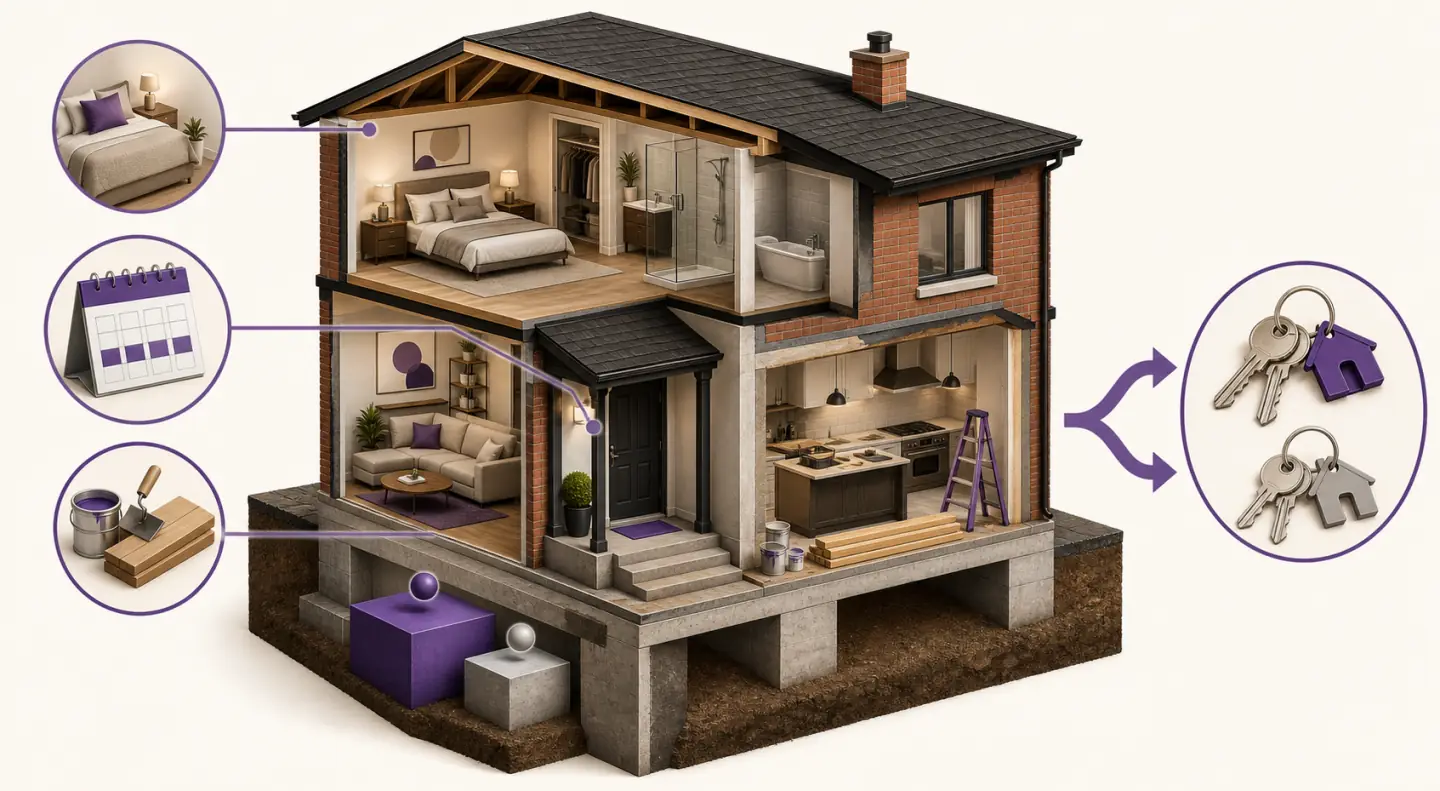
If two people can reach different answers using the same clause, the clause needs more work.
Province snapshot: house rules are not the same across Canada
Family property law is provincial and territorial. This section highlights four common examples, not every rule or exception.
Ontario: special matrimonial home treatment
Ontario is the province where a home owned before marriage most often surprises people.
Ontario's public guidance says that the full value of the family home is included in the equalization calculation even if one spouse owned it before marriage, received it as a gift, or inherited it. The usual date-of-marriage deduction does not apply to a property that is a matrimonial home at separation.
The Ontario Family Law Act allows spouses and people intending to marry to make a marriage contract dealing with ownership and division of property. That means a carefully drafted contract may change the financial result between the spouses.
However, section 52(2) says a marriage contract provision that tries to limit a spouse's rights under Part II, Matrimonial Home, is unenforceable. Part II includes equal possession rights while the parties are spouses and restrictions on selling or mortgaging the home without the other spouse's consent.
In practical terms, an Ontario agreement may address the value or equalization treatment of the home, but it cannot simply erase statutory possession rights. Read the detailed Ontario prenup and matrimonial home guide if the property is in Ontario.
British Columbia: starting property may be excluded, growth is different
Under BC's Family Law Act, property acquired before the spousal relationship began is generally excluded property. The spouse claiming the exclusion must prove it. The increase in value of excluded property during the relationship is generally family property.
Sections 92 and 93 allow written, witnessed agreements to divide property and debt equally or unequally, include or exclude property, and use a different valuation approach. A court may set an agreement aside for significant non-disclosure, vulnerability, lack of understanding, other contract-law concerns, or significant unfairness in the statutory circumstances.
For a BC homeowner, the agreement can define how starting equity and later growth will be handled, but the records proving the original value still matter. See Prenuptial Agreements in BC.
Alberta: property agreements have formal lawyer acknowledgments
Alberta's Family Property Act permits spouses and adult interdependent partners to make a written agreement about the status, ownership, and division of property.
Sections 37 and 38 impose a specific process for contracting out of the statutory property rules. Each person must make a written acknowledgment, apart from the other, before a different lawyer. The acknowledgment covers understanding the agreement, awareness of possible future property claims, and signing freely and voluntarily.
A house clause should be coordinated with that formal process, not pasted into a generic document at the last minute. The Alberta prenuptial agreement guide explains the signing requirements in more detail.
Quebec: family patrimony and a notarial marriage contract
Quebec uses a civil-law framework. The Government of Quebec's marriage contract guidance says a marriage contract must be signed before a notary. It can choose or modify a matrimonial regime and address property outside the family patrimony.
The Civil Code's family patrimony rules are mandatory in important ways. Article 423 says spouses cannot renounce family patrimony rights in advance through a marriage contract or otherwise. Family residences can form part of that patrimony.
A downloadable online draft is therefore not a completed Quebec marriage contract, and a home-protection plan must be reviewed and executed through a Quebec notary.
If you live in another province or territory, confirm the default property rules, formalities, family-home protections, and court review standards that apply there. Do not copy an Ontario or BC clause and assume it travels across Canada unchanged.
What if you are not married yet?
If you live together and do not plan to marry immediately, the right document may be a cohabitation agreement rather than a prenup.
That distinction matters because common-law property rights vary sharply by province. In Ontario, unmarried partners do not automatically use the married-spouse equalization system, although contribution-based claims may arise. In British Columbia, many unmarried partners become spouses for property purposes after living in a marriage-like relationship for at least two years. Alberta's Family Property Act also applies to adult interdependent partners.
If one partner already owns the home, start with Cohabitation Agreement When One Partner Owns the House. If you are buying together, use the Cohabitation Agreement for Buying a House in Canada.
Couples who expect to marry should ask whether the cohabitation agreement continues, changes, or should be replaced after marriage. Ontario generally deems a cohabitation agreement to become a marriage contract when the partners marry, but some home-related terms can still be affected by matrimonial home rules.
Records to collect before drafting the house clauses
Good wording cannot rescue missing facts. Assemble a house disclosure package that includes:
- title search or deed
- purchase agreement and closing statement
- current mortgage and secured line-of-credit statements
- current appraisal or a defensible valuation method
- property tax assessment, while recognizing it may not equal market value
- proof of the original down payment
- gift letters or family loan documents
- major renovation invoices and permits
- proof of mortgage principal payments
- co-ownership, trust, or nominee agreements
- rental or business-use information if the property has mixed use
- insurance and tax information relevant to a sale or transfer
Both partners should disclose their wider financial position too. A court may look at the agreement as a whole, not only the house paragraph. Use Prenuply's financial disclosure checklist to organize the rest of the package.
A practical process for protecting a home
Step 1: identify the exact concern
Are you protecting starting equity, a parent's gift, future appreciation, affordability, or the right to stay temporarily? Each concern needs a different rule.
Step 2: learn the default law
You cannot evaluate a prenup without knowing what would happen if you signed nothing. Confirm whether the relationship is treated as married, common-law, or an adult interdependent partnership in your province.
Step 3: align title, mortgage, and agreement plans
Tell the family lawyer who is on title, who owes the mortgage, and whether either will change. Obtain lender consent where required. Do not sign a family agreement based on a title transfer that may never be approved.
Step 4: choose a formula and test it
Run realistic numbers for appreciation, a sale loss, unequal principal payments, a large renovation, and a failed refinance. Write down the order of calculations.
Step 5: exchange complete disclosure
Give each partner the valuation, debt records, and wider financial disclosure with enough time to review them.
Step 6: use separate legal review
Each partner should obtain independent advice. Alberta has specific separate-lawyer acknowledgments, Quebec requires a notary, and separate advice is a strong safeguard elsewhere. Learn what to expect in Independent Legal Advice for Prenups in Canada.
Step 7: keep the evidence and review the plan
Store the signed agreement, certificates, disclosure, appraisal, and contribution records together. Review the agreement after a purchase, refinance, title change, major renovation, move to another province, or large family contribution.
Common mistakes to avoid
- Relying on title alone without learning the family-property rules.
- Saying the owner "keeps the house" without a buyout and financing process.
- Protecting gains while ignoring losses and sale costs.
- Treating every housing payment as an ownership contribution.
- Calling parental money a gift in one place and a loan in another.
- Using an old tax assessment as the only evidence of market value.
- Trying to make a prenup bind the mortgage lender.
- Copying a clause from another province.
- Signing shortly before the wedding without full disclosure and separate advice.
- Forgetting to update the plan after adding a partner to title or refinancing.
For the broader enforceability risks, read Are Prenups Enforceable in Canada?.
FAQ
Can a prenup keep a house in my name in Canada?
A prenup can often state that the home or a defined interest in it remains separate between the partners, subject to provincial law and court review. It does not itself guarantee that title will never change or remove family-home possession rights. Coordinate the agreement with title, mortgage, and real estate advice.
If I bought the house before marriage, is it automatically protected?
No. The answer varies by province. Ontario gives a matrimonial home special treatment and generally does not allow the usual date-of-marriage deduction for a home that is the matrimonial home at separation. BC generally treats property acquired before the relationship as excluded, but later growth is generally family property. Obtain province-specific advice.
Can a prenup protect my down payment?
It can often create a reimbursement or equity formula for a documented down payment. The clause should state whether the amount is fixed, indexed, paid before other proceeds are divided, or converted into a percentage. Keep bank records and coordinate any family gift or loan documents.
Does paying the mortgage give my partner part of the house?
Not automatically in a simple one-payment-one-percentage way. The result depends on title, provincial law, the relationship status, the nature of the payment, and any agreement. A prenup or cohabitation agreement can define how principal payments, interest, taxes, and maintenance are treated between the partners.
Can a prenup protect an inherited house?
It may help define how an inherited home and its growth are treated, but using the property as the family home can change the analysis. Ontario and Quebec have particularly important family-home or family-patrimony rules. Keep inheritance, title, valuation, and mortgage records, and obtain local advice before moving family money into the property.
What happens if the owner cannot afford the buyout?
The agreement should provide a financing deadline and a fallback sale process. A promise to keep the house cannot force a bank to approve refinancing or release the other borrower from the mortgage.
Do both partners need lawyers for a house prenup?
Separate legal advice is strongly recommended. A home is often the couple's largest asset, and each person needs to understand both the agreement and the rights being changed. Alberta has formal separate-lawyer acknowledgment requirements for agreements under its Family Property Act, and Quebec marriage contracts require a notary.
Bottom line
A prenup can often protect a house in Canada by defining starting equity, appreciation, contributions, reimbursements, and sale or buyout rules. It works best as part of a coordinated plan, not as a magic sentence.
The strongest process combines accurate valuation, full financial disclosure, clear formulas, enough time, separate professional advice, and records that match title, mortgage, gift, and loan documents. Province-specific limits still apply, especially for Ontario matrimonial homes and Quebec family patrimony.
If you are ready to organize the decisions, create a Canadian prenup draft with Prenuply, then have each partner take the draft and disclosure package to independent legal professionals before signing.
Sources checked
This article was researched and checked on July 21, 2026 using the Ontario Family Law Act, Ontario guidance on dividing property, the British Columbia Family Law Act, the Alberta Family Property Act, Alberta family law change guidance, Government of Quebec marriage contract guidance, and the Civil Code of Quebec family patrimony rule.
Prenuply AI Inc. is not a law firm and does not provide legal services or legal advice. Prenuply provides technology tools and general legal information to help users prepare agreement drafts for review with qualified legal professionals.