
A last-minute prenup in Canada is not automatically impossible, but it is usually harder than couples expect. The legal document is only one part of the work. You also need financial disclosure, time to review terms, room for revisions, and a realistic chance for each partner to get independent legal advice before signing.
There is no single Canada-wide deadline that says a prenup must be signed a certain number of days before the wedding. The real question is whether the process looks fair, informed, and voluntary. If the agreement is rushed, sprung on one partner, or signed under wedding pressure, it may be easier to challenge later.
This guide explains when a last-minute prenup may still be workable, when it becomes risky, and what to do if your wedding date is close.
Is it ever too late to get a prenup in Canada?
It depends on how close the wedding is and how much work is left.
A prenup is more realistic if both partners already agree on the main terms, have organized their financial information, and can each speak with their own lawyer quickly. It becomes much riskier if one partner is seeing the idea for the first time, major assets are still undisclosed, or the signing would happen right before guests arrive.
A practical rule is this: the closer you are to the wedding, the simpler and more careful the process needs to be. If the timeline is too compressed, ask family lawyers whether you should wait and use the right post-wedding domestic contract or marriage contract route in your province instead of forcing a rushed signature.
For a broader planning sequence, see Prenuply's 8-step guide to creating a prenup in Canada. If you are still comparing options, the guide on where to get a prenup in Canada can help you choose between an online draft, a lawyer-led process, and province-specific review.
Why timing matters for enforceability
Courts usually look at the whole process, not just the wedding date. A prenup signed close to the ceremony can still be taken seriously if the surrounding facts show that both people understood what they were signing and had a fair chance to make decisions.
Timing matters because it affects several enforceability factors:
- Voluntariness: Was either partner pressured by the wedding date, family expectations, deposits, or travel plans?
- Disclosure: Did both partners have a clear picture of assets, debts, income, business interests, real estate, pensions, and other financial details?
- Understanding: Did each partner understand the nature and consequences of the agreement?
- Legal advice: Did each partner have enough time to get independent advice and consider changes?
- Fairness of process: Were important terms negotiated openly, or presented as a surprise?
Ontario's Family Law Act requires domestic contracts to be in writing, signed by the parties, and witnessed, and it also gives courts grounds to set aside a contract in situations such as non-disclosure or a failure to understand the nature or consequences of the agreement. British Columbia's Family Law Act, section 93 has similar practical themes for setting aside agreements, including significant non-disclosure, taking improper advantage of vulnerability, and lack of understanding.
That is why a last-minute prenup should not be treated as a form to sign. The process is the product.
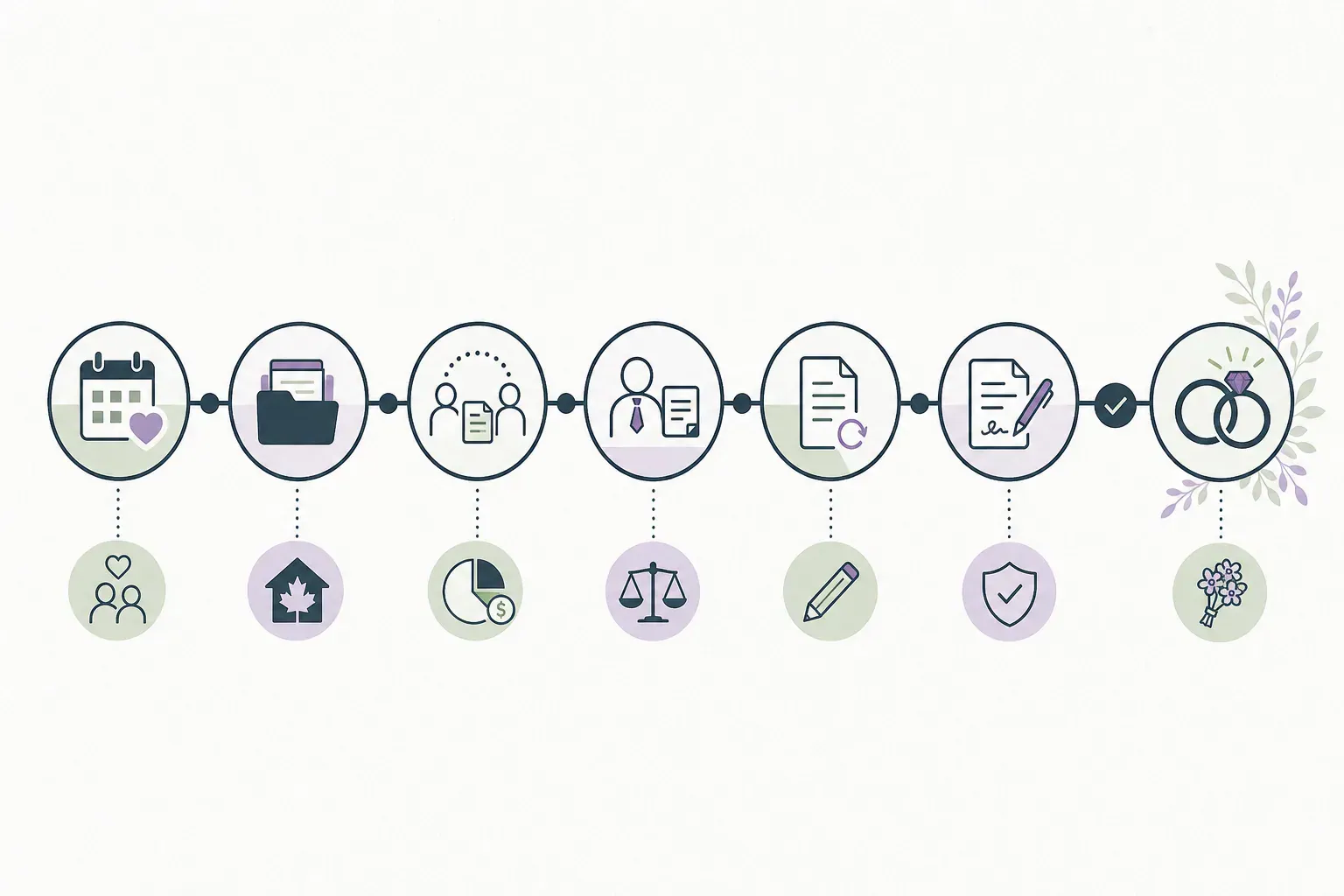
A practical prenup timeline before the wedding
Every couple is different, but these timing bands are a useful starting point.
| Time before wedding | Practical read | What to focus on |
|---|---|---|
| 8 weeks or more | Best planning window | Full disclosure, custom terms, lawyer review, revisions, calm signing |
| 4 to 6 weeks | Often workable | Keep documents organized, book lawyers early, avoid unnecessary complexity |
| 2 to 3 weeks | Possible but tight | Prioritize key terms, move quickly, leave revision and advice time |
| 1 week or less | High risk | Get urgent legal advice before signing anything, consider waiting if the process feels pressured |
| Day before or wedding day | Usually a bad idea | Avoid surprise demands, ultimatum-style signing, or ceremonial pressure |
This timeline is not a legal rule. It is a risk-management guide. Some simple files move quickly, and some complex files take months. A couple with businesses, multiple properties, blended family obligations, private company shares, expected inheritances, or cross-border assets should assume the process will take longer.
What to do if the wedding is 30 days away
A 30-day window can be workable if both partners are aligned and responsive. The goal is to reduce friction without cutting corners.
1. Decide the must-have terms first
Do not try to solve every possible future disagreement in the first draft. Start with the reason you are getting the prenup.
Common priorities include:
- protecting a home one partner owned before marriage
- keeping a business or professional practice separate
- protecting an inheritance or expected family gift
- clarifying responsibility for student loans, tax debt, or business debt
- setting rules for increases in value during the marriage
- deciding whether and how spousal support should be addressed
If you are unsure what belongs in the agreement, review what cannot be included in a prenup in Canada before you draft. Child support and parenting terms are especially sensitive and should be discussed with a lawyer.
2. Build financial disclosure immediately
Financial disclosure is where many last-minute prenups stall. The agreement should be based on a clear understanding of each person's financial picture.
Gather current information about:
- bank and investment accounts
- real estate and mortgages
- business interests and shareholder agreements
- pensions, RRSPs, TFSAs, and other registered accounts
- credit cards, loans, tax debts, and lines of credit
- valuable personal property
- expected inheritances or family gifts, if relevant
- income, bonuses, commissions, and self-employment earnings
Prenuply has a dedicated financial disclosure checklist for Canadian prenups if you need a deeper list.
3. Create a draft before lawyers review it
A clear draft helps lawyers move faster because they can react to actual language instead of starting from vague instructions. That is where an online tool can help, as long as it is used correctly.
Prenuply lets couples organize their information and generate a Canadian prenup template to take to lawyers for review. You can start a prenup draft if you need a structured first version, but the draft should not replace independent legal advice.
4. Book separate legal review early
Each partner should have their own chance to ask questions privately. Sharing one lawyer for both partners is not a substitute for independent advice.
When time is short, contact lawyers before the draft is perfect. Ask whether they can review within your deadline, what documents they need, and whether the timeline is realistic. If either lawyer says the process is too rushed, take that warning seriously.
5. Leave room for revisions
A first draft is rarely the final draft. One partner may want clearer wording, more disclosure, a different support clause, or a narrower approach to a business or home.
If your schedule has no time for changes, it may be too tight. A signature after real review is stronger than a signature obtained quickly.
What if the wedding is less than two weeks away?
Less than two weeks is not the time for surprises. If one partner is just learning about the prenup, slow down.
You still have options:
- Start the disclosure process now: Even if signing before the wedding is unrealistic, organized disclosure helps the next step.
- Create a draft for review: A draft can clarify issues and make lawyer conversations more productive.
- Ask lawyers whether signing before the wedding is appropriate: Do not assume speed is acceptable because the document is short.
- Consider a post-wedding agreement route: In some provinces, couples can enter a domestic contract or marriage contract after marriage. The name, rules, and formalities vary by province.
- Do not use the wedding as leverage: A prenup presented as an ultimatum right before the ceremony creates avoidable risk.
A rushed agreement can also be emotionally expensive. Even if it is technically signed, it can damage trust if one partner feels cornered. If your goal is long-term financial clarity, the process should feel deliberate.

Province-specific timing issues to know
Prenups and marriage contracts are governed provincially, so timing problems can look different depending on where you live.
Ontario
In Ontario, prenups are usually called marriage contracts. The Family Law Act sets formal requirements for domestic contracts and includes set-aside grounds related to disclosure, understanding, and general contract law. A last-minute signing can raise questions if one partner did not have enough time to understand the agreement or get advice.
Ontario also has special rules around the matrimonial home. If your prenup is partly about a house one partner bought before marriage, read the guide on Ontario prenups and the matrimonial home.
British Columbia
In BC, agreements about property and debt are often analyzed under the Family Law Act. Section 93 lets a court set aside or replace an agreement in certain circumstances, including significant non-disclosure, vulnerability, lack of understanding, and other common-law concerns. This makes timing important because rushed review can feed into those issues.
For a province-specific overview, see Prenuply's BC prenuptial agreement guide.
Alberta
Alberta has formal requirements for family property agreements, including lawyer acknowledgment steps under the Family Property Act. That can make last-minute signing more difficult because each partner needs proper legal process, not just a quick signature.
Quebec
Quebec uses different terminology and a civil law framework. Marriage contracts are handled by notarial act. Éducaloi explains that a marriage contract must be made before a notary, which means couples need to account for notary availability and province-specific planning.
How to make a last-minute prenup process less risky
If you are close to the wedding date, focus on process quality.
Use this checklist:
- Talk first, draft second. Make sure both partners understand why the prenup is being discussed.
- Share financial information early. Do not wait until the signing meeting.
- Avoid surprise terms. Major clauses should not appear for the first time at the end.
- Use plain language. Both partners should understand the deal before lawyers refine it.
- Document the process. Keep track of disclosure, drafts, review dates, and advice meetings.
- Use separate lawyers. Independent legal advice helps each partner assess the agreement privately.
- Sign away from wedding pressure. A calm weekday signing is better than a ceremony-week emergency.
- Be willing to pause. If the process feels unfair, waiting may be the better choice.
The strongest prenup is not necessarily the fastest one. It is the one created with enough time for disclosure, advice, and genuine consent.
Should you use an online prenup if time is short?
An online prenup platform can be useful when time is short because it helps you organize facts, identify common clauses, and create a draft more efficiently. It should not be used to skip legal review.
Prenuply is designed for couples who want a practical starting point before speaking with lawyers. The platform can help you create a structured Canadian prenup template, then you can take that draft to your own legal advisors for province-specific review. If you are under time pressure, starting your draft online may help you use lawyer time more efficiently.
For more context, read Online Prenup Canada: Is It Legal and Do You Need a Lawyer?.
Frequently asked questions about last-minute prenups in Canada
Can we sign a prenup the day before the wedding?
You should get legal advice before doing that. A day-before signing can create obvious concerns about pressure, lack of review time, and lack of independent advice. It is not automatically invalid in every case, but it is rarely the cleanest process.
Is a rushed prenup automatically invalid?
No. Rushed timing by itself does not automatically decide everything. The bigger question is whether both partners had disclosure, understanding, legal advice, and real choice. A rushed timeline can make those facts harder to prove.
Do both partners need separate lawyers?
Separate lawyers are strongly recommended, and in some provincial contexts the formal process makes independent legal advice especially important. One lawyer cannot give both partners independent advice about competing financial interests.
Can we change a prenup after the wedding?
Often, couples can amend or replace domestic contracts, but the rules and formalities depend on the province. Changes should be in writing and reviewed by lawyers. If the wedding is too close, ask whether a post-wedding agreement route is more appropriate than rushing.
What is the best time to start a prenup?
Start as early as possible, ideally before wedding planning becomes intense. Eight weeks or more gives most couples more room for disclosure, drafting, legal review, and revisions. More complex finances may need more time.
Bottom line
A last-minute prenup in Canada may be possible, but it is not the ideal path. If you still have several weeks, move quickly and keep the process organized. If the wedding is days away, get legal advice before signing and consider whether waiting would produce a stronger agreement.
The best next step is to organize your financial information, discuss the key terms calmly, and create a draft that lawyers can review. Prenuply can help you start that draft, but your lawyers should guide the final legal decision.
This article provides general information about last-minute prenups in Canada. It is not legal advice. Prenuply AI Inc. is not a law firm and does not provide legal services. For advice about your specific situation, consult a qualified family lawyer in your province.