
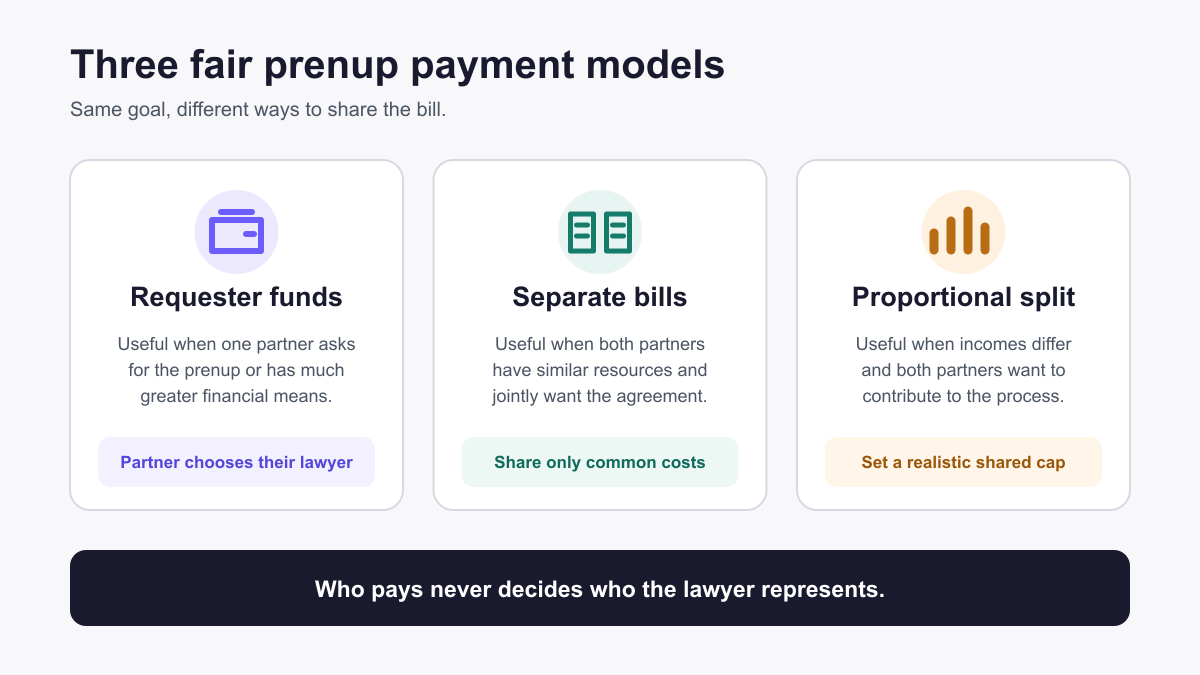
There is no single rule saying who pays for a prenup in Canada. Couples commonly choose one of three arrangements: the person requesting the prenup pays the main costs, each partner pays their own lawyer, or they divide the total according to income or another agreed formula. The fairest choice is the one that gives both people meaningful access to independent advice without letting the payor control that advice.
The payment plan is part of the process, not a test of who benefits more. A well-planned prenup should protect both partners' ability to understand the terms, ask for changes, and decide freely.
Who pays for a prenup in Canada at a glance
| Payment model | Often makes sense when | Main safeguard |
|---|---|---|
| Requesting or higher-income partner funds most costs | One person wants the agreement or the income gap is large | The other partner chooses and instructs their own lawyer |
| Each partner pays their own lawyer | Both have similar resources and jointly want the agreement | Agree in advance how shared drafting costs are divided |
| Proportional split or shared budget | Incomes differ, but both want to contribute | Set a realistic cap that does not restrict necessary advice |
None of these models is automatically fair in every relationship. A 50/50 split may feel simple but can create very different burdens. One person paying everything can improve access, but only if payment remains separate from lawyer selection, instructions, and confidential communications.
First, separate the costs you are dividing
“The prenup cost” is usually several different bills:
- an online platform or initial drafting service
- the lawyer who drafts or revises the agreement for one partner
- a separate lawyer who advises the other partner
- additional negotiation or revision time
- business, pension, property, tax, or valuation advice when needed
- signing, witnessing, or notarial work, depending on the province and agreement
Prenuply's current prenup package is $49 CAD for three generations, but lawyer fees and other professional services are separate. Published Canadian legal fees vary by location, scope, complexity, and the number of revisions. Our Canadian prenup cost guide explains those components in more detail.
Before debating percentages, ask each provider what the quote includes. A low drafting quote may not include the other partner's review, financial disclosure follow-up, negotiations, signing, taxes, or disbursements.
Option 1: The requesting partner pays most or all costs
This model is often practical when one partner is asking for the prenup, bringing substantially more wealth into the marriage, or proposing terms that require the other person to give up rights they would otherwise have.
Paying can remove a financial barrier to independent advice. It can also make the conversation feel less like, “I want protection, and you must pay to evaluate it.” That does not mean the requesting partner must accept an unlimited bill. The couple can agree on a reasonable review budget and a process for approving work beyond it.
The critical distinction is funding versus control. The partner receiving advice should be free to:
- choose a qualified lawyer who has not been selected for them
- meet with that lawyer privately
- give instructions without the payor present
- receive candid advice and request revisions
- keep communications and detailed bills confidential
Ontario's Law Society says a lawyer may accept payment from someone other than the client, but is not required to. Its guidance also says the payor is not the client, payment does not create a right to confidential information, and the lawyer's obligations remain with the client. Each firm may document or handle the arrangement differently, so ask before sending funds.
For a deeper explanation of separate advice, see our guide to independent legal advice for Canadian prenups.
Option 2: Each partner pays their own lawyer
Separate bills create a clean boundary. Each person retains, instructs, and pays their own lawyer, while the couple splits any genuinely shared platform or administrative cost.
This can work well when incomes and savings are similar. It may also feel emotionally balanced because neither person is financing the other's position.
The weakness is access. A $1,000 review bill is not the same burden for someone with $8,000 in monthly disposable income as it is for someone with $800. If an equal split prevents one partner from obtaining enough advice to understand the agreement, the simplicity of 50/50 has worked against the quality of the process.
Equal payment also does not make one-sided terms fair. Cost sharing and agreement fairness are separate questions. Couples can use our guide to balanced terms in a fair prenup to discuss the substance without treating the invoice split as proof of balance.
Option 3: Use a proportional split or shared budget
A proportional model divides costs using income, disposable income, or another agreed measure. For example, partners earning 70% and 30% of combined income might fund a shared legal-cost pool in the same proportions. Each still retains a separate lawyer.
Another approach is a shared base budget:
- Agree that the couple will fund a defined amount for drafting and separate review.
- Allocate that amount 50/50 or proportionally.
- Let each client independently authorize work within their own retainer.
- Decide in advance how genuinely unexpected work will be handled.
This model can feel cooperative without requiring the lower-income partner to absorb a disproportionate burden. The cap must remain realistic. A payment rule should not pressure someone to accept unclear terms because the agreed budget has run out.

How one partner can pay without owning the advice
If one partner funds the other's lawyer, build independence into the arrangement from the beginning.
Let the client choose the lawyer
The payor can provide a budget or a list of public directories, but the person receiving advice should make the final choice. Avoid using the drafting lawyer's colleague or a professional whose loyalty could reasonably feel unclear.
Use separate retainers and communications
Each lawyer should confirm who their client is, what work is included, and how information will be handled. The couple should not assume the payor is entitled to meeting notes, legal advice, or detailed invoices.
Ask how the firm accepts third-party payment
Some firms may accept direct payment. Others may prefer the client to receive funds and pay the bill themselves. Ontario's regulator recommends written instructions about payment, refunds, and confidentiality. Do not improvise the arrangement after the work is underway.
Never make continued payment depend on agreement
“I will only pay if you sign my draft” undermines the point of independent review. Funding should not be used to limit questions, revisions, or the client's ability to decline the agreement.
If the payment conversation is becoming adversarial, pause the drafting. Our prenup conversation guide offers neutral scripts for discussing goals before positions harden.
What is fair in common situations?
You both want the prenup and earn similar incomes
Each partner paying their own lawyer and splitting the initial drafting cost can be straightforward. Confirm the scope before anyone retains counsel.
One partner has much more wealth and requested the prenup
The wealthier or requesting partner may reasonably fund both sides' legal budgets. The less wealthy partner should still choose and instruct their own lawyer. A defined review allowance with a process for additional work is usually clearer than a vague promise to “cover it.”
A parent or family business is pushing for the agreement
Family members sometimes offer to pay because an inheritance, business, farm, or cottage is involved. That makes client identity and confidentiality especially important. The engaged partner, not the parent or business, should direct their own lawyer. Each lawyer should approve the payment structure before funds move.
One partner expects to pause work for caregiving
Current income may not reflect the economic plan for the marriage. A proportional split may be more reasonable, and the agreement itself should address the planned career impact. See our guide to prenups for stay-at-home parents.
One partner's complex assets drive most of the work
A corporation, trust, foreign property, stock compensation, or several real estate holdings can increase disclosure and drafting time. The partner bringing that complexity may offer to fund the extra work, while both partners preserve separate advice.
Does the answer change by province?
The fair payment models are practical choices, but the professional steps differ by province.
| Province | Why the legal budget may look different |
|---|---|
| Ontario | A marriage contract must be written, signed, and witnessed. Disclosure and understanding can matter if the contract is later challenged. Separate advice is a strong safeguard. |
| British Columbia | Section 93 of the Family Law Act addresses written, witnessed property agreements and grounds for setting them aside, including non-disclosure, vulnerability, and lack of understanding. |
| Alberta | Sections 37 and 38 of the Family Property Act create specific acknowledgement requirements before lawyers who are not acting for the other spouse. Couples should budget for those separate legal relationships. |
| Quebec | A marriage contract must be signed before a notary. Ask the notary what is included and whether separate advice is appropriate for the proposed terms. |
The statutes and official guidance reviewed for this article govern agreements and signing safeguards. They do not provide a standard couple-by-couple formula for allocating professional fees. Confirm the process and payment arrangement with local professionals.
A five-question budget conversation
Before paying any retainer, answer these questions together:
- Who asked for the prenup, and why? Name the shared goal without assigning blame.
- What services are likely required? Separate the platform, drafting, review, negotiation, valuation, and signing costs.
- What can each partner realistically afford? Compare the burden, not just the dollar amount.
- How will independence be protected? Confirm separate lawyer choice, private communication, and control of instructions.
- What happens if more work is needed? Set a process for extensions instead of using the budget as leverage.
Start early enough to get real quotes and consider the advice. Our Canadian prenup timeline shows where disclosure, drafting, review, and signing fit before a wedding.
Frequently asked questions
Does the person asking for a prenup have to pay?
No general Canadian rule automatically assigns the cost to the person who asked. That person may offer to pay because the agreement mainly addresses their assets or because the other partner cannot reasonably fund advice.
Can the wealthier partner pay for both prenup lawyers?
Often, yes, if the lawyers accept and properly document third-party payment. Each partner should independently choose, retain, instruct, and communicate with their own lawyer. Payment does not make the other partner's lawyer the payor's lawyer.
Should prenup costs be split 50/50?
They can be, but equal dollars are not always an equal burden. Similar-income partners may prefer separate bills. Couples with a large income or wealth gap may find requester-funded or proportional costs fairer.
Can a parent pay the prenup legal fees?
A law firm may accept third-party funds, but it may impose conditions or decline. The parent should not select the client's lawyer, direct the work, or expect confidential information. Ask the lawyer to document the arrangement before payment.
What if one partner cannot afford independent legal advice?
Do not solve the problem by rushing them to sign without meaningful advice. Consider having the requesting or higher-income partner fund a reasonable review budget, narrowing unnecessary complexity, and obtaining written scopes from lawyers. If access remains inadequate, pause and get local guidance.
Is Prenuply's $49 price the total prenup cost?
No. The current $49 CAD package covers Prenuply's guided prenup template and three generations. It does not include lawyers, a Quebec notary, negotiations, valuations, tax advice, or other professional services. Review the current Prenuply pricing and local legal quotes together.
Make the payment plan part of a fair process
Who pays for a prenup matters because access to advice matters. Choose a model that fits both partners' resources, then protect separate lawyer choice, confidential communication, and the freedom to ask for changes.
When you are ready to organize your decisions before lawyer review, start a Canadian prenup draft with Prenuply. The guided process can help you identify assets, debts, and preferences without replacing independent legal advice.
Sources and further reading
- Law Society of Ontario, third-party payment of legal fees
- Law Society of Ontario, independent legal advice and representation
- Ontario Family Law Act, sections 52, 55, and 56
- British Columbia Family Law Act, sections 92 and 93
- Alberta Family Property Act, sections 37 and 38
- Gouvernement du Quebec, marriage contracts
Legal disclaimer: This article provides general information about prenup costs and payment arrangements in Canada. It is not legal advice or a fee quote. Prenuply AI Inc. is a technology company, not a law firm, and does not provide legal services. Family law, professional rules, fees, and signing requirements vary. Each partner should consult their own qualified lawyer, or a Quebec notary where applicable, about their situation before signing.