
One partner plans to leave a $78,000 job for three years after a child arrives. The other expects to keep earning, building a pension, and advancing at work. Both choices support the family, but only one produces a paycheque and a current résumé.
That is why a prenup for a stay-at-home parent in Canada should do more than protect the higher earner's existing assets. It should also address the financial risk created when one partner pauses work, reduces hours, relocates, or becomes the family's primary caregiver.
This guide explains nine protections Canadian couples can discuss, how support and property terms interact, which child-related decisions cannot be locked in before separation, and why a review clause matters. The examples are planning illustrations, not recommended amounts or legal advice. Each partner should receive separate advice from a family lawyer in the province where the agreement will be used.
Quick answer: can a prenup protect a stay-at-home parent in Canada?
Yes. Depending on provincial law, a marriage contract or prenuptial agreement can address property, debt, spousal support, savings commitments, housing transitions, insurance, and what happens if one partner leaves paid work for family care.
A balanced approach often combines several tools:
- A support clause that does not ignore a planned career interruption
- Personal savings or retirement contributions during the caregiving period
- A property-sharing adjustment tied to time or caregiving
- A transition fund for training and career re-entry
- Housing and insurance protections
- Clear review triggers after children, disability, relocation, or extended leave
The agreement cannot reliably predetermine parenting arrangements or contract away a child's right to appropriate support. Those issues remain subject to governing law and the child's best interests.
Why caregiving belongs in the prenup conversation
Caregiving is not a rare edge case. A 2024 Statistics Canada study reported that 42% of Canadians aged 15 or older provided unpaid care to children or care-dependent adults in 2022. Six percent were caring for both groups.
The financial effects can continue after the daily care period ends:
- Lost employment income and bonuses
- Slower wage growth and fewer promotions
- Missed pension or retirement contributions
- Reduced professional seniority or business momentum
- Licensing, training, and child-care costs when returning to work
- Greater dependence on the earning partner for housing and everyday cash flow
Canadian support law recognizes that family roles can create economic advantages and disadvantages. Section 15.2 of the federal Divorce Act directs courts considering spousal support to look at the spouses' circumstances and the functions each performed. Its objectives include addressing economic effects of the marriage and financial consequences of caring for children.
The federal Spousal Support Advisory Guidelines are not legislation and do not decide entitlement, but courts and family lawyers often use them to estimate support ranges after entitlement has been established. A prenup should be designed with that legal context in mind, not as if unpaid care has no economic value.
For the broader fairness framework, read What Is a Fair Prenup in Canada?. This guide focuses specifically on the planned caregiver's side of the equation.
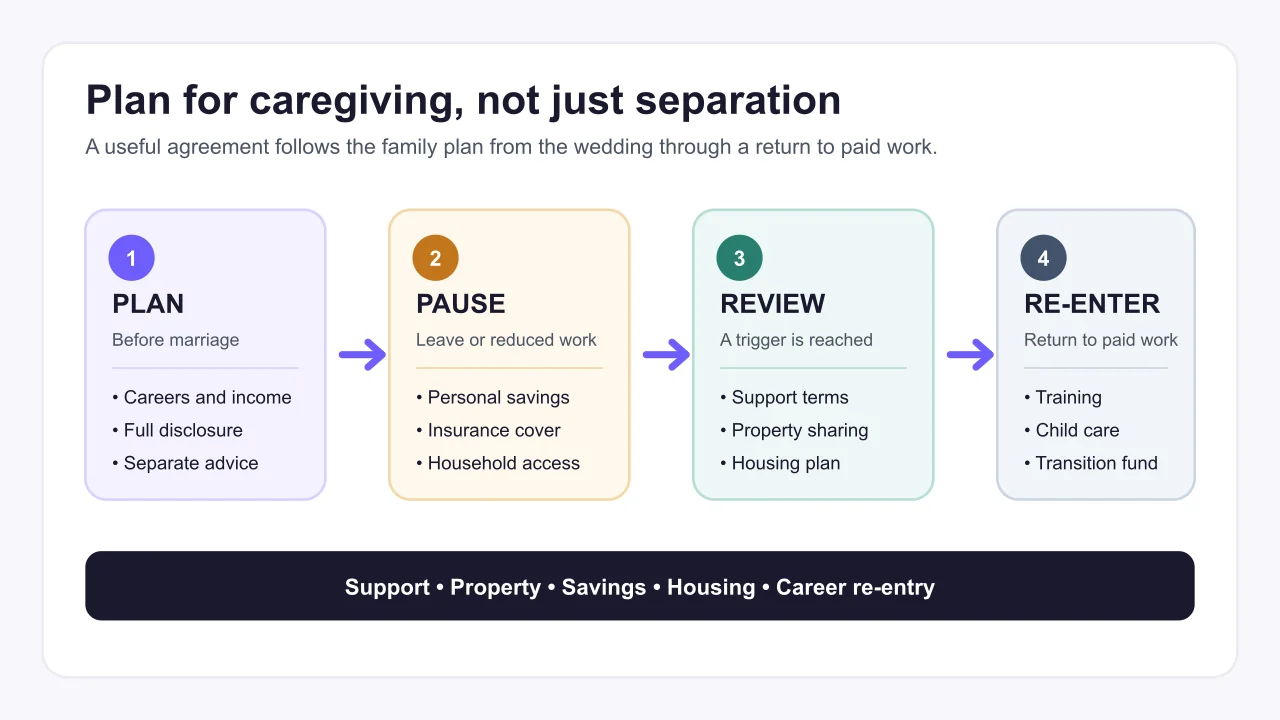
Nine prenup protections to discuss for a stay-at-home parent
There is no single stay-at-home parent clause. A workable agreement usually connects support, property, savings, housing, and review terms so they do not contradict one another.
1. Avoid an automatic full waiver of spousal support
A full support waiver may look simple when both partners are working and the wedding is still ahead. It can look very different after one partner spends years outside paid employment to care for children or dependent adults.
Possible approaches to discuss with separate lawyers include:
- Leaving future support rights open under the law
- Setting a limited waiver that stops applying after a defined caregiving event
- Providing a minimum transition period, subject to legal review
- Using a formula linked to relationship length and time outside paid work
- Requiring a new support review when a career pause crosses a stated threshold
The point is not to guarantee a particular future award. It is to prevent a foreseeable family plan from being ignored by a boilerplate waiver.
Support clauses receive careful scrutiny, and provincial tests differ. Prenuply's dedicated guide to spousal support in a prenup explains waivers, limits, review clauses, and later court review in more detail.
2. Define what activates the caregiving protections
The phrase "if one spouse becomes a stay-at-home parent" leaves important questions unanswered. Does the clause apply during parental leave? What if a partner works one day a week, pauses a business, cares for an aging parent, or moves because of the other partner's career?
A lawyer can help define objective triggers, such as:
- Employment income falls below an agreed percentage of prior income for a stated period
- Paid work drops below a stated number of hours for family care
- One partner takes more than a stated number of months of unpaid leave
- The couple agrees in writing that one partner will become the primary caregiver
- A child or dependent adult develops needs that materially affect a partner's work
- One partner relocates and gives up employment to support the family move
The agreement should also explain what evidence records the trigger and when the protection begins. Clear mechanics reduce later arguments about whether a verbal family decision counted.
3. Build personal savings during the career pause
Every adult should have practical access to money, even in a single-income household. Couples can discuss regular transfers to an account owned by the caregiver, an agreed personal spending amount for each partner, or a household budget that preserves equal day-to-day autonomy.
If the plan uses registered accounts, tax rules and contribution room matter. For example, the Canada Revenue Agency explains that contributions to a spousal RRSP use the contributor's deduction limit. A tax professional should check the structure before the couple writes a fixed registered-account promise into an agreement.
The clause should answer:
- How much is contributed and how often
- Whether the amount changes with inflation or income
- Which account receives the funds
- What happens if contribution room is unavailable
- Whether missed contributions accumulate
- How the obligation ends when paid work resumes
This is both a separation-planning issue and a healthy household-finance issue.
4. Address pension and retirement gaps directly
Time outside the workforce can affect workplace pension growth and private retirement savings. The Canada Pension Plan has child-rearing provisions that may protect CPP benefit calculations for eligible primary caregivers of children under seven, but eligibility is specific and the provision does not replace a workplace pension, employer match, or years of personal investing. Quebec residents should ask about the separate QPP framework.
Couples can discuss:
- Ongoing household-funded retirement contributions
- A property adjustment that recognizes missed pension accumulation
- How workplace pensions will be valued and treated at separation
- Record-keeping for CPP or QPP child-rearing applications
- A review when the caregiver returns to work or changes retirement plans
Pension rules are technical. Avoid promising a transfer that a pension statute or plan will not permit. Prenuply's guide to pensions, RRSPs, TFSAs, and retirement savings in a prenup is a useful companion.
5. Consider a property-sharing step-up
Some couples want one partner's pre-marital business, investments, or real estate to remain separate. They can still discuss whether the caregiver should receive a growing share of other family property as the relationship and career interruption continue.
Illustrative structures include:
- A fixed share that begins after a caregiving trigger
- A percentage that increases after five, ten, or fifteen years
- A defined credit for each full year outside paid work
- Joint ownership of selected new assets while pre-marital assets remain separate
- A larger share of the family home or liquid investments instead of an interest in an operating business
The result should be tested against more than one future. Model an early separation, a long marriage, a second child, disability, a business loss, and a period where both partners reduce work. A one-sided formula that shares gains but assigns all losses to the caregiver is not balanced merely because it has percentages.
6. Create a realistic housing transition
A caregiver may have less current income, a thinner recent employment record, and less immediate ability to qualify for a mortgage or lease. A prenup can discuss a separation transition without trying to make permanent parenting decisions.
Topics may include:
- A defined period to remain in the home, subject to applicable law and safety
- How carrying costs are paid during a sale or buyout process
- A neutral appraisal and buyout timeline
- A moving or rental-deposit fund
- Access to liquid funds before final property division
- What happens if neither partner can afford the existing home
Province-specific limits matter. In Ontario, for example, section 52 of the Family Law Act allows marriage contracts to address property and support, but a term that tries to limit a spouse's Part II matrimonial-home rights is unenforceable. A home clause should be reviewed locally rather than copied from another province.
If a home is a major part of the plan, also read Can a Prenup Protect a House in Canada?.
7. Fund career re-entry, not just short-term support
A return to paid work may require more than sending applications. The caregiver may need new credentials, professional dues, software training, a supervised placement, interview clothing, transportation, or child care before the first paycheque arrives.

A career re-entry provision can define:
- Eligible training, licensing, and examination costs
- A maximum amount or annual budget
- Whether child-care and transportation costs are included
- When funding becomes available
- How long it remains available after separation
- Whether unused funds expire
- A fair approval process that neither partner controls alone
Avoid promising that the caregiver will be self-sufficient by an arbitrary date. The actual path depends on occupation, health, care responsibilities, local labour conditions, and the length of the employment gap.
8. Coordinate life and disability insurance
When the household depends heavily on one income, death or disability can create an immediate problem. Couples may discuss term life insurance, disability coverage, beneficiary designations, and who pays premiums during the caregiving period.
The agreement should not treat an insurance sentence as self-executing. It can include proof-of-coverage dates, notice before cancellation, what happens if coverage becomes unavailable, and how insurance coordinates with wills, support obligations, and existing employer plans.
Coverage needs can change when income, debt, children, or housing changes. Review it instead of locking in one number for decades.
9. Add review triggers with an actual process
A review clause is especially important when the couple is planning children but does not know who will pause work, for how long, or whether care needs will change.
Useful review triggers can include:
- Pregnancy, birth, or adoption
- A parental leave longer than expected
- More than 12 months of reduced or no employment income
- A second or later child
- A child or adult dependent with significant care needs
- Relocation for either partner's work
- Disability or serious illness
- A major increase in income or sale of a business
- Five years passing since the last legal review
The clause should say who starts the review, how quickly the partners meet separate lawyers, who pays reasonable review costs, and what happens if no amendment is signed. A review clause does not automatically rewrite the agreement.
A worked example: one career pause, several connected protections
Consider Maya and Chris, an engaged Ontario couple:
- Maya earns $78,000 and has a defined-contribution workplace plan.
- Chris earns $190,000 and owns shares in a private company.
- They expect Maya to take three years away from paid work after their first child.
- Chris wants the pre-marital company shares protected.
- Maya wants the agreement to recognize lost earnings, retirement saving, and career re-entry.
They might ask their separate lawyers to compare packages like these:
| Planning issue | Question for the agreement | Illustration to test |
|---|---|---|
| Existing company shares | What stays separate, and what happens to later growth? | Keep identified pre-marital shares separate, then model a separate family-property adjustment |
| Support | Does a waiver survive an agreed career pause? | Preserve support rights or suspend the waiver after a defined caregiving trigger |
| Savings | Does Maya keep building assets in her own name? | Test a fixed annual transfer, subject to tax and account rules |
| Retirement | How is missed pension growth addressed? | Compare annual contributions with a later property credit |
| Housing | What happens before a sale or buyout is complete? | Test carrying costs, appraisal timing, and a transition fund |
| Career re-entry | Who pays for updated credentials and child care? | Test a capped training and transition budget with a neutral approval process |
| Review | What if the pause lasts six years instead of three? | Trigger a new review at 12 months, 36 months, and after another child |
The numbers are deliberately absent. A fair amount depends on their assets, debts, tax position, province, expected standard of living, and the rights each would otherwise have. The value of the exercise is seeing how the clauses interact.
For example, a generous property step-up may change the support discussion. A large support waiver may make personal savings and housing protections more important. Protecting company voting control does not require the caregiver to leave the marriage without liquid assets.
Red flags for the future caregiver
Pause and get separate advice if the proposal includes any of these:
- A full support waiver even if one partner leaves paid work for children
- A promise to "take care of you" that is not reflected in the document
- A caregiving clause that only applies if the higher earner gives written permission
- No access to financial statements for a business or trust being protected
- A fixed payment with no inflation, timing, or enforcement terms
- Property protection for one partner with all household debt shifted to the other
- A requirement to return to work by a date that ignores care needs or labour conditions
- Child-support or parenting terms presented as permanently binding
- One lawyer advising both partners
- A document delivered shortly before the wedding with pressure to sign
Full disclosure matters even when the article's focus is caregiving. Use Prenuply's financial disclosure checklist to organize assets, debts, income, businesses, pensions, and supporting documents.
Province checkpoints for caregiving-related prenup terms
Family law is provincial, while the federal Divorce Act governs divorce and related support orders for married spouses. The same clause can face different formalities and review tests across Canada.
| Province | Important checkpoint |
|---|---|
| Ontario | Marriage contracts can cover property and support. They must be written, signed, and witnessed. Courts can set aside domestic contracts for significant disclosure failures, lack of understanding, or other contract-law grounds. Matrimonial-home possession rights have special limits. |
| British Columbia | Written agreements can divide property and address spousal support. Sections 93 and 164 of BC's Family Law Act set out circumstances for later court review, including disclosure problems, vulnerability, understanding, time passed, and significant unfairness. |
| Alberta | A property agreement under sections 37 and 38 of Alberta's Family Property Act requires written acknowledgements made separately before different lawyers. Support planning needs its own province-specific analysis. |
| Quebec | A Quebec marriage contract selects a matrimonial regime for property outside the family patrimony and must be notarized. Family patrimony rules still interact with the agreement. Use a Quebec notary. |
The table is a starting point, not a complete statement of each province's law. Couples in Manitoba, Saskatchewan, Atlantic Canada, and the territories should use local advice and formalities too.
What a prenup cannot decide in advance about children
A prenup can plan for the adults' finances. It should not promise that one parent will receive custody, set a permanent parenting schedule, or waive child support.
Under the Divorce Act, parenting decisions must be based only on the child's best interests. Justice Canada's parenting-arrangements guidance explains that even when parents agree, the best-interests test governs if a judge must decide.
Child support also belongs to the child. Ontario's Family Law Act, for example, allows a court to disregard a domestic-contract term that is unreasonable under the child-support guidelines.
Couples can still discuss intentions, such as hoping one parent will take leave or agreeing to budget for child care. Keep those family plans separate from claims that a future court must follow a pre-wedding parenting decision.
When to start and when to review
Start before either partner has resigned, declined a promotion, moved, or become financially dependent on the plan. It is easier to negotiate clearly while both people still have current income and options.
A practical timeline is:
- Discuss caregiving and career assumptions before drafting.
- Exchange complete financial disclosure.
- Put the first proposal in writing months before the wedding.
- Have each partner use a separate lawyer.
- Revise and sign using the formalities for the province.
- Review after a caregiving trigger, not only after conflict starts.
Read How Long Does a Prenup Take in Canada? for a fuller drafting and signing timeline. Prenuply also explains what independent legal advice for a prenup usually involves.
Questions to take to separate lawyers
Each partner can bring the same factual plan to a different lawyer:
- What rights would each of us have without this agreement?
- How would our province treat a support waiver after a planned career pause?
- Which events should activate or end the caregiving protections?
- Should compensation occur during the relationship, at separation, or both?
- How should retirement and pension gaps be measured?
- Which home rights cannot be changed by contract?
- How do the property and support clauses affect one another?
- What happens if the caregiver returns part time or starts a business?
- How should disability, elder care, or another child change the plan?
- What must we do for an amendment to be enforceable?
If one partner offers to pay reasonable legal fees for the other partner's independent lawyer, the lower-earning partner should still choose and instruct that lawyer privately.
Frequently asked questions
Should a stay-at-home parent sign a prenup?
A stay-at-home parent should not sign or reject a prenup based on the label alone. Compare the proposed agreement with the rights available under provincial and federal law, model the effect of the planned career pause, insist on full disclosure, and obtain independent advice. A balanced prenup can protect the caregiver as well as the higher earner.
What should a prenup include for a stay-at-home mom or dad?
Common topics include spousal support, personal savings, retirement contributions, property sharing, housing transition, career re-entry costs, insurance, and review triggers. The terms should be gender-neutral and should also work if the caregiving role changes.
Can a Canadian prenup waive spousal support?
Many Canadian agreements can address or waive spousal support, but the result is not automatically beyond later review. The governing test depends on the province and circumstances. A planned period outside paid work is a reason to examine a full waiver especially carefully.
Can the agreement set child support or custody before marriage?
It cannot safely make those issues final. Child support and parenting remain governed by legislation, guidelines, and the child's best interests. Keep adult financial planning separate from attempts to predetermine future parenting outcomes.
Does parental leave count as becoming a stay-at-home parent?
Not automatically. A carefully drafted agreement can distinguish protected statutory leave, an extended unpaid career pause, part-time work, and permanent withdrawal from paid employment. Define the trigger instead of relying on a label.
Can the higher earner pay for both lawyers?
The higher earner can often fund reasonable fees, but each partner should independently choose, instruct, and communicate with a different lawyer. Paying the invoice should not create control over the advice.
When should the prenup be updated after having a child?
Use the timing written into the review clause and seek local advice promptly if the real caregiving plan differs from the assumptions in the signed agreement. A child's birth, adoption, extended leave, disability, or major income change are common review triggers. Any amendment should follow the province's required formalities.
Build the agreement around the life you actually expect
A prenup should not assume both partners will earn at today's level forever. If one partner may become a stay-at-home parent or primary caregiver, put that possibility at the centre of the planning process.
Map the career pause, savings, retirement, property, housing, insurance, and re-entry path. Test the result after three years and after fifteen. Then give both partners complete disclosure, enough time, and separate professional advice.
If you are ready to organize those decisions, create a personalized Canadian prenup draft with Prenuply. Use it as a structured starting point for discussion and independent legal review before signing.
Official sources used in this guide
- Divorce Act, section 15.2
- Department of Justice Canada, Spousal Support Advisory Guidelines
- Statistics Canada, unpaid caregiving study
- Ontario Family Law Act
- British Columbia Family Law Act
- Alberta Family Property Act
- Government of Quebec, marriage contracts
- Canada Pension Plan child-rearing provisions