
A Canadian prenup does not usually expire just because time passes. It generally continues according to its wording unless it contains a sunset clause, both partners amend or replace it, both partners properly rescind it, or a court sets aside or declines to enforce part of it.
That short answer comes with an important warning: family law is provincial, the exact agreement matters, and an old clause can become harder to rely on if life changes expose problems with disclosure, understanding, fairness, or support. A prenup that still exists is not automatically a prenup that will produce every result one partner expects.
This guide explains how long a prenup can last in Canada, what a sunset clause does, when an agreement should be reviewed, and how married couples can update one without creating avoidable uncertainty.
Does a prenup expire in Canada? Quick answers
| Event | Does the prenup automatically expire? | Practical next step |
|---|---|---|
| Five, ten, or twenty years pass | Usually no, unless the agreement sets an expiry date or event | Read the duration, termination, review, and amendment clauses |
| The couple gets married | Usually no, because a prenup is normally intended to operate during or after marriage | Confirm the agreement identifies the marriage and province correctly |
| The couple has a child | Usually no | Review support, caregiving, property, insurance, and estate-planning terms |
| One partner stops working | Usually no | Check whether the agreement addresses career sacrifice or has a review trigger |
| The couple buys a home | Usually no | Review title, down payment, mortgage, renovation, occupancy, and sale terms |
| The couple moves provinces or countries | Not automatically in most cases | Obtain advice in the new jurisdiction before assuming the old wording will work there |
| Both partners want different terms | No automatic change | Use a properly prepared written amendment or replacement agreement |
| One partner wants to cancel it | Usually not unilaterally | Get legal advice about the existing agreement and available options |
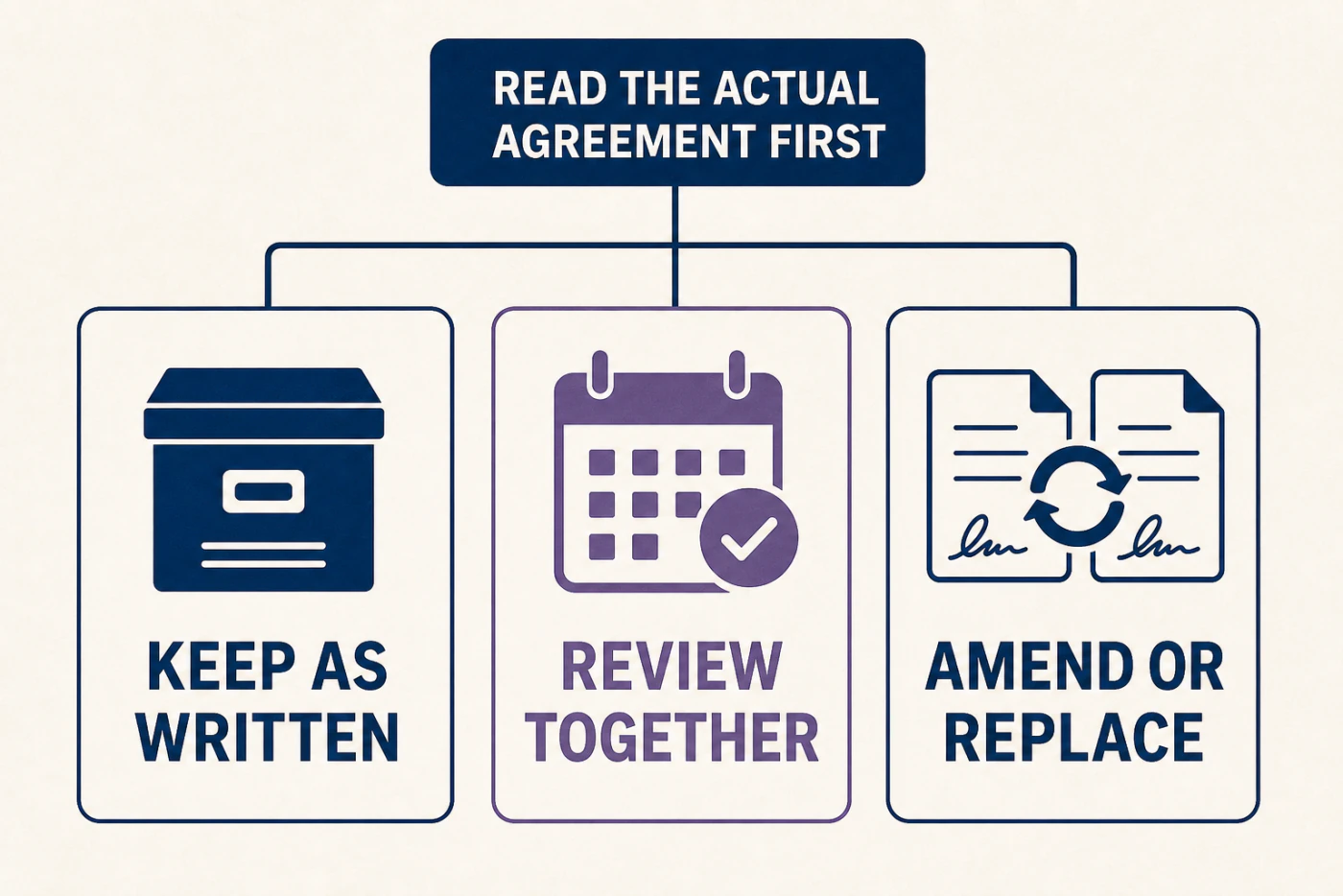
The safest first step is simple: find the signed agreement and read what it actually says. Look for headings such as term, duration, sunset, review, amendment, rescission, termination, reconciliation, and governing law.
Expiry, enforceability, and relevance are different questions
People often use “expired” to describe three separate problems.
1. Has the agreement ended under its own wording?
An agreement can say that all or part of it ends on a date or after an event. This is an expiry question. A ten-year sunset clause, for example, might end the whole agreement on the tenth wedding anniversary. A partial sunset might end only a spousal-support waiver while keeping property clauses in place.
2. Could a court set aside or disregard a term?
An agreement may still be on paper but face an enforceability challenge. Provincial laws allow courts to examine issues such as significant non-disclosure, lack of understanding, improper pressure, contract-law defects, and, in some contexts, unfair consequences or support objectives.
For a deeper explanation, read Are Prenups Enforceable in Canada?.
3. Does the wording still fit the couple's real life?
A clause can remain legally relevant yet be commercially or practically outdated. An agreement written when neither partner owned a home may say nothing useful about a later $900,000 property, unequal down payments, mortgage prepayments, or renovations funded by one family. That gap is not the same as automatic expiry, but it is a reason to review the document.
These distinctions matter because simply calling an old agreement “expired” can hide the real question. Couples should identify whether they are dealing with an actual sunset clause, a possible legal challenge, or wording that no longer matches their finances.
Four ways a Canadian prenup can end or change
A sunset clause reaches its trigger
A sunset clause causes the entire agreement, or selected terms, to stop applying after a defined time or event. The clause should say exactly what ends, when it ends, and what happens next.
Common structures include:
- full expiry after a fixed number of years of marriage
- expiry of only one provision, such as a support waiver
- staged changes at the fifth, tenth, and fifteenth anniversaries
- a change after a defined event, such as a child, disability, or career break
- mandatory review without automatic expiry
The last option is not technically a sunset. A review clause asks the couple to revisit the agreement, while a sunset clause changes legal rights automatically.
The spouses sign an amendment
An amendment changes selected parts of the existing agreement. A careful amendment identifies the original agreement, lists the clauses being replaced, provides the new wording, and confirms that the rest remains in force.
In Ontario, section 55 of the Family Law Act says that an agreement to amend or rescind a domestic contract is unenforceable unless it is in writing, signed by the parties, and witnessed. Other provinces have their own formalities and risks.
The spouses replace or rescind the agreement
Couples can sometimes replace the original prenup with a new marriage contract or postnuptial agreement. They can also agree to rescind it. The new document should remove doubt about whether the old terms still apply.
British Columbia's Family Law Act provides a useful drafting principle in section 7: when a new agreement changes a previous one, the changed portions are treated as revoked and the rest of the earlier agreement remains effective. That is why a vague note saying “we no longer need the prenup” is a poor substitute for a properly executed document.
If you are already married and need new terms, see Can You Get a Prenup After Marriage in Canada?.
A court sets aside or declines to enforce a provision
This is not the same as expiry. It is a legal determination made after a dispute.
For example, Ontario's section 56 allows a court to set aside a domestic contract or a provision where a party failed to disclose significant assets, debts, or liabilities, did not understand the nature or consequences of the contract, or where ordinary contract law would permit the agreement to be set aside. British Columbia's section 93 contains its own test for written, witnessed property agreements.
No article can predict that result from the age of a document alone. The wording, negotiation, disclosure, advice, conduct after signing, governing law, and circumstances at enforcement can all matter.
What is a sunset clause in a prenup?
A sunset clause is a built-in endpoint. It may apply to the whole prenup or only to one part.
Imagine a couple where one partner enters the marriage with a business worth $700,000 and the other plans to reduce paid work when they have children. They might consider several different structures:
| Structure | Example planning direction | Main trade-off |
|---|---|---|
| Full sunset | The entire agreement ends after fifteen years | Simple, but all customized protections may disappear at once |
| Partial sunset | Business ownership terms continue, but a support waiver ends after ten years | Preserves selected asset rules while allowing support terms to evolve |
| Graduated terms | A compensatory amount or sharing percentage changes at defined milestones | More tailored, but definitions and calculations must be precise |
| Review clause | The couple must review the agreement after five years or a child's birth | Encourages discussion but may not change anything if no amendment is signed |
| Amendment after an event | The spouses agree to negotiate new terms after a career break | Flexible, but an agreement to negotiate may not guarantee a final result |
The risk of a full sunset is the “cliff edge.” One day the customized rules apply, and the next day provincial default rules may apply instead. If the couple wants gradual change, a partial sunset, formula, or scheduled review may be easier to align with their intentions.
The existing Prenuply guide to trigger clauses in a prenup explains how to define the event, evidence, consequence, and effective date.
Seven times to review a prenup
A review does not mean the agreement has failed. It is a chance to compare the document with current facts before anyone needs to rely on it in a dispute.
1. Before the wedding
If the document was prepared months or years before the wedding, confirm that the financial schedules are current and that both partners still understand the terms. New property, debt, a bonus, business shares, or a family gift may require updated disclosure.
Starting early also gives each person time to obtain advice from a separate lawyer without wedding pressure. Prenuply's Canadian prenup timeline explains how disclosure, drafting, review, and signing fit together.
2. After the birth or adoption of a child
A child does not normally make a prenup vanish. It can, however, change income, expenses, insurance needs, housing plans, and caregiving roles.
Child support and parenting decisions remain subject to the law applicable when those issues arise. Couples should not assume a prenup can lock in future parenting arrangements or contract out of a child's rights. The more useful review questions concern adult financial planning:
- Will one parent reduce paid work?
- Should retirement or education savings continue during a leave?
- Do support or property terms still reflect the expected career sacrifice?
- Do wills, life insurance, and beneficiary designations fit the new family structure?
For balanced options, see Prenup Protections for a Stay-at-Home Parent.
3. When buying or substantially renovating a home
Homes create recurring disputes because title, down payments, mortgage principal, carrying costs, renovations, and occupancy rights are not the same thing.
Ontario matrimonial-home rules require special care. Other provinces also have family-home, property, and occupancy rules that may not match a generic clause. Before the purchase, ask:
- Is the down payment a gift, loan, or contribution that earns a larger share?
- Will mortgage principal and appreciation be shared equally?
- What happens if one partner funds a major renovation?
- Is there a buyout formula and valuation process?
- How are a loss, refinancing, or early sale handled?
Read Can a Prenup Protect a House in Canada? for a detailed checklist.
4. When a business or compensation package changes materially
A start-up can become a valuable corporation. An employee can receive stock options or restricted share units. A professional may incorporate a practice. An older prenup might identify the original shares but say nothing about retained earnings, shareholder loans, dilution, new holding companies, vesting, tax, or growth caused by either spouse's work.
A review can update disclosure and clarify valuation dates, record keeping, guarantees, and whether future growth is separate or shared. It can also coordinate the prenup with a shareholders' agreement, partnership agreement, or corporate reorganization.
5. After moving to another province or country
Canadian family law is provincial, and cross-border rules can be complex. A governing-law clause is useful, but it does not automatically prevent another court or legal system from applying mandatory local rules.
Before or soon after a move, ask a lawyer in the new location to review:
- whether local formalities were satisfied
- how the new jurisdiction treats property and support agreements
- whether a choice-of-law clause is likely to work as intended
- whether local assets, homes, pensions, or corporations need different wording
- whether a confirming agreement would reduce uncertainty
Couples with foreign assets or planned relocation can use the Prenup Guide for International Couples in Canada as a starting point.
6. After a major inheritance, family gift, or debt change
An inheritance clause is only as useful as the records behind it. A review can document the amount received, the account or property holding it, and what happens to income, growth, replacement property, or money used for a family home.
The same applies to new liabilities. A business guarantee, tax debt, professional loan, or large line of credit may not fit a general “separate debts” clause. Current disclosure and precise definitions help the couple understand what is actually being protected.
7. At a scheduled interval, even if nothing dramatic happened
There is no universal Canadian rule requiring renewal every three, five, or ten years. Still, a periodic review can reveal administrative problems before they become legal ones.
A practical review might happen every three to five years, or on anniversaries chosen by the couple. It should check:
- whether the signed original and disclosure schedules can be found
- whether names, addresses, and asset descriptions are accurate
- whether the agreement still matches how property and debt are handled
- whether later emails or informal promises conflict with the document
- whether wills, insurance, beneficiary designations, titles, and corporate documents are coordinated

Province-specific rules that affect amendments and enforcement
There is no single federal Prenuptial Agreements Act. The provincial law, court, and facts matter.
Ontario
Ontario calls a prenup a marriage contract. Section 55 of the Family Law Act requires a domestic contract, and an agreement to amend or rescind one, to be in writing, signed, and witnessed. Section 56 lists grounds on which a court may set aside a domestic contract or a provision, including significant non-disclosure and lack of understanding. Ontario also limits what a marriage contract can do to matrimonial-home rights.
British Columbia
Section 92 of British Columbia's Family Law Act lets spouses make agreements about property and debt. Section 93 applies to a written property agreement with each spouse's signature witnessed and describes when the Supreme Court may set aside or replace all or part of it. Section 7 explains the effect of a later agreement that changes an earlier one.
Alberta
Sections 37 and 38 of Alberta's Family Property Act use the phrase “subsisting written agreement” and impose specific acknowledgement requirements for agreements intended to contract out of the statutory property rules. Each party must make a written acknowledgement, apart from the other, before a different lawyer, covering the agreement's nature and effect, possible future claims, and voluntary execution.
Quebec
Quebec uses a different civil-law and matrimonial-regime structure. The Government of Quebec says spouses can change their matrimonial or civil-union regime at any time if both consent, but they must sign a new marriage or civil-union contract before a notary. The new regime takes effect when signed and is not retroactive. Family patrimony rules still require separate analysis.
| Province | Key update point | Primary source |
|---|---|---|
| Ontario | Amendments and rescissions must meet written, signed, witnessed formalities | Ontario Family Law Act, sections 55 and 56 |
| British Columbia | A later agreement can revoke changed portions while leaving the rest effective | BC Family Law Act, sections 7, 92, and 93 |
| Alberta | Property agreements under sections 37 and 38 require separate lawyer acknowledgements | Alberta Family Property Act, sections 37 and 38 |
| Quebec | Changing the matrimonial regime requires a new notarial contract and mutual consent | Government of Quebec, changing a matrimonial regime |
The Quebec English URL structure can change. If that link redirects, use the Government of Quebec page titled “Changing a regime during a marriage or civil union.”
How to update a prenup without weakening it
Start with the complete signed file
Collect the executed agreement, every schedule, acknowledgement or certificate, and any prior amendment. A draft without signatures is not a substitute for the final package.
Prepare fresh financial disclosure
List current property, debts, income, corporations, trusts, pensions, insurance, and significant gifts or inheritances. Attach supporting statements or valuations appropriate to the issue being changed.
Use the Prenup Financial Disclosure Checklist to organize the records.
Write down the change in plain language first
Before negotiating legal wording, identify the result both partners are trying to achieve. For example: “The home down payment remains separate, mortgage principal is shared equally, and renovations over $10,000 are recorded as contributions.” A lawyer can then test the goal against provincial law and draft precise terms.
Use separate legal advice
Each spouse should have the opportunity to consult a different lawyer. Independent advice helps each person understand what the update changes, what rights may be given up, and whether disclosure is complete. It is especially important for support waivers, major asset imbalances, businesses, trusts, foreign property, and Alberta section 38 acknowledgements.
State what happens to the old agreement
The amendment should clearly say which clauses are deleted, replaced, or confirmed. If the whole prenup is being replaced, the new agreement should say so directly. Do not rely on a handwritten margin note, an unsigned email, or an oral promise.
Follow the signing rules again
An amendment can fail even when the business deal is clear if the required form, signatures, witnesses, acknowledgements, or notarial steps are missing. Use the rules for the province and the type of agreement involved.
Coordinate related documents
A prenup does not operate in isolation. After an amendment, review wills, beneficiary designations, life insurance, home title, shareholder agreements, trusts, powers of attorney, and any family loan documents. Conflicting documents can create avoidable disputes.
What if one spouse will not agree to an update?
A scheduled review clause does not always force a spouse to accept new terms. If one person declines to amend, the existing agreement may continue according to its wording unless it has already sunsetted, been properly rescinded, or is later affected by a court decision.
Do not sign a hurried side letter or hide a major transaction to work around the disagreement. Each person should get their own advice about the current document, disclosure duties, and the consequences of proceeding with a home purchase, business transaction, move, or career change without an amendment.
A practical annual document check
You do not need to renegotiate a prenup every year. A short document check can still be useful:
- Confirm where the signed original and digital copy are stored.
- Confirm both spouses can access the final agreement and schedules.
- Note major changes in property, debt, business interests, and family circumstances.
- Check the next review or sunset date, if any.
- Add a lawyer review to the calendar well before that date.
This simple process protects against the most mundane failure: discovering years later that the couple has only an unsigned draft or cannot locate the disclosure schedules.
Frequently asked questions
Does a prenup expire after ten years in Canada?
Not automatically. A ten-year expiry applies only if the agreement includes a clause that creates it or the parties later agree to that result. Read the actual document and obtain province-specific advice before assuming it ended.
Do prenups need to be renewed every five years?
There is no general Canada-wide five-year renewal rule. Periodic review is still useful, particularly after major financial or family changes. A review alone does not necessarily amend the agreement.
Does having a baby cancel a prenup?
Usually not by itself. A child can materially change income, caregiving, housing, insurance, estate planning, and support circumstances. Child support and parenting remain governed by the applicable law when those issues arise, so adult financial terms should be reviewed carefully.
Can one spouse cancel a prenup?
Usually not through a unilateral email or statement. The agreement and provincial formalities govern amendment or rescission. A spouse who believes the agreement is invalid or should be set aside needs individual legal advice.
Does moving to another province invalidate a prenup?
Not automatically, but it can change the legal analysis. The new province may have different property, support, home, signing, and court rules. Cross-border couples should obtain advice in every relevant jurisdiction.
Is an old prenup still valid after many years of marriage?
It can be. Age alone does not necessarily end it. The real questions are what the agreement says, whether a sunset or amendment applies, whether provincial formalities were met, whether disclosure and understanding were adequate, and how current law treats the terms at enforcement.
Is a review clause the same as a sunset clause?
No. A review clause tells the couple to revisit the agreement. A sunset clause automatically ends or changes specified terms when its trigger occurs. The agreement should explain what happens if a review takes place but no amendment is signed.
The bottom line
A Canadian prenup usually lasts according to its wording, not according to a universal expiry clock. The most important questions are whether the agreement contains a sunset, whether later documents changed it, whether life changes have made a review sensible, and whether provincial law could affect enforcement.
If you are preparing a new agreement, Prenuply can help you create an organized, customized prenup template and financial disclosure package for lawyer review. Start your Canadian prenup early enough for both partners to consider the terms and obtain independent advice.
Primary sources and further reading
- Ontario Family Law Act, sections 52, 55, and 56
- British Columbia Family Law Act, sections 7, 92, and 93
- Alberta Family Property Act, sections 37 and 38
- Government of Quebec, changing a matrimonial or civil-union regime
- Prenuply guide to trigger clauses
- Prenuply guide to marriage contracts after marriage
Legal disclaimer: This article provides general legal information, not legal advice. Family law and signing requirements vary by province and facts. Court treatment of domestic contracts can depend on disclosure, understanding, pressure, fairness, support objectives, later conduct, and current circumstances. Each partner should consult their own qualified family lawyer before signing, amending, rescinding, or relying on a prenup or marriage contract. Prenuply AI Inc. is a technology company, not a law firm, and does not provide legal services.