
A cohabitation agreement does not always have to be drafted by a lawyer or notarized in Canada. The correct signing process depends on your province and what the agreement covers. Ontario generally requires a written, signed, witnessed domestic contract. British Columbia has specific witnessing rules for property and debt agreements. Alberta property agreements can require separate lawyer acknowledgements. Quebec allows two witnesses or a lawyer or notary.
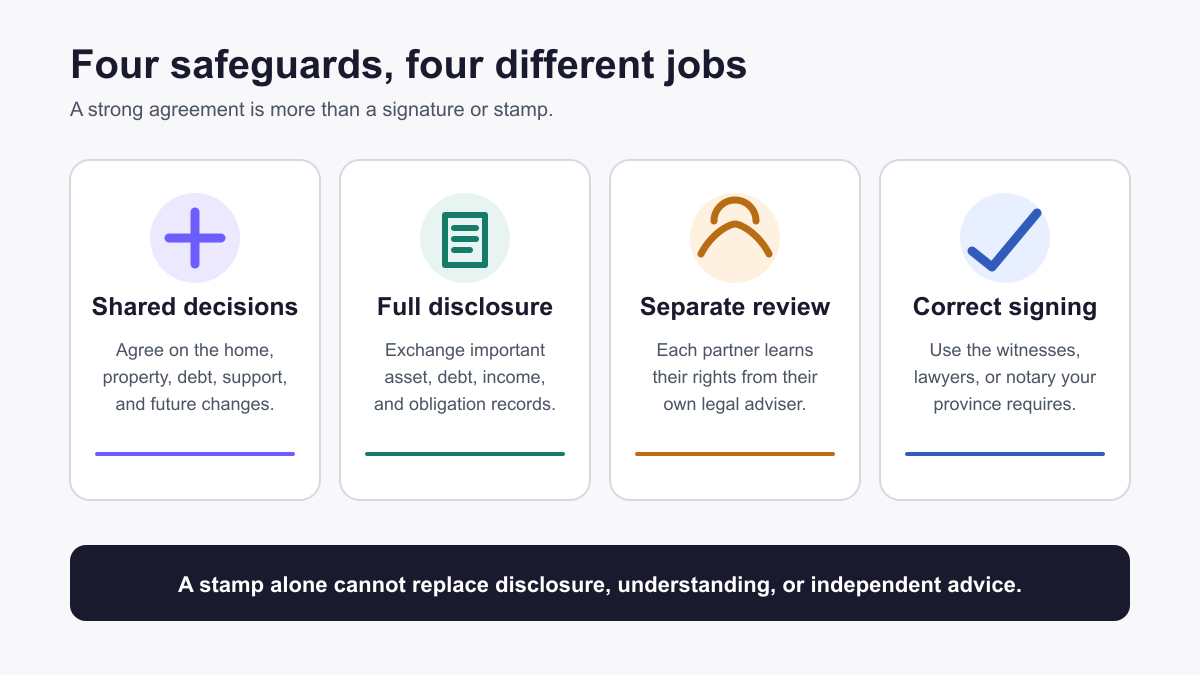
That is why “Do we need a lawyer?” is really four questions: Who prepares the draft? Who explains each partner's rights? Who watches the signatures? Does a notary have a required role?
This guide separates those jobs, compares four provincial approaches, and shows how an online first draft can fit into a careful legal-review process. It is general legal information, not legal advice.
Quick answer: lawyer, witness, or notary?
| Step | What it does | Is it the same as legal advice? |
|---|---|---|
| Drafting | Turns your decisions into a written agreement | No. A template or online service can help draft without advising either partner. |
| Financial disclosure | Records important property, debts, income, and obligations | No, but incomplete disclosure can put an agreement at risk. |
| Independent legal advice | Explains the law, the agreement, and the rights one partner may be changing | Yes. Each partner needs their own lawyer for advice to be independent. |
| Witnessing | Confirms that a person signed the document | No. A witness does not normally explain the legal effect. |
| Notarization | Authenticates a signature or document, depending on the service and province | No. A notarial seal does not fix unclear terms or missing disclosure. |
The safe question is not “What is the minimum paperwork?” It is “What process gives both partners a clear, voluntary, province-appropriate agreement?”
Can you prepare a cohabitation agreement without a lawyer?
In some provinces, yes. A couple can discuss terms, collect financial information, and prepare a first draft themselves or with a guided online service. British Columbia's public legal-information service even explains what to do if couples write their own agreement.
But drafting is only one stage. A useful agreement must describe what each partner owns, how future property and debt will be treated, what happens to the home, and whether support is addressed. It should also explain what happens if the couple later marries, moves provinces, buys property, or makes a major financial change.
A vague sentence such as “we each keep our own assets” may not answer what happens to growth in value, mortgage payments, renovations, joint accounts, or a business funded during the relationship. Review by a family lawyer can expose those gaps before they become disputes.
If you are still deciding what to cover, start with the Canadian cohabitation agreement checklist.
What independent legal advice actually adds
Independent legal advice, often shortened to ILA, is a private review by a lawyer who represents only one partner. The same lawyer cannot independently advise both sides of the agreement.
During that review, the lawyer can:
- explain the default family-law rules in that province
- compare those rules with the proposed agreement
- identify property, support, tax, estate, or business issues that need other advice
- check whether the financial disclosure is adequate
- confirm that the client understands the consequences
- recommend changes and document the advice given
Independent advice is different from paying one lawyer to draft for the couple. A drafting lawyer represents one client, even if both partners supplied information. The other partner normally retains a different lawyer for independent review.
In Ontario and BC, legislation does not make ILA a universal drafting requirement for every cohabitation agreement. It still matters because lack of understanding, pressure, vulnerability, and non-disclosure can become reasons to challenge an agreement. Alberta has stricter lawyer-acknowledgement rules for agreements that opt out of statutory property division.
The BC legal-aid guidance on independent advice makes the practical point clearly: each person gets advice from their own lawyer before signing a family agreement.
Provincial signing rules are not interchangeable
Family law is provincial. A signing method that works in one province should not be copied into another without checking the local law.
| Province | Key rule to know | Is notarization always required? |
|---|---|---|
| Ontario | Section 55 of the Family Law Act says a domestic contract is unenforceable unless it is written, signed by the parties, and witnessed. | No. The statute requires witnessing, not routine notarization. |
| British Columbia | Section 93 applies to written property and debt agreements where each spouse's signature is witnessed by at least one person. The same witness may watch both signatures. | No. A witness is the statutory step described for these agreements. |
| Alberta | Sections 37 and 38 require each party to acknowledge covered property terms in writing, apart from the other, before a lawyer who is not acting for the other party. | A notarial stamp is not a substitute for the separate-lawyer acknowledgement. |
| Quebec | Quebec says de facto spouses may sign their own agreement in the presence of two witnesses, or have it drawn up by a lawyer or notary. | No. A notary is one route, not the only route for a cohabitation agreement. |
These are high-level examples, not a complete Canada-wide signing manual. Manitoba, Saskatchewan, Atlantic Canada, and the territories have their own legislation and court rules. Get local advice when the agreement changes property or support rights.
For a closer look at the default rules, see the Prenuply guides for Ontario common-law couples, BC common-law couples, Alberta adult interdependent partners, and Quebec de facto spouses.
Does notarization make an agreement enforceable?
Not by itself. Notarization may provide useful evidence about identity or signing, but it does not repair the substance of the agreement.
A court may still examine issues such as:
- whether important assets or debts were omitted
- whether one partner understood the agreement
- whether someone used pressure, urgency, or vulnerability
- whether the wording is clear enough to apply
- whether the terms conflict with legislation or public policy
- whether the agreement tries to control child support or parenting in a way the court cannot accept in advance
In other words, a seal can help prove that a signature was authenticated. It does not prove that both partners exchanged complete information, understood the rights at stake, or made workable choices.
A cost-aware process that still uses lawyers well
Couples do not necessarily need to pay lawyers to discover every bank account number or decide who owns the sofa. They can do the organizing first, then use professional time for legal judgment.
- Agree on the goals. Discuss the home, existing property, future purchases, debt, shared expenses, support, businesses, inheritances, and what would happen on separation.
- Exchange financial disclosure. List important assets and debts and attach supporting records where appropriate. Do this before final terms are locked.
- Create an organized first draft. A guided online service can turn the couple's answers into a consistent document for review.
- Send the draft to separate lawyers. Each partner should receive advice privately. Do not sign the draft first and ask for advice afterward.
- Resolve proposed changes. Update the same working version so the document, schedules, and advice certificates stay consistent.
- Follow the province's signing process. That may involve witnesses, separate lawyer acknowledgements, or a lawyer or notary.
- Store complete signed copies. Each partner should keep the agreement and disclosure schedules. Review it after major changes such as marriage, a move, a home purchase, a child, or a business sale.

Prenuply's Canadian cohabitation agreement flow is designed for step three. It helps couples create a personalized draft in plain language for PDF and Word download. It does not replace the province-specific advice and signing work in steps four to six. Current pricing is also explained in the cohabitation agreement cost guide.
When should you involve lawyers from the beginning?
An online-first process works best when the partners are cooperative, transparent, and broadly aligned. Start with a family lawyer instead when:
- one partner is applying pressure or there are safety concerns
- the couple already expects to separate
- a home, farm, corporation, trust, pension, foreign asset, or large inheritance is involved
- the partners disagree about support or ownership
- one person may not understand the language or consequences of the agreement
- there is an existing court order, domestic contract, shareholder agreement, or estate plan to coordinate
- tax advice, a valuation, or real-estate title work is needed
A family lawyer may also refer the couple to an accountant, tax lawyer, corporate lawyer, estate lawyer, or Quebec notary. A cohabitation agreement cannot replace every document. Quebec's government, for example, expressly notes that a cohabitation agreement does not replace a will or an incapacity mandate.
Frequently asked questions
Can we use the same lawyer for a cohabitation agreement?
One lawyer may draft for one partner, but cannot give independent legal advice to both partners. If both want ILA, they need separate lawyers. Quebec notarial practice and local professional rules may use a different process, so ask the notary or lawyer who they represent and what advice each partner is receiving.
Does a cohabitation agreement need to be notarized in Ontario?
Ontario's Family Law Act requires domestic contracts to be in writing, signed, and witnessed. It does not list routine notarization as the formal requirement. A lawyer can advise how the witnesses should sign and whether another authentication step is useful for your circumstances.
Can a witness be a friend or family member?
Rules and best practices vary. Use an independent adult with no interest in the agreement, who is physically or electronically present in a legally acceptable way and can later identify what they observed. Ask local counsel about age, remote witnessing, and whether each partner should use a different witness.
Is an online cohabitation agreement legally binding?
Online creation does not automatically make an agreement valid or invalid. The content, disclosure, voluntariness, understanding, legal advice, and execution all matter. An online document should be treated as a structured first draft, then reviewed and signed according to provincial law.
Can we sign after we have already moved in together?
Often, yes. Couples can make a cohabitation agreement before or during cohabitation. Starting earlier is usually easier because there is more time for disclosure, advice, and revisions. The guide to making an agreement after moving in explains that process.
What if we later get married?
The answer depends on the province and the wording. Ontario generally deems a cohabitation agreement to become a marriage contract when the parties marry. Alberta requires the agreement to clearly show an intention for covered property terms to continue after marriage. Review the document before the wedding rather than assuming it converts automatically everywhere.
Bottom line
You may not need a lawyer to type the first draft of a Canadian cohabitation agreement. You do need a process that matches your province and lets both partners make informed, voluntary decisions.
For many cooperative couples, the practical route is: organize the facts together, generate a personalized draft, exchange full financial disclosure, obtain separate legal review, make revisions, and then follow the correct witnessing or professional-signing rules.
Start a Canadian cohabitation agreement draft, then take the draft to qualified local professionals before signing.
Sources checked
- Ontario Family Law Act, sections 53 to 56
- British Columbia Family Law Act, sections 92 and 93
- Family Law in BC: making an agreement when you live together
- Alberta Family Property Act, sections 37 and 38
- Alberta: dividing property between unmarried partners
- Gouvernement du Quebec: cohabitation agreement
Sources and product information were checked on August 10, 2026. Laws and signing practices can change. Confirm the current requirements with a family lawyer or Quebec notary before relying on an agreement.