
In Saskatchewan, unmarried partners who have lived together as spouses continuously for at least two years generally fall within the property-law definition of “spouse.” A Saskatchewan cohabitation agreement can set different rules for a home, other property, debts, and future assets, but the province has unusually specific signing and separate-lawyer requirements for a binding property contract.
That two-year point matters, but it is not a countdown that transfers half of every asset on the anniversary date. Title does not automatically change. Instead, qualifying partners can gain the right to ask a court to divide family property if the relationship ends. The family home receives special treatment, and the details of a properly completed agreement can be decisive.
This guide explains the Saskatchewan rules in plain language, what a cohabitation agreement should address, and how to prepare a useful draft for separate legal review. It provides general information, not legal advice.
Saskatchewan cohabitation agreement: the quick answer
A cohabitation agreement in Saskatchewan is a written contract between partners who live together or plan to live together. For property purposes, Saskatchewan’s Family Property Act calls a contract that satisfies section 38 an interspousal contract.
The practical rules are:
- The Act generally includes unmarried partners who have cohabited as spouses continuously for at least two years.
- Family property is generally subject to equal distribution, with statutory exemptions and fairness considerations.
- The family home has a special equal-distribution rule and does not receive the same starting-value exemption as most property owned before the relationship.
- A binding property contract must be in writing and signed by each partner before a witness.
- Each partner must make a separate written acknowledgment before a lawyer who is not acting for the other partner and is not taking the other partner’s acknowledgment.
- The court can disregard the property terms if the contract was unconscionable or grossly unfair when it was made.
- A common-law property application generally must be started within 24 months after cohabitation ends.
Those rules make Saskatchewan different from provinces where witnessing alone is the central statutory formality. A downloaded form or an unsigned conversation is not the same as a Saskatchewan interspousal contract.
When are you common-law in Saskatchewan?
There is no single “common-law” date for every Canadian law or program. Tax, benefits, immigration, support, estates, and property can use different definitions. For this article, the important clock is the one in Saskatchewan’s Family Property Act.
Section 2 includes a person who is cohabiting or has cohabited with the other person as spouses continuously for at least two years. That definition is gender-neutral and applies to same-sex and different-sex couples.
| Point in the relationship | Property-law significance |
|---|---|
| Before moving in | Partners can prepare an interspousal contract in contemplation of cohabitation, but the Act says it is unenforceable until cohabitation begins. |
| During the first two years | The two-year property definition has not been met solely by the passage of time. Other laws or claims may still be relevant. |
| After two continuous years as spouses | The partners generally meet the Act’s unmarried-spouse definition for family property. |
| After separation | A qualifying common-law spouse generally has 24 months after cohabitation ends to bring a property application. |
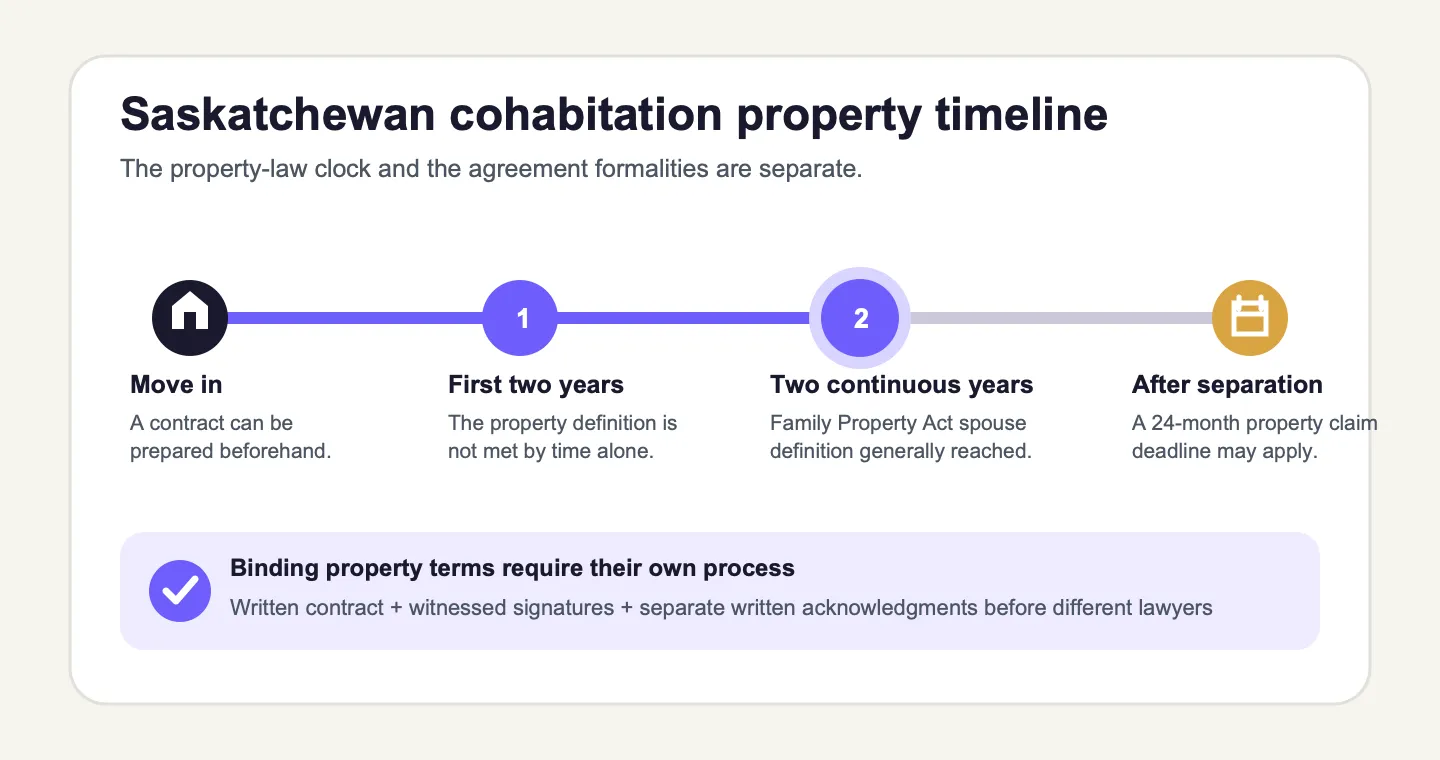
The phrase “as spouses” can involve facts about how the relationship actually operated. If the start date, continuity, or nature of the relationship is disputed, do not rely on a calendar alone. A Saskatchewan family lawyer can assess the evidence and the definitions that apply to each issue.
For a national comparison, see whether common-law property is always split 50/50 in Canada.
What happens to property without an agreement?
The default law is the starting point for deciding whether you need a Saskatchewan cohabitation agreement. It is not simply “everything is jointly owned after two years.”
Family property is generally divided equally
Section 21 of the Family Property Act directs a court to distribute family property or its value equally, subject to the Act’s exemptions, exceptions, and equitable considerations. Those considerations include the length of cohabitation, when property was acquired, contributions to a partner’s career, debts, tax consequences, dissipation, and written agreements.
The Act does not automatically put both names on a bank account, vehicle, farm, business, or land title. Section 43 says the statute itself does not vest title in the other spouse. The right is usually a right to seek a property distribution, not an automatic title transfer on day 730.
The family home is special
The family home deserves its own discussion. Section 22 generally calls for the home or its value to be distributed equally, subject to limited fairness exceptions. The Government of Saskatchewan’s Family Matters guidance summarizes the point directly: the equity in a family home is generally divided equally between spouses regardless of title or who contributed financially.
That is important when one partner owned the Saskatoon condo, Regina house, acreage, or farm residence before the other moved in. Section 23 can exempt the starting value of many assets owned before the spousal relationship, but it expressly excludes the family home and household goods from that ordinary starting-value exemption.
This does not mean every home outcome is predetermined. Mortgages, tax, multiple residences, unusual facts, children, a valid interspousal contract, and court orders can all matter. It does mean that “my name is the only name on title” is not a complete Saskatchewan property plan.
Read the broader guide to a cohabitation agreement when one partner owns the house before deciding how your home clause should work.
Other pre-relationship property can have a starting-value exemption
For property other than the family home and household goods, section 23 generally exempts the fair market value at the start of the spousal relationship when the asset was already owned, inherited, or received as a qualifying third-party gift. The rule is more precise than “what is mine stays mine.”
You may need records showing:
- what the asset was;
- who owned it;
- its fair market value at the relevant date;
- the debt attached to it;
- later contributions, exchanges, sales, or refinancing; and
- whether it became or funded a family home.
Values and tracing can become harder years later. A clear agreement and contemporaneous disclosure can reduce uncertainty, but a lawyer should confirm how the statutory exemption applies to your facts.
What can a Saskatchewan cohabitation agreement cover?
Section 38 allows an interspousal contract to address the possession, ownership, management, and distribution of current and future family property. A practical agreement often turns those broad categories into detailed operating rules.
1. A home one partner already owns
The agreement can identify:
- the owner and current title;
- the home’s agreed starting value and mortgage balance;
- whether household payments are rent, shared expenses, reimbursement, or equity-building contributions;
- how mortgage principal, interest, taxes, insurance, repairs, and capital renovations are treated;
- whether appreciation is shared and under what formula;
- how an appraisal will be selected and paid for;
- whether either partner has a buyout option; and
- how much move-out time is available after separation.
Do not use one vague sentence to cover title, occupation, contributions, growth, and sale. They are different issues.
2. A home purchased together
Couples buying together should align the cohabitation agreement with the offer, title, mortgage, and any declaration of trust. Useful terms can cover unequal down payments, ongoing mortgage contributions, capital improvements, loss allocation, sale triggers, and buyout mechanics.
Our guide to a cohabitation agreement for buying a house in Canada includes decision models for couples planning the purchase.
3. Bank accounts, investments, pensions, and future savings
An agreement can distinguish separate accounts from joint accounts and explain how contributions, income, withdrawals, and investment growth are treated. It can also state how new assets purchased with separate or joint funds will be classified.
Pension and registered-plan terms can interact with federal or provincial rules, beneficiary designations, tax, and plan administration. Ask the reviewing lawyers whether specialist or plan-administrator input is needed.
4. Businesses, professional practices, and farms
Saskatchewan couples may need to address a corporation, partnership, farm operation, quota, land, equipment, inventory, retained earnings, intellectual property, or professional goodwill.
A useful clause should go beyond the business name. It may need rules for new shares, reorganizations, shareholder loans, personal guarantees, employment income, capital contributions, increases in value, and the effect of one partner’s unpaid work. Corporate, tax, estate, and valuation advice may be necessary.
5. Existing and future debts
The agreement can allocate responsibility for student loans, credit cards, tax debts, business guarantees, vehicle loans, and new borrowing. It should also explain what happens when one partner refinances the other’s debt, signs a guarantee, or uses joint funds to make payments.
A private agreement between partners does not release either person from a lender’s contract. If both people sign a mortgage or line of credit, the lender’s rights remain a separate issue.
6. Household costs during the relationship
Couples can record how they intend to share rent, mortgage payments, utilities, groceries, child-related costs, and major repairs. These clauses work best when they state whether the arrangement creates any ownership or reimbursement right.
For renters, the cohabitation agreement does not replace the lease or change the landlord’s rights. Saskatchewan’s tenancy agreement guidance explains the separate information and signing requirements for residential leases.
7. Spousal support
Partners may want to address support if one person reduces paid work, relocates, contributes to the other’s career, or takes on more caregiving. Support terms require careful legal advice because entitlement and enforceability depend on more than a single waiver sentence.
Review the options in spousal support clauses for Canadian prenups and cohabitation agreements. Child support is different. Parents cannot use a private relationship contract to remove a child’s legal rights, and parenting decisions remain subject to the child’s best interests.
8. Separation logistics and review triggers
The agreement can provide a process for notice, exchange of information, appraisal, mediation, sale, buyout, temporary occupancy, and dividing ordinary household items. It can also require review after a child, home purchase, marriage, major inheritance, move to another province, business sale, disability, or extended caregiving period.

Saskatchewan signing rules: more than two signatures
For the property terms to qualify as a binding interspousal contract under section 38, the statutory process matters.
The contract must be written and witnessed
Each partner signs the written contract in the presence of a witness. Both partners should sign the same final version, with every schedule attached and every change completed before signing.
Each partner gives a separate written acknowledgment
Each person acknowledges in writing, apart from the other partner, that they:
- understand the nature and effect of the contract;
- know they may have future property claims under the Act; and
- intend to give up those claims to the extent needed for the contract to operate.
Different lawyers are required for the acknowledgments
The acknowledgment must be made before a lawyer who is not acting for the other partner and is not taking the other partner’s acknowledgment. In practical terms, each partner needs a separate Saskatchewan lawyer for this formal step.
This is not paperwork to complete after the fact. The lawyers need time to review the full agreement, disclosure, and consequences before taking the acknowledgments. Prenuply can help couples request independent lawyer review, but the lawyers remain independent from Prenuply and from one another.
Fairness and complete coverage still matter
Formal signatures do not cure every problem. Section 24 says a court can apply the Act as if there were no interspousal contract if the contract was unconscionable or grossly unfair when it was entered.
The same section also says property not dealt with by the contract is distributed under the ordinary statutory rules. A narrow agreement may be intentional, but an accidental omission can create the uncertainty the couple hoped to avoid.
Complete financial disclosure helps each person and lawyer understand the bargain. Use the financial disclosure checklist to organize ownership, values, debts, income, and supporting records.
A Saskatchewan homeowner example
Jordan owns a Saskatoon bungalow with $240,000 of equity when Sam moves in. Sam will pay half of utilities and groceries, contribute $900 per month toward housing, and help with a $35,000 basement renovation. They expect to stay together but have not decided whether Sam should build equity.
Their agreement needs separate answers to several questions:
- Does the $900 payment create equity, reimburse expenses, or function as rent between the partners?
- Is Jordan’s starting equity protected, shared, or handled through another formula?
- Does Sam recover the basement contribution first, share in the resulting increase in value, or receive no property interest?
- Who approves future capital work and keeps the receipts?
- What value date and appraisal method apply if they separate?
- Can either partner buy out the other’s contractual interest?
- How long can Sam remain in the home after separation?
- What changes if they marry, have a child, refinance, or add Sam to title?
There is no universal fair formula. One couple may protect all starting equity and share later principal reduction. Another may reimburse documented renovations. Another may move to joint title with unequal beneficial shares.
The valuable work is choosing the rule deliberately, documenting it precisely, and understanding how it compares with Saskatchewan’s default family-home rules.
When should you make the agreement?
The Act allows two people to enter an interspousal contract before they begin cohabiting, although it is not enforceable until cohabitation starts. Couples can also make an agreement after moving in or after crossing the two-year point.
Earlier is usually easier because:
- starting values and debts are easier to document;
- neither partner is negotiating against an immediate separation deadline;
- home contributions have not yet accumulated without a shared understanding;
- there is time for separate lawyer review; and
- the couple can align the agreement with title, a mortgage, insurance, and estate planning.
If you already live together, it is not automatically too late. The guide to signing a cohabitation agreement after moving in explains how to reconstruct the timeline and records.
What if you later marry?
Do not assume the wedding has no effect or that every clause automatically fits the married relationship. Section 38 allows spouses to amend, vary, or cancel an interspousal contract through another contract completed with the same formalities.
Before marriage, ask both lawyers to confirm:
- whether the existing agreement continues;
- whether the definitions and support terms still fit;
- whether a home, new asset, child, or career change needs updated treatment;
- whether financial schedules need new values; and
- whether the signing and acknowledgment package remains complete.
Use the wedding as a planned review trigger, not an emergency redraft a few days before the ceremony.
How much does a Saskatchewan cohabitation agreement cost?
There is no reliable single province-wide price. The cost depends on whether you start from a template or a lawyer-drafted document, the complexity of the property, the amount of negotiation, valuation or tax work, and the fees charged by each partner’s separate lawyer.
| Route | What it provides | What still remains |
|---|---|---|
| Blank-form or DIY draft | A low-cost starting structure | Saskatchewan customization, disclosure, negotiation, separate lawyer acknowledgments, and final signing |
| Prenuply template | A guided, province-aware draft with PDF and editable Word files | Separate Saskatchewan lawyers, advice, revisions, acknowledgments, witnessing, and any specialist work |
| Lawyer-first drafting | Advice and customized drafting from the beginning | A separate lawyer for the other partner, plus any valuation, tax, corporate, or estate work |
Prenuply’s current cohabitation package is $49 CAD and includes three generations. Separate legal fees are not included. Check the current Prenuply pricing and compare the broader cohabitation agreement cost guide before budgeting.
How to create a Saskatchewan cohabitation agreement
1. Record the relationship timeline
Write down the move-in date, any periods living apart, the date the home became the shared residence, and any planned wedding or relocation. Do not assume the CRA date or an insurance form settles the property-law question.
2. Build separate financial snapshots
Each partner lists assets, debts, income, guarantees, pensions, businesses, trusts, and expected inheritances. Record current values and supporting documents. For a home, include title, mortgage, purchase records, appraisal evidence, and renovation contributions.
3. Decide the rules before drafting clauses
Talk through ownership, growth, debt, household payments, support, and separation logistics in plain language. Identify where you agree, where you need advice, and what future events should trigger a review.
4. Prepare a complete working draft
You can start with counsel or use a guided document-preparation service. Prenuply is a technology company, not a law firm. It generates a customized Saskatchewan cohabitation agreement template for lawyer review, not legal advice or a guaranteed court outcome.
5. Use separate lawyers
Each partner gives their own lawyer the draft, schedules, and supporting disclosure. The lawyers explain possible claims, review fairness and wording, recommend changes, and complete the required separate acknowledgments if the agreement is ready.
6. Sign, witness, and keep the full package
Keep the signed agreement, all schedules, acknowledgment certificates, disclosure, valuation records, and evidence of any later amendment together. Make sure each partner has a complete copy.
7. Coordinate related documents
A cohabitation agreement does not itself change land title, release a mortgage borrower, replace a lease, make a will, or update beneficiary designations. Coordinate those documents with the agreement and professional advice.
Use the full Canadian cohabitation agreement checklist to prepare before the lawyer appointments.
Frequently asked questions
Is common-law exactly two years in Saskatchewan?
Two continuous years of cohabiting as spouses is the key unmarried-spouse threshold in Saskatchewan’s Family Property Act. It is not one universal definition for tax, immigration, benefits, estates, or every support issue. Always identify which law or program you are asking about.
Does my partner own half my house after two years?
The passage of two years does not automatically add a partner to title. However, a qualifying spouse may be able to seek a family-property distribution, and the family home is generally subject to a special equal-distribution rule. Title alone is not the complete answer.
Do both partners need separate lawyers?
For a binding Saskatchewan interspousal property contract under section 38, each spouse’s separate written acknowledgment must be taken by a lawyer who is not acting for the other spouse and is not taking the other spouse’s acknowledgment. Couples should plan for separate lawyers.
Can we sign a cohabitation agreement before moving in?
Yes. Section 38 permits an interspousal contract in contemplation of starting cohabitation, but says it is unenforceable until cohabitation begins. Complete the disclosure and legal review before signing, rather than treating the move-in date as the only condition.
Can we make an agreement after two years?
Yes. Crossing the two-year point does not prevent a later agreement. Existing values, accumulated contributions, and possible claims may make the analysis more complex, so accurate disclosure and separate advice become especially important.
Can a cohabitation agreement cover future property?
Yes. Section 38 expressly allows a contract to address future family property. The drafting should explain how new assets, substitutions, growth, income, and joint contributions will be classified.
Does the agreement replace a will?
No. Saskatchewan estate law uses its own rules, and beneficiary designations or jointly owned assets may pass outside a will. Coordinate the agreement with wills, powers of attorney, insurance, registered plans, and any intended releases.
A practical next step
Start with four facts: the move-in date, who owns the home, what each person owns and owes, and how you want future contributions to work. Then compare those intentions with Saskatchewan’s two-year property threshold, family-home rule, and formal lawyer-acknowledgment process.
When you are ready, create a Saskatchewan cohabitation agreement template. Bring the complete draft and financial schedules to separate Saskatchewan lawyers before signing.
Sources checked
- The Family Property Act, Saskatchewan, especially sections 2, 3.1, 20 to 24, 38, 40, and 43
- Government of Saskatchewan: Family Matters Program
- Government of Saskatchewan: Tenancy Agreements
- Government of Saskatchewan: About Wills and Why You Need One
Last reviewed: August 3, 2026. Laws, forms, prices, and public guidance can change.
This article provides general information about Saskatchewan cohabitation agreements. It is not legal advice. Prenuply AI Inc. is a technology company, not a law firm, and does not provide legal services. Have each partner consult a separate qualified Saskatchewan family lawyer about the final agreement and signing process.