
Professionals often need a prenup for a different reason than other couples. The main issue is not only a house, savings account, or inheritance. It is the value of a practice that may depend on licensing rules, patient or client relationships, retained corporate earnings, student debt, equipment, receivables, leases, and future growth.
That matters if you are a doctor, dentist, lawyer, accountant, therapist, pharmacist, architect, consultant, or another professional who owns, is buying into, or expects to build a professional practice in Canada.
A prenup can help you and your partner agree on how the practice will be treated if the marriage ends. It can also make the conversation more transparent before the wedding, while both people still have time to get advice and negotiate carefully.
This guide explains what professional practice owners should think about before creating a Canadian prenup, what to disclose, and which clauses usually deserve lawyer review.
Quick answer: should doctors, dentists, and professionals get a prenup?
Many professionals should at least consider one before marriage. A professional practice can become one of the most valuable assets in a relationship, even when most of the value is not sitting in a bank account.
A prenup may help address:
- who keeps shares in a professional corporation or clinic entity
- whether future practice growth is shared or separate
- how retained earnings and corporate savings are treated
- what happens to equipment, receivables, goodwill, and lease obligations
- whether student loans, practice loans, or shareholder debt stay with one partner
- how a buyout would be calculated if any value is shared
- what financial records each partner reviewed before signing
- how spousal support is handled if one partner supports the other through training, practice growth, child care, or relocation
The goal is not to hide value from a spouse. The goal is to make the value visible, decide what is fair, and reduce the chance that a personal separation disrupts a clinic, firm, employees, patients, clients, or other owners.
If you are still comparing broader business-owner issues, start with Prenuply's guide to prenups for entrepreneurs in Canada. This article focuses on the special issues that arise for professional practices.
Why professional practices are harder than regular savings
A savings account is usually easy to identify. A professional practice is not.
The value might be spread across:
- shares in a professional corporation
- a partnership interest
- a clinic, dental office, law firm, accounting firm, therapy practice, or consulting practice
- equipment, technology, leaseholds, furniture, and supplies
- accounts receivable and work in progress
- retained earnings inside a corporation
- goodwill attached to the business name, referral sources, location, patient base, or client base
- goodwill attached personally to the professional's reputation and licence
- debt used to buy into the practice or finance equipment
- restrictive agreements with partners, associates, landlords, lenders, or regulators
That mix creates two planning problems.
First, a practice can have value even if the professional does not feel wealthy. A dentist with a new clinic may have expensive equipment, a lease, bank debt, and no extra cash, yet the practice may still need to be valued during a separation. A lawyer or accountant may have receivables and a book of clients, but no simple resale market.
Second, some value may be difficult to divide without hurting the business. Courts and spouses often focus on compensation or equalization, not literally handing over clinic shares. But if the agreement is vague, the owner may still face an expensive valuation fight or a cash payment that strains the practice.

What Canadian family law usually cares about
The exact rules depend on your province, your relationship facts, and whether you are married or common-law. Still, a few themes show up across Canada.
Property value can matter even when ownership stays with one person
Professional corporations and practice interests are usually treated as property interests that can have family-law value. That does not always mean your spouse becomes a shareholder or partner. It may mean the practice value is considered when dividing family property or calculating an equalization payment.
For example, British Columbia's Family Law Act says family property includes shares or interests in corporations, partnerships, associations, organizations, businesses, or ventures. It also allows spouses to make agreements about property and debt division, subject to court review in certain cases.
Ontario uses an equalization system for married spouses. Under Ontario's Family Law Act, future spouses or spouses can make a marriage contract dealing with ownership or division of property and support obligations. The same Act also sets formal requirements for domestic contracts and allows courts to set aside a contract in situations such as significant non-disclosure or lack of understanding.
The practical takeaway is simple: "the practice is in my name" is not enough planning.
Growth can be the main issue
For many professionals, the practice is small or new at the wedding date. The bigger issue is what happens if it grows during the marriage.
Growth can come from:
- opening a second clinic or office
- buying into a partnership
- retaining profits in a corporation
- adding associates or staff
- improving referral relationships
- buying equipment
- moving from employee income to owner income
- using family income or savings to support the practice
- a partner doing more unpaid home or child care work while the professional builds the practice
A prenup should not only list the practice as it exists today. It should say what happens to future growth, replacement entities, new shares, holding companies, reinvested profits, and sale proceeds.
For broader future-property planning, read Can a Prenup Protect Future Assets in Canada?.
Income and support are separate from property
Professional practice owners often blur salary, dividends, retained earnings, personal expenses, and reinvestment. Family law may examine income differently from tax planning.
Property clauses can say how the practice value is divided. Support clauses deal with future need, income, career sacrifices, health, child care, and relationship roles. A partner who helped financially during medical school, moved cities for a residency, reduced work hours, managed the household, or supported clinic growth may have a different support argument than a partner who had no role in the professional path.
That does not mean a prenup cannot discuss support. It means support clauses should be specific, fair, and reviewed carefully. Prenuply has a separate guide on spousal support clauses in prenups and cohabitation agreements.
What a professional-practice prenup can cover
A Canadian prenup can often deal with property and support planning, subject to provincial limits and court review. For a professional, useful clauses may include the following.
1. The current practice value
If the practice already exists, the agreement should include a clear snapshot of what it is worth, or explain how the couple is treating it for agreement purposes.
This may include:
- corporate financial statements
- tax returns
- shareholder or partnership agreements
- buy-sell agreements
- bank debt and security documents
- equipment lists
- lease obligations
- receivables and work in progress
- a valuation report, accountant letter, or agreed estimate
- notes about goodwill and whether the practice depends heavily on one person's personal reputation
The more valuable or complex the practice is, the less useful a casual estimate becomes. Some couples need a Chartered Business Valuator, accountant, or corporate lawyer involved before the family lawyer finalizes the agreement.
2. Future growth in the practice
If the practice grows after marriage, who owns that growth?
Common approaches include:
- the owner keeps the practice and all future growth as separate property
- the owner keeps the starting value, while future growth is shared in a set percentage
- the non-owner partner receives a capped payment if the marriage lasts a certain number of years
- the couple shares only growth tied to family contributions, not passive market growth or personal goodwill
- the agreement creates a formula for valuing and paying any share over time
No single approach is right for every couple. A prenup that is too one-sided may create conflict or later enforceability risk. A prenup that ignores growth may fail to solve the main problem.
3. Retained earnings and corporate cash
Professionals sometimes leave money inside a professional corporation for tax planning, debt repayment, equipment, payroll, parental leave, or expansion.
A prenup should address whether retained earnings are:
- part of the protected practice value
- available for family spending
- available for support calculations
- treated differently from salary or dividends already paid out
- affected if retained earnings are used to buy personal assets
This is an accountant and lawyer review issue. A family lawyer can draft the clause, but the tax and valuation context matters.
4. Practice debt and student loans
Professional couples often have uneven debt. One partner may have medical school debt, dental school debt, law school debt, practice acquisition debt, or a line of credit secured against business assets.
The prenup can say:
- which debts remain separate
- whether either partner is responsible for guaranteeing practice debt
- whether family funds used to pay business debt create a reimbursement right
- how new practice debt will be disclosed
- what happens if a refinance combines business and family debt
Debt clauses protect both partners. The professional may want to protect the practice. The non-owner partner may want protection from business risk they did not agree to carry.
5. Sale proceeds and replacement assets
A protected practice can change form. A dentist might sell a clinic and buy into a group practice. A physician might move retained earnings to a holding company. A lawyer might leave a partnership and start a professional corporation. A therapist might sell a client list and open a different clinic model.
The prenup should say whether protection follows:
- sale proceeds
- replacement shares
- holding companies
- new professional corporations
- investments bought with practice proceeds
- real estate bought for the practice
- a second clinic or new office
Without tracing language, couples can end up arguing about whether the protected asset stopped being protected when it changed form.
6. Valuation method and payment timing
A prenup can reduce future disputes by setting a valuation process before there is conflict.
For example, it might say:
- which valuation date applies
- whether a Chartered Business Valuator is used
- how the valuator is selected
- whether personal goodwill is treated differently from enterprise goodwill
- whether tax costs and transaction costs are considered
- whether buyout payments can be made over time
- whether the practice owner keeps control of the practice while paying any agreed amount
Payment timing matters. A practice can be valuable on paper but illiquid in real life. A forced immediate payment may hurt patients, clients, employees, and lenders. If the couple agrees that some value will be shared, the agreement should consider whether payment can be staged.
7. Confidentiality and business records
Professional practices often involve private records: patient files, client files, employee records, billing data, partnership documents, insurance details, and regulatory information.
A prenup should not require either partner to hand over information they are not legally allowed to share. Instead, it can create a sensible disclosure process, such as:
- summary financial statements
- accountant-prepared schedules
- valuation reports that exclude private client or patient details
- confidentiality undertakings where appropriate
- secure handling of corporate records
This is especially important for regulated professionals.
8. Spousal support review triggers
A professional practice prenup should not treat the non-owner partner as invisible.
Support or fairness review clauses may be useful if:
- one partner moves for the other's training or practice
- one partner reduces work to manage child care
- one partner works unpaid or underpaid in the clinic or office
- the professional has a major income increase after the wedding
- the relationship lasts much longer than expected
- illness, disability, or parental leave changes the couple's finances
Some couples waive support. Others preserve support. Others create review triggers. The right answer depends on facts and province.
What to disclose before signing
For professionals, disclosure should be more detailed than a basic list of bank accounts.
Consider preparing:
- personal tax returns and notices of assessment
- professional corporation tax returns, if applicable
- financial statements for the practice
- shareholder, partnership, associate, or buy-in agreements
- practice loans, leases, guarantees, and lines of credit
- student loans and professional school debt
- equipment leases and finance contracts
- receivables, work in progress, and major payables
- insurance policies tied to the practice
- retirement accounts and investments
- real estate used by the practice
- a list of assets bought with practice income
- any prior valuation, accountant letter, or appraisal
For a broader disclosure list, use Prenuply's financial disclosure checklist for Canadian prenups.
Province notes for professionals
This is not legal advice, and province-specific review matters. Here are a few planning themes.
Ontario
Ontario married spouses use net family property equalization. A marriage contract can deal with ownership or division of property and support, but domestic contracts must be in writing, signed, and witnessed. Ontario courts may set aside a domestic contract for issues such as significant non-disclosure, lack of understanding, or other contract-law problems.
Ontario also has special matrimonial home rules, so a professional who owns a home before marriage should not assume a general business clause protects the home. Read Prenuply's guide to Ontario prenups and the matrimonial home if a house is part of the plan.
British Columbia
BC's family property rules include corporate shares and business interests. BC spouses can make agreements that divide, exclude, or value property and debt differently, but agreements can be reviewed by a court in certain circumstances, including disclosure and fairness concerns.
Alberta
Alberta professionals should pay close attention to signing formalities and independent legal advice. Alberta family property agreements have specific requirements, and professional practice growth can still become a major issue if the agreement does not define what is excluded.
Quebec
Quebec marriage contracts interact with matrimonial regimes and notarial practice. If you are in Quebec, do not treat a generic common-law province prenup template as enough. Use Quebec-specific legal advice.
Mistakes professionals should avoid
Waiting until the wedding is too close
Last-minute signing creates pressure and makes it harder for each partner to get advice. Start early, especially if you need valuation work or accountant input. If the wedding is soon, read Last-Minute Prenup in Canada: Is It Too Late Before the Wedding?.
Listing the corporation but not the growth
"My professional corporation is separate property" may not answer what happens to future growth, retained earnings, replacement shares, goodwill, or sale proceeds.
Ignoring the non-owner partner's contribution
If one partner handles more household work, child care, relocation, scheduling, or unpaid clinic support so the practice can grow, a completely one-sided clause may not match the relationship reality.
Mixing practice money and personal money without records
If protected practice proceeds are used for a family home, joint investment account, or shared debt, records matter. The agreement should explain what happens when money is moved or mixed.
Assuming a template can solve valuation
Templates can help you organize the issues. They cannot tell you what a dental practice, medical corporation, law firm interest, accounting practice, or therapy clinic is worth. Use a lawyer and accountant where the value is material.
How Prenuply fits into the process
Prenuply helps Canadian couples create a structured prenup draft based on their facts. For a professional practice owner, that means collecting better inputs before lawyer review:
- the type of practice
- the province
- current assets and debts
- whether there is a professional corporation
- whether one partner owns shares or expects to buy in
- whether future growth, debt, income, or sale proceeds need special treatment
- whether support clauses need to account for training, relocation, child care, or clinic contributions
The draft is not a replacement for legal advice. It is a clearer starting point for review, negotiation, and revision.
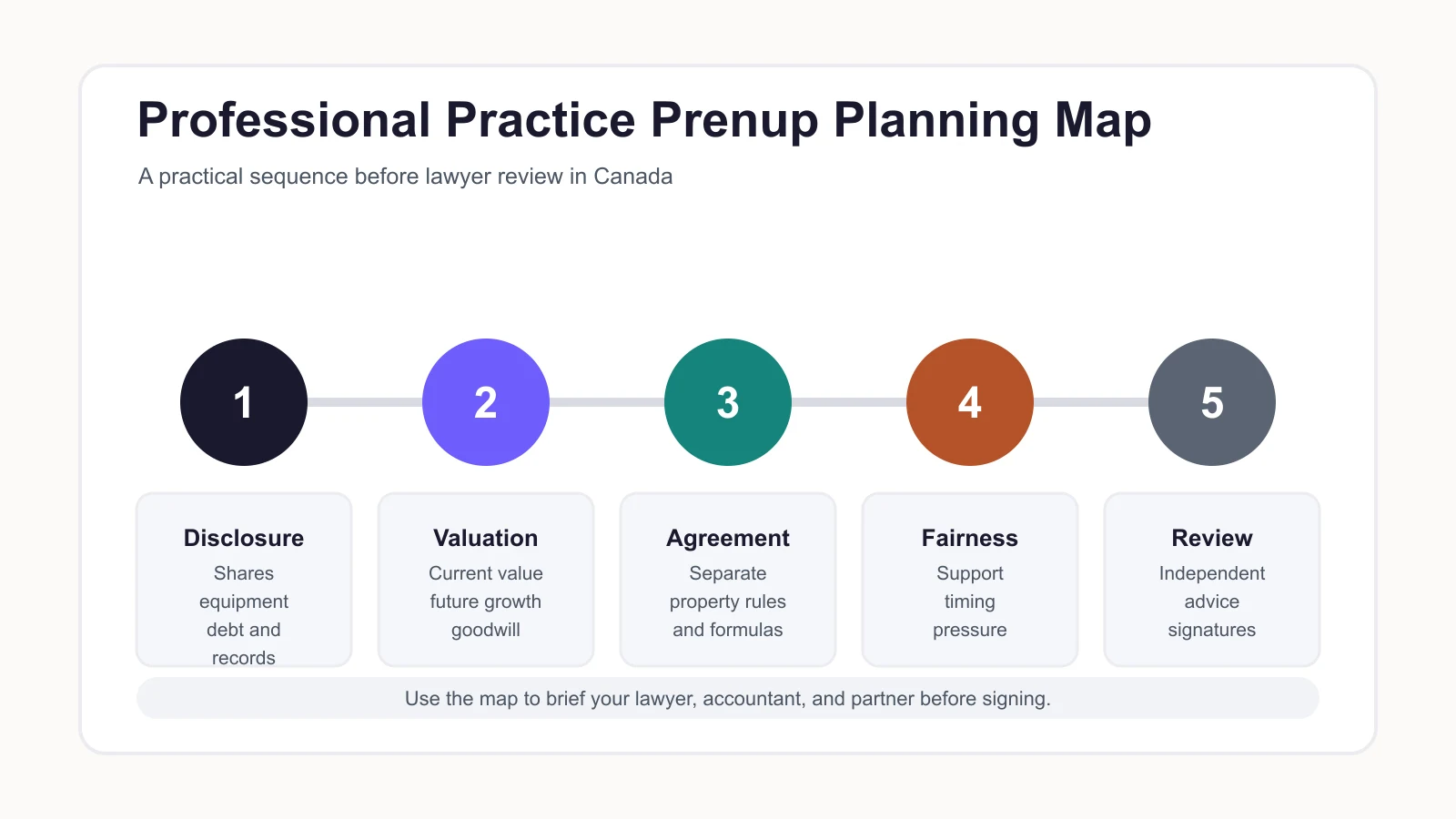
If you own a practice or expect to build one, create the draft early, gather your records, and have each partner get independent legal advice before signing.
Sources reviewed
- Ontario Family Law Act, including marriage contracts, domestic contract formalities, and setting-aside rules.
- British Columbia Family Law Act, including family property, business interests, property agreements, and court review of agreements.
- Federal Divorce Act section 15.2, for spousal support objectives in divorce.