
One partner has $150,000 for the down payment. The other has $50,000. You plan to share the mortgage, live in the home together, and build a future there. Should ownership be 75/25, 50/50, or something in between?
That is the real question behind an unequal down payment in Canada. The arithmetic is easy. Deciding what each payment means, and writing rules that still work after a sale, refinance, separation, loss, or marriage, is the harder part.
This guide compares five ways couples can split home equity when their down payments are different. It includes a worked example, province checkpoints, and a before-closing list for your cohabitation agreement. The models are illustrations, not recommendations. A family lawyer and real estate lawyer in your province should review the structure before you commit funds or sign closing documents.
Quick answer: how can couples split equity after unequal down payments?
Canadian couples commonly consider five models:
- Ownership follows the down payment ratio.
- Ownership is 50/50, and the larger contribution is a gift.
- Each down payment is returned first, then remaining equity is shared.
- One partner lends part of the down payment to the other.
- A running capital account tracks approved contributions over time.
None is automatically the fairest. The best fit depends on how you will divide mortgage principal, interest, repairs, renovations, risk, and caregiving. Whatever you choose should line up with the title, mortgage, wills, and a province-specific cohabitation or co-ownership agreement.
For the full transaction checklist, start with Prenuply's guide to a cohabitation agreement for buying a house in Canada. This article goes deeper on the equity formula itself.
Why an unequal down payment becomes complicated
A home purchase creates several legal and financial relationships at once:
- Title records legal ownership of the property.
- The mortgage records what the borrowers owe the lender.
- Your cohabitation agreement can record rights and obligations between the partners.
- The money trail shows who paid the deposit, down payment, closing costs, mortgage principal, and improvements.
- Provincial family and property law may add default rules or claims based on relationship status and time together.
These layers do not automatically match. A couple can hold title equally while contributing different amounts. Both borrowers can be responsible to the lender for the full mortgage even if their private agreement says they will split payments 70/30. A partner who is not on title may still make substantial contributions.
A private agreement cannot change the lender's rights. It can clarify what the partners owe each other and how they intend to divide net equity.
That distinction matters when one partner asks, "If I pay more now, do I own more?" The honest answer is: only if the title, agreement, and applicable law support that result.
Start by defining net equity
Couples often discuss percentages without agreeing on the amount those percentages will apply to.
For a sale, net equity might mean:
Sale price, minus the mortgage payout, mortgage penalties, real estate commission, legal fees, agreed repairs, adjustments, and other sale costs.
For a buyout, the calculation may use an appraised value instead of a sale price. The agreement should say:
- How the home will be valued
- Whether one appraisal or two will be used
- Which debts and costs come off the value
- Whether a hypothetical real estate commission is deducted in a buyout
- How mortgage penalties are treated
- What happens if the partners disagree about value
The same percentage can produce very different results depending on how net equity is defined.
Five ways to split home equity when down payments are unequal
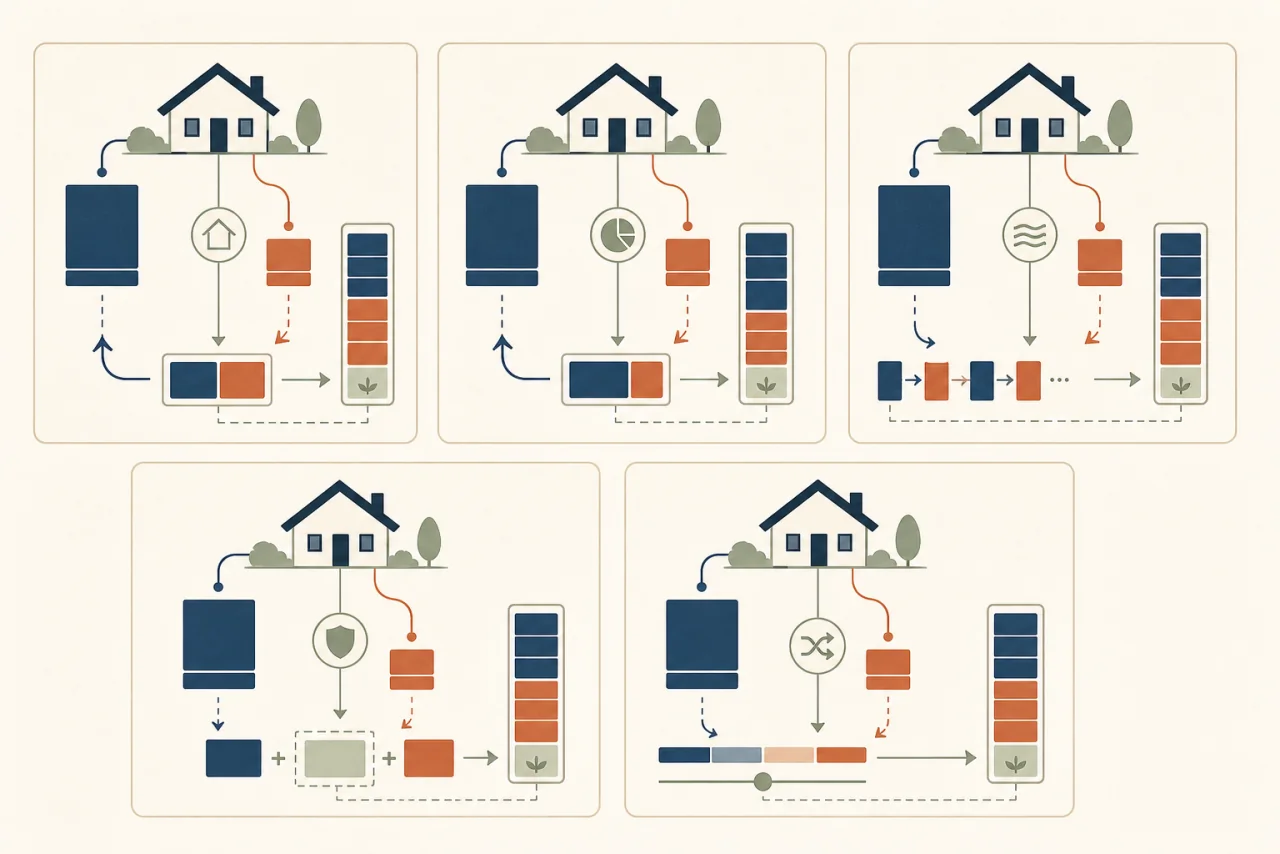
Model 1: ownership follows the initial down payment ratio
If Partner A contributes 75% of the down payment and Partner B contributes 25%, they may choose 75/25 ownership and divide net equity in the same proportions.
This is simple when the partners also plan to pay mortgage principal and major improvements in that ratio. It becomes less intuitive if monthly payments are 50/50, one partner funds a large renovation, or one partner takes time away from paid work for caregiving.
The agreement should answer:
- Does the 75/25 split apply to all gains and losses?
- Must mortgage principal also be paid 75/25?
- Do mortgage interest, taxes, utilities, and insurance affect ownership?
- Can the ownership ratio change?
- How will later capital contributions be credited?
Do not assume a title percentage answers every one of these questions.
Model 2: equal ownership, with the extra contribution treated as a gift
Some couples choose 50/50 ownership even though one partner brings more cash. The larger contribution may reflect higher current savings, while the couple views the home as a fully shared project.
This can be a valid relationship choice. It should be an informed choice, not an accidental one.
If the extra amount is intended as a gift, the documents should not imply that it must be repaid later. Each partner should understand the effect if the home rises or falls in value. The contributing partner should also consider whether the gift affects estate plans, creditor exposure, or expectations from family members who supplied the funds.
If parents helped with the purchase, read the separate guide to a prenup for a down payment gift in Canada. A lender's gift letter, a family loan, and a couple's private agreement should not contradict one another.
Model 3: return each down payment first, then divide the remainder
Under a return-first model, each partner receives their documented down payment from available net equity before the remaining amount is divided, often equally.
For example:
- Partner A receives up to $150,000.
- Partner B receives up to $50,000.
- Remaining net equity is divided 50/50.
This model protects the starting contributions while sharing later growth. It can fit couples who expect to pay the mortgage equally after closing.
The phrase "receives their down payment back first" is not enough. The agreement also needs a loss rule. If only $120,000 of net equity remains, the home cannot return the original $200,000. Possible approaches include sharing the shortfall in proportion to the down payments, sharing it equally, or applying another agreed formula.
The agreement should also say whether the protected amount is:
- A fixed number
- Adjusted for inflation
- Given a share of appreciation
- Reduced by agreed losses
- Transferred to a replacement home after a refinance or sale
Model 4: one partner makes a documented loan to the other
Suppose each partner wants 50/50 ownership, but Partner B is $50,000 short of an equal down payment. Partner A could lend $50,000 to Partner B, subject to the lender's approval and proper disclosure.
The partners then each contribute $100,000 to the purchase, while Partner B owes a separate $50,000 debt to Partner A.
This structure can separate ownership from the temporary cash imbalance. It also creates loan questions:
- Is interest charged?
- When is the loan due?
- Is it repaid on sale, separation, refinance, or a fixed date?
- What happens if the home has negative equity?
- Is the loan secured?
- Does the mortgage lender permit the arrangement?
- What happens to the debt if either partner dies?
Never use a private loan to hide debt from a mortgage lender. If the lender requires a non-repayable gift, a contradictory side loan can create serious problems. Discuss the proposed structure with the mortgage professional, real estate lawyer, and each partner's family lawyer before closing.
Model 5: use running capital accounts
A capital-account model tracks selected contributions over time. The account might credit:
- The initial down payment
- Mortgage principal, but not interest
- Approved capital improvements
- Agreed closing costs
- Special assessments
- Emergency structural repairs
It might exclude ordinary living costs such as utilities, groceries, insurance, property tax, routine maintenance, and mortgage interest. Those exclusions are a couple's planning choice, not a universal rule.
At sale or buyout, net equity can be divided using the capital-account balances or another formula based on them.
This is the most flexible model and the most demanding to administer. The agreement needs rules for receipts, joint approval, recordkeeping, missed payments, unpaid labour, and annual statements. A complicated formula that nobody updates may be less useful than a simpler rule the couple can actually follow.
Comparison table
| Equity model | May fit when | Main issue to resolve |
|---|---|---|
| Down payment ratio | Contributions and ongoing capital payments will remain unequal | Whether gains, losses, principal, and renovations follow the same ratio |
| Equal ownership and gift | Both partners intentionally want a fully equal home from day one | Confirming the larger contribution is not repayable |
| Return contributions first | Starting cash differs, but future mortgage payments will be shared | How losses, appreciation, and replacement properties are handled |
| Partner loan | The couple wants equal ownership with a temporary cash imbalance | Lender disclosure, repayment, interest, security, and default |
| Capital accounts | Contributions will change over time and the couple wants detailed tracking | Which payments earn equity and how records are maintained |
Worked example: $150,000 versus $50,000
Assume:
- Purchase price: $800,000
- Partner A down payment: $150,000
- Partner B down payment: $50,000
- Starting mortgage: $600,000
- Net equity at sale, after the mortgage and agreed sale costs: $360,000
Here is how four simplified models could differ:
| Model | Partner A | Partner B |
|---|---|---|
| 75/25 ownership | $270,000 | $90,000 |
| 50/50 ownership | $180,000 | $180,000 |
| Return $150,000 and $50,000, then split the remaining $160,000 equally | $230,000 | $130,000 |
| Equal ownership plus a $50,000 partner loan repaid at sale | $230,000 | $130,000 |
The last two rows produce the same numbers in this example, but they are not the same legal or financial structure. A loan can affect cash flow, death, default, refinancing, and lender disclosure. A return-first equity clause operates through the home proceeds.
A simplified capital-account example could produce another result. If approved capital balances at sale were $225,000 for Partner A and $135,000 for Partner B, a proportional split of $360,000 would be $225,000 and $135,000. A lawyer should test the formula against gains, losses, debt, and province rules before it goes into an agreement.

What should the agreement say beyond the down payment?
The equity formula is only one part of a useful home section. A cohabitation agreement should also address the following topics.
Mortgage principal versus mortgage interest
Principal reduces the loan and builds equity. Interest is the cost of borrowing. Couples may choose to treat them differently.
If payments are made from one joint account, the agreement should still state who is considered to have contributed what. It should also explain what happens after a job loss, parental leave, disability, or extended period of unequal income.
Closing costs
Land transfer tax, legal fees, title insurance, inspections, adjustments, and moving costs can be significant. Decide whether they are ordinary shared costs or capital contributions that affect the equity calculation.
Repairs and improvements
Replacing a broken water heater is different from adding a $100,000 extension. Define routine maintenance, emergency repairs, and capital improvements. Consider requiring written approval before a project can change the equity split.
Sweat equity
One partner may complete renovations personally. If unpaid labour earns a credit, explain how hours and value will be approved. If it does not earn a credit, say that too.
Buyout and sale rules
A practical agreement can set:
- A notice process when one partner wants out
- A first opportunity for the other partner to buy
- An appraisal method
- A refinancing deadline
- A rule if refinancing is declined
- A process for choosing a real estate agent
- Who lives in the home while a sale is pending
- How carrying costs are paid during the transition
Death, disability, and estate planning
Title and a cohabitation agreement do not replace wills, powers of attorney, beneficiary designations, or insurance planning. Ask how the equity formula works if one partner dies and whether the survivor has a purchase option or temporary occupancy right.
Title, mortgage, and agreement do different jobs
| Document | Main job | What it may not decide by itself |
|---|---|---|
| Title | Records legal ownership and the form of co-ownership | The complete payment, reimbursement, buyout, or support arrangement |
| Mortgage | Sets borrower obligations to the lender | The partners' private split of costs and equity |
| Cohabitation or co-ownership agreement | Records rights and obligations between the partners | The lender's rights, tax treatment, or every mandatory family-law rule |
| Will and estate documents | Plan for death and decision-making | The separation formula between living partners |
Ontario's official co-ownership guide recommends addressing ownership, financial responsibilities, maintenance, sale, exit, death, and dispute resolution in a legal contract. Romantic partners have the same practical need for clarity, plus family-law issues that vary by province.
Province checkpoints for unequal down payments
Canada does not have one common-law property rule. A formula that seems sensible in one province may interact differently with statutory property rights in another.
Ontario
Ontario says common-law couples are not automatically required to divide property acquired while living together, although a partner who contributed to property owned by the other may have a claim. The province also says common-law partners can make a cohabitation agreement setting their property rights.
Under Ontario's Family Law Act, a cohabitation agreement must be in writing, signed, and witnessed to be enforceable as a domestic contract. Ontario recommends that partners exchange financial information and speak to different lawyers.
See Prenuply's Ontario cohabitation agreement guide and the province's current property division guidance.
British Columbia
BC's property-division rules can apply to unmarried couples who have lived together in a marriage-like relationship for at least two years. The province says couples can opt out of the statutory rules with an agreement.
BC also distinguishes family property from excluded property, and the person claiming an exclusion is responsible for proving it. Records showing the source of a down payment can matter.
Review the BC government common-law property overview and Prenuply's BC cohabitation agreement guide.
Alberta
Alberta's Family Property Act applies to adult interdependent partners. The province describes that status as including partners who have lived in a relationship of interdependence for at least three years, have a child together in a relationship of some permanence, or have entered an adult interdependent partner agreement.
Alberta also says partners can opt out and draft their own property-division agreement. Review the province's unmarried partner property guidance and Prenuply's Alberta cohabitation agreement guide.
Manitoba
Manitoba says its family property rules generally apply to common-law partners who register their relationship or live together for at least three years. Its basic rule gives eligible partners an equal share in the value of family property, and the province says partners can opt out through a proper written agreement.
Read the Manitoba common-law property guide and Prenuply's Manitoba cohabitation agreement guide.
Saskatchewan
Saskatchewan's Family Property Act definition of spouse includes people who have cohabited as spouses continuously for at least two years. Saskatchewan public guidance says family-home equity is generally divided equally between spouses regardless of title or who contributed financially.
Ask a Saskatchewan lawyer how an agreement, title choice, contribution formula, and the family home rules interact before closing.
Quebec and the Atlantic provinces
Quebec has a distinct civil-law system, including newer parental union rules for some de facto spouses with children. Read Prenuply's Quebec cohabitation agreement and parental union guide, then consult a Quebec notary or family lawyer.
The Atlantic provinces also have their own definitions, property rules, formalities, and court approaches. Do not apply an Ontario or BC formula without local review.
A fair-equity conversation before closing
The word "fair" can hide different assumptions. Use concrete questions:
- Is the larger down payment a gift, a loan, a protected contribution, or a larger ownership stake?
- Should both partners share future appreciation equally?
- Who bears a loss if the home sells for less than expected?
- Does paying more mortgage principal increase ownership?
- Do interest, tax, insurance, utilities, and routine repairs affect equity?
- How will parental leave or unpaid caregiving be recognized?
- Do major renovations change the split?
- What records will each partner keep?
- What happens if one partner cannot pay temporarily?
- What happens if you marry, refinance, move provinces, or buy a replacement home?
This conversation should happen before one partner has transferred the deposit or given notice on their current home. A last-minute agreement can create pressure and leave too little time for disclosure and independent advice.
Before-closing document checklist
Gather:
- The agreement of purchase and sale
- Deposit receipt
- Mortgage commitment or pre-approval
- Proposed title instructions
- Each partner's proof of down payment
- Bank statements showing the source of funds
- Parent gift letters or loan documents
- Estimated closing costs
- Inspection and planned repair information
- Existing cohabitation agreement, will, or domestic contract
- A list of each partner's assets and debts
Then write down:
- The chosen equity model
- The loss rule
- The mortgage and expense split
- The renovation rule
- The buyout and sale process
- The review triggers
For a broader planning list, use Prenuply's cohabitation agreement checklist for Canada. For legal-cost planning, see cohabitation agreement cost in Canada.
Frequently asked questions
Do we still need an agreement if title says tenants in common?
Title percentages are important, but they may not explain mortgage payments, closing costs, renovations, buyouts, losses, death, or what happens if you later marry. A co-ownership or cohabitation agreement can address the broader plan. Ask local lawyers whether one combined agreement or separate documents fit your purchase.
Can our ownership percentages change over time?
They can be designed to change, but the method should be clear and administratively workable. Changes may also require title, lender, tax, or registration advice. Do not rely on an informal spreadsheet alone.
Should mortgage payments be split by income or ownership?
Either can be a relationship choice. If payments follow income while ownership follows another formula, state that clearly. Also say whether a larger payment changes equity or is simply a larger contribution to current housing costs.
What if only one partner qualifies for the mortgage?
Mortgage qualification does not answer who should own the home or what the non-borrowing partner's payments mean. Lender requirements, title, insurance, and the agreement must be coordinated. For a related scenario, read the guide to a cohabitation agreement when one partner owns the house.
What happens to the agreement if we marry?
The answer depends on the province and wording. In Ontario, the Family Law Act says a cohabitation agreement is deemed to be a marriage contract if the partners marry. Other provinces have their own rules and formalities. Include marriage as a review trigger and get advice before the wedding.
Do both partners need separate lawyers?
Separate independent legal advice is strongly recommended. It helps each partner understand the agreement, the rights they may be changing, and the effect of the equity formula. Ontario's public guidance specifically recommends different lawyers and financial disclosure for cohabitation agreements.
Bottom line
An unequal down payment does not require unequal ownership, and equal ownership does not automatically mean the larger contribution was intended as a gift. The couple has to decide.
Choose a formula that works in a gain and a loss. Define net equity. Coordinate title, mortgage, agreement, and estate documents. Put the rules in writing before closing, exchange full financial information, and give each partner time for independent legal advice.
Prenuply can help you organize the property, contribution, expense, and exit terms into a structured starting draft. You can start a Canadian cohabitation agreement, then have each partner's lawyer review the result before signing.
Sources checked
- Ontario: Develop a legal contract for co-ownership
- Ontario: Dividing property when a marriage or common-law relationship ends
- Ontario Family Law Act, sections 53 to 56
- British Columbia: Common-law partners and property or debt
- British Columbia Family Law Act, Part 5
- Alberta: Dividing property between unmarried partners
- Manitoba: Common-law partners and property
- Saskatchewan Family Property Act
This article provides general information about unequal down payments, home equity, and cohabitation agreements in Canada. It is not legal, mortgage, tax, financial, or real estate advice. Prenuply AI Inc. is a technology company, not a law firm, and does not provide legal services. Laws and lender requirements change. For advice about your situation, consult qualified family and real estate lawyers in your province.